FinTech funding tops $1bn this week as 2026 investment momentum builds
FinTech companies raised just over $1bn this week, as FinTech funding continued its promising start to 2026.
Following a two-week stretch in which FinTech funding topped $2.3bn, the 2026 deals market continued to gather momentum.
Several large rounds pushed activity higher again, led by cloud security firm Upwind and payments company Sokin, both of which raised more than $100m, alongside Float, which also secured a nine-figure financing.
The prominence of these large rounds reflects a broader shift in the market. In 2025, FinTech deals of $100m or more rose 21% year on year, as investors increasingly concentrated capital into more established businesses — a trend that continues to shape funding activity at the start of 2026.
Activity this week was spread across a broad range of subsectors, with funding flowing primarily towards firms building core financial and security infrastructure.
Infrastructure and enterprise software was the most prominent area, led by Upwind’s aforementioned $250m Series B. The cloud security firm is using the capital to scale its runtime-first security platform and support global expansion as enterprises adopt more AI-driven and real-time cloud applications.
Elsewhere, firms such as Lerian and Paraglide raised fresh funding to build modern financial rails, automate back-office workflows and reduce reliance on manual processes.
PayTech also saw strong activity with three deals — Sokin, Float, and Mesh — collectively pushing capital into payments and financial infrastructure.
InsurTech captured four rounds, including Sixfold, Fulcrum, Pace, and Mantas. Sixfold and Pace are both using funding to develop AI-driven underwriting and operational platforms, Fulcrum is automating back-office processes for insurance brokers, and Mantas is launching parametric insurance for cloud downtime.
RegTech and compliance saw two deals. heyData raised $16.5m to unify IT security and regulatory compliance into a single platform, while AiStrike secured $7m to scale its AI-native cyber defence offering.
WealthTech completed two deals this week. Gridline’s $18.5m Series A will expand its private markets infrastructure for advisory firms, and WealthAi’s $800k pre-seed is being used to build an AI-first operating system for wealth managers and family offices.
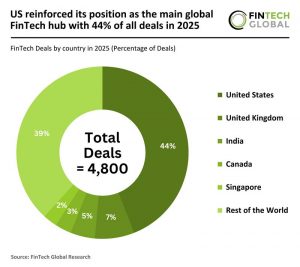
The United States once again dominated this week’s FinTech funding, with 15 of the 34 deals tracked this week coming from US-headquartered companies.
Elsewhere this week, the UK landed four deals, while Germany secured two rounds. Canada, Singapore, Brazil, the UAE, the Philippines, and Belgium each recorded one significant deal, highlighting a growing diversity of FinTech hubs beyond the US.
Upwind raises $250m series B to scale runtime-first cloud security
Upwind, a runtime-first cloud security company, has raised $250m in Series B funding as it looks to accelerate product development and global expansion amid strong enterprise adoption.
The funding round was led by Bessemer Venture Partners, with participation from Salesforce Ventures and Picture Capital. Existing backers including Greylock, Cyberstarts, Craft Ventures and TCV also participated. The raise brings the company’s total funding to $430m.
The Series B marks the start of what Upwind calls “The Next Wave”, a new phase focused on scaling its runtime-first approach to cloud security as enterprises adopt AI-driven and real-time cloud applications.
The company operates in the cloud-native application protection platform (CNAPP) market.
Upwind was built around the belief that effective cloud security must rely on runtime evidence rather than posture snapshots.
Since its $100m funding round a year ago, Upwind has recorded 900% year-over-year revenue growth and 200% logo growth. Over the same period, the company expanded its workforce from 150 to more than 300 employees and strengthened its presence across the U.S., U.K. and Israel, with additional momentum in Asia-Pacific markets.
Business payments firm Sokin secures $100m debt facility
Sokin, a global business payments company, has secured financing from Oxford Finance with a $100m long-term debt facility.
The company has agreed a $100m long-term debt facility which will provide Sokin with additional capital to support its expansion plans.
Sokin positions itself as an end-to-end platform for global businesses, focused on streamlining payments and treasury workflows across borders. Its offering covers accounts payable, receivable and treasury operations, aiming to reduce complexity for firms managing multiple currencies and international counterparties.
The firm said the facility will be used to accelerate growth across North America, Asia, the Middle East and South America, while also funding the acquisition of additional regional licences, new banking partnerships and further scaling of its global infrastructure. Sokin also plans to invest in the development and launch of new products, including embedded payments capabilities.
Float secures close to $100m to expand Canadian business finance
Float Financial, a Canadian business finance platform, has secured close to CAD $100m in new funding to expand access to working capital and high-yield business accounts for companies across the country, aiming to unlock more than $1.5bn in annualised spending power.
The funding consists of two debt facilities provided by Silicon Valley Bank, a division of First Citizens Bank, alongside a tier-1 Canadian bank. The facilities enable Float to continue offering interest rates of up to 4% on business accounts, positioning the firm as a leading provider of yield in Canadian business banking.
According to a recent Float report, Canadian business revenues rose 5% in 2025, but rising costs continued to compress margins. Many companies avoided taking on new debt despite growth opportunities, against a backdrop of economic growth of just 1.2% last year. Float believes this has left businesses at a crossroads between defensive positioning and intentional growth supported by smarter access to capital.
Float is also enhancing its Business Account product, increasing base interest rates from 2% to 3% on every dollar while continuing to offer up to 4% interest overall. Customer funds are held in segregated trust accounts at a tier-1 Canadian bank and protected by CDIC insurance up to CAD $100,000.
Superstate secures $82.5m to expand tokenised securities platform
Superstate, which connects financial assets with digital assets capital markets, has announced the successful close of an $82.5m Series B financing round, led by Bain Capital Crypto and Distributed Global.
The latest round brought in participation from a cohort of strategic investors including Haun Ventures, Brevan Howard Digital, Galaxy Digital, Sentinel Global, Bullish, Hypersphere Capital, Flowdesk and Intersection. Existing backers 1kx, ParaFi and Road Capital also joined the financing.
Since its Series A, Superstate has been developing infrastructure tailored to making the issuance and transfer of tokenised securities efficient, compliant and composable with decentralised finance (DeFi).
Mesh raises $75m at $1bn valuation to unify digital asset payments
Mesh, a digital asset payments network, has closed a $75m Series C funding round that values the company at $1bn, as it accelerates plans to build a universal infrastructure for digital asset-based payments.
The funding round was led by Dragonfly Capital, with participation from Paradigm, Moderne Ventures, Coinbase Ventures, SBI Investment and Liberty City Ventures. With this raise, Mesh has now secured more than $200m in total funding since launch.
The company positions itself as addressing inefficiencies in traditional payment rails by connecting a fragmented global digital asset ecosystem. Mesh aims to bypass slow settlement times and high fees by providing a single network that enables interoperability across wallets, blockchains and digital assets, as the sector shifts from experimentation toward real-world adoption.
Proceeds from the Series C will be used to support Mesh’s international expansion across Latin America, Asia and Europe, while also accelerating product development and strengthening its global network.
Rogo raises $75m Series C to scale AI finance platform
Rogo, a FinTech company building an agentic end-to-end AI system for financial workflows, has raised $75m in a Series C funding round and announced its expansion into Europe with the opening of a London office.
The Series C was led by Sequoia Capital, with participation from Henry Kravis and Wells Fargo, alongside continued backing from existing investors Thrive Capital, Khosla Ventures, Tiger Global, and J.P. Morgan. The latest round brings Rogo’s total funding to more than $165m.
The newly raised capital will be used to scale what Rogo describes as the world’s first truly agentic end-to-end AI system designed specifically for financial workflows. The company also plans to expand deployment of its platform across large financial institutions globally, with an immediate focus on accelerating its European presence.
As part of this expansion, Rogo has opened its first international office in London. The office will be led by co-founder John Willett, who will spend the next year working directly with European financial institutions to support their AI strategies and priorities.
Lunar raises €46m to fuel Nordic banking expansion
Nordic challenger bank Lunar, a digital full-service bank serving consumers and businesses, has announced a €46m capital increase to accelerate growth across the Nordic region.
The €46m investment will be used to scale Lunar’s fast-growing business banking offering, further develop its lending proposition, and support expansion into new Nordic markets including Norway and Finland.
Lunar has seen increasing adoption of paid subscriptions across both consumer and business segments, with its business customer base reaching 40,000 users in January.
The round was led by a combination of existing and new shareholders, highlighting continued confidence in Lunar’s strategy and execution. Existing backers Heartland and Orbit Alliance participated in the raise, alongside new investor 100A, a London-based fintech investor focused on Series A and later-stage companies.
Lunar now serves more than one million users across the Nordic region, with a steadily increasing proportion choosing paid products. In its most recent half-year results, the bank reported strong growth across both consumer and business segments.
With its own banking licence and proprietary infrastructure, Lunar also powers Moonrise, its payments and banking services platform. This infrastructure enables the company to pursue opportunities beyond traditional consumer and SME banking, while supporting faster execution and product development built around real user behaviour rather than legacy systems.
Outtake raises $40m led by ICONIQ to fight AI deception
Outtake, a digital trust platform protecting organisations from AI-driven impersonation, has raised a $40m Series B led by ICONIQ.
The round was led by ICONIQ, with participation from CRV and S32, alongside a group of technology and security executives investing as angel backers.
Angel investors joining the round include Satya Nadella, CEO of Microsoft; Nikesh Arora, CEO of Palo Alto Networks; Bill Ackman, CEO of Pershing Square Holdings; Shyam Sankar, CTO of Palantir; Trae Stephens, co-founder of Anduril; Bob McGrew, former VP of Research at OpenAI; Guillermo Rauch, CEO of Vercel; and John Donovan, former CEO of AT&T.
Outtake said digital identity is “rapidly eroding” as AI reduces the cost and complexity of cybercrime, enabling deception to be executed faster and at greater scale across the channels organisations use to engage the public.
The company positions its platform as a single protection layer across digital identity surfaces, designed to help security teams detect, investigate and disrupt identity-based threats as coordinated campaigns rather than isolated incidents. Outtake also said it partners with enterprises to create tailored workflows intended to improve investigation and prioritisation, reduce time to takedown, and surface threats embedded in images, video and complex online ecosystems.
Memcyco, a real-time digital risk protection platform, focused on stopping brand impersonation scams and ATO fraud, has announced fresh funding of $37m.
The firm said it has secured $37m in an oversubscribed Series A round led by new investors NAventures, the corporate venture arm of National Bank of Canada, E. León Jimenes, and PagsGroup, the family office of Steve Pagliuca, with participation from existing backers Capri Ventures and Venture Guides.
Memcyco offers an “agentless” approach to detecting and disrupting digital impersonation attempts, aiming to give enterprises visibility into scams as they unfold and intervene before credentials are stolen or customers are defrauded, without adding friction to users.
The company said the new capital will be used to accelerate global expansion of its platform, as it seeks to move organisations away from reactive fraud responses and towards earlier, real-time disruption of attacks.
HealthTech Recare secures up to €37m to scale AI care platform
Recare, a Berlin-based HealthTech company specialising in digital discharge management and AI-driven care coordination, has secured a growth financing round of up to €37m to accelerate product development and expand beyond its home market.
The round, which includes a €7m option, was led by DNV, with participation from CIBC Innovation Banking and a group of additional investors, according to Beinsure.
Following the transaction, DNV becomes Recare’s largest shareholder, underlining its strategic commitment to digital health infrastructure and workflow optimisation in regulated environments.
Founded in 2017, Recare develops workflow technology for hospitals and post-acute care providers, focusing on the often complex transition of patients from hospital settings into rehabilitation, nursing, or home-care.
Its software-as-a-service platform digitises discharge management, allowing hospitals to search for and coordinate follow-up care through a standardised digital process rather than relying on manual phone calls, faxes, and fragmented documentation.
The company says the new funding will be used to accelerate the rollout of its AI agent across hospitals and care facilities, while also supporting international expansion. Recare plans to deepen its presence across Germany and push further into overseas healthcare markets, responding to rising operational pressures and staffing shortages across Europe’s health systems.
Lerian, a Brazilian start-up building open-source financial infrastructure for FinTechs and digital institutions, has announced fresh funding as it looks to scale its platform at home and start laying the groundwork for international expansion.
According to Finextra, the company has raised R$30m in a seed round led by MAYA Capital, with participation from Norte Ventures, Supera Capital, Crivo Ventures, Blustone, and individual investor Kevin Efrusy, a partner at Accel. Lerian said the round was oversubscribed and came in above its initial target of about US$3m.
Lerian develops modular, cloud-native infrastructure aimed at institutions that need modern building blocks for operating financial products. At the centre of the offering is Midaz, an open-source ledger designed to give customers greater transparency and flexibility, including the ability to audit and customise code while reducing the risk of vendor lock-in.
Around that core ledger, the start-up has been adding tools that it says can be combined depending on a client’s needs. These include Flowker, which it positions as an orchestration layer for processes such as onboarding and compliance, Tracer for real-time transactional risk assessment, Reporter for regulatory reporting and operational analytics automation, and Matcher, a transaction reconciliation engine. Lerian says the wider platform is built to support everyone from early-stage FinTechs to regulated institutions processing high transaction volumes.
InsurTech firm Sixfold secures $30m to advance AI underwriting
Sixfold, an AI underwriting InsurTech company focused on modernising insurance decision-making, has secured fresh capital as it looks to deepen its footprint with insurers around the world.
The New York-based firm has raised $30m in a Series B funding round led by Brewer Lane, with strategic backing from Guidewire.
Existing investors Bessemer Venture Partners and Salesforce Ventures also participated in the round, reaffirming their support for the company’s growth strategy.
Founded to address inefficiencies in insurance underwriting, Sixfold develops artificial intelligence designed to support property and casualty insurers. Its technology automates and augments underwriting workflows, helping insurers assess risk more quickly and consistently. By applying AI across large volumes of structured and unstructured data, the platform aims to improve decision quality while reducing manual effort for underwriting teams.
The newly raised capital will be used to develop what the company describes as its ‘AI Underwriter’, an autonomous system capable of handling end-to-end underwriting tasks. Sixfold plans to expand its research and engineering teams to accelerate product development, while also scaling its commercial operations to meet rising demand across North America, Europe, Latin America and Australia.
US InsurTech Fulcrum secures $25m for insurance automation platform
Fulcrum, a US-based InsurTech company focused on automating back-office processes for insurance brokers, has raised $25m as it looks to expand the reach of its software among some of the largest brokerage houses in the country.
The company secured the funds across its seed and Series A funding rounds, according to Life Insurance International.
The financing was led by venture capital firm CRV, with backing from South Park Commons, Foundation Capital and a number of angel investors.
Founded to modernise operational workflows in the insurance sector, Fulcrum develops automation tools designed to reduce the manual burden placed on brokerage teams. Its platform enables brokers to streamline tasks such as analysing coverage and claims, generating proposals, checking policies, preparing sales materials for clients and carriers, and issuing certificates.
The new capital will be used to advance its platform and accelerate adoption among large brokerage firms. The company is focused on deepening its integrations with existing agency-management systems, allowing brokers to deploy automation without overhauling their current technology stacks.
Gridline secures $18.5m Series A to scale private markets platform
Gridline, a turnkey alternatives management platform for advisory firms, has raised $18.5m in Series A funding to accelerate the development of its integrated private markets infrastructure for the wealth channel.
The funding round was led by FINTOP and will be used to advance Gridline’s mission to replace fragmented systems and manual workflows with a single, purpose-built platform designed to support private market investing with greater scale, reliability and operational rigour.
Private market investments have increasingly become a core component of client portfolios rather than niche allocations. Despite this shift, many advisory firms continue to rely on disconnected tools, spreadsheets and third-party providers to manage these assets, introducing operational risk and limiting their ability to scale. Gridline is positioning its platform as a response to these challenges by providing unified infrastructure tailored specifically for private markets.
Gridline delivers a centralised system that supports the full private markets operating lifecycle. This includes investment diligence, onboarding, execution, oversight and reporting, replacing manual processes and disconnected portals with a single platform. The approach is intended to reduce manual effort, mitigate operational risk and allow firms to scale private market offerings with institutional discipline.
heyData raises $16.5m to unify security and compliance
heyData, a compliance platform, has secured $16.5m in Series A funding led by Riverside Acceleration Capital (RAC).
The funding round marks a key milestone for the company, which aims to make compliance intuitive, automated and accessible, rather than complex and expert-driven.
heyData co-founder Miloš Djurdjević said, “We’re building heyData for the reality of modern business. This round gives us the fuel to bring IT security and compliance together in one place, so you can stop coordinating tasks and start feeling in control.”
The timing of the round was accelerated due to increasing regulatory pressure in Europe and growing digital security threats.
The funding will support three strategic areas: the expansion of united security and compliance features on a modular platform, the addition of more compliance frameworks and deeper integrations to automate work, and the geographic scaling of heyData’s solution beyond its established foothold in the DACH region into broader European markets.
Mine raises $14m to launch AI money agent for young adults
Mine, a personal finance company for young adults, has raised $14m in Series A funding to support the launch of its AI-powered money agent and accelerate the development.
The $14m Series A round was led by 359 Capital, with participation from Kleiner Perkins and new investor FJ Labs. Existing backers Y Combinator and U.S. News & World Report also joined the round. This latest raise brings the company’s total capital raised to $28m.
The funding coincides with the company’s rebrand to Mine, a move that reflects its ambition to make money management feel more personal for a new generation of young Americans.
Originally launched as a single credit-building product, the company has since evolved into a full-service platform designed to help young adults take ownership of their financial lives. “Your finances should feel like they’re in your hands — not hanging over your head,” said Scott Smith, co-founder of Mine. “The new name represents our commitment to helping young adults truly own their financial lives and build a foundation for their futures.”
HeyMax raises $11m Series A to scale travel loyalty across APAC
HeyMax, a Singapore-headquartered loyalty and travel rewards platform, has raised $11m in Series A funding to accelerate product development and expand its regional footprint across Asia-Pacific.
The funding round was led by Peak XV Partners, with participation from strategic investor Betatron Venture Group. Existing backers January Capital and Tenity also continued their support. Additional investors included Rob Rosenstein, co-founder and chairman of Agoda, and David Lee, FinTech advisor, independent bank director, and former president of Visa APAC.
Founded in 2023, HeyMax operates a platform designed to unify fragmented loyalty and travel rewards ecosystems. Through its flagship rewards currency, Max Miles, consumers can earn and redeem value seamlessly across brands, payment cards, airlines, and hotels.
The newly raised capital will be used to enhance HeyMax’s product capabilities, with a particular focus on AI-empowered rewards experiences that simplify earning and redemption.
Geographically, HeyMax plans to build on its presence in Singapore and Hong Kong SAR by expanding into Japan, the Taiwan region, and Australia by the end of 2026.
Jelou raises $10m to scale WhatsApp-based transactional AI
Jelou, a FinTech company building AI agents that execute real financial operations inside messaging apps, has raised $10m in Series A funding to expand its WhatsApp-based transactional platform across the Americas.
The funding round was led by Wellington Access Ventures, with participation from Krealo, Credicorp’s corporate venture arm, and Collide Capital.
With this raise, Jelou has secured $13m in total funding, following a $3m Seed round previously led by Act One Ventures and Arca Continental Ventures.
The capital will be used to scale Brain, Jelou’s core platform that enables businesses to build and deploy AI agents capable of securely executing transactions directly within WhatsApp. These AI agents are designed to go beyond basic customer support, handling actions such as executing payments, opening bank accounts, verifying identity, underwriting credit, and progressing financial workflows entirely within a chat conversation.
Jelou’s approach addresses a long-standing friction point in digital commerce. While messaging has become the primary channel for customer communication across Latin America and beyond, critical financial actions are often redirected to separate apps, portals, or call centres. According to the company, this fragmentation increases abandonment and operational costs. Brain is designed to close this gap by allowing transactions to be completed at the moment customers are ready to act.
Furl, a security remediation start-up focused on agentic AI for fixing security issues, has raised fresh funding as it looks to automate one of the most manual parts of enterprise cyber defence.
The company said it had secured a $10m seed round led by Ten Eleven Ventures, with participation from Rapid7 CEO Corey Thomas and Open Opportunity Fund.
Founded by veterans of Rapid7, Automox and Censys, Furl is targeting the “execution” gap in security operations, arguing that while detection and prioritisation have improved, remediation still relies on slow, fragmented processes spread across security and IT teams. The business says this creates growing vulnerability backlogs, while problems such as misconfigurations, outdated software, broken installations and policy drift can remain unresolved for months. It also cited a Cyentia report commissioned by Cisco which found organisations fix only 1 in 10 vulnerabilities they identify.
Furl’s platform is designed to move beyond alerts and tickets by taking action on security and IT findings. It ingests results from existing tools, analyses real-world system context across endpoints and servers, and then autonomously executes remediation steps, with built-in validation intended to confirm issues have actually been fixed.
Pace raises $10m to automate insurance operations
Pace, an agentic AI startup automating insurance operations, has raised $10m in a Series A led by Sequoia Capital to accelerate AI adoption across insurance workflows.
The funding reflects growing investor interest in boosting the insurance industry’s challenging operational processes.
Through the tranche, Pace is targeting tasks that have traditionally relied on business process outsourcing, with the goal of replacing manual, offshore-heavy workflows with AI-driven systems that improve speed, accuracy, and scalability.
Founded in 2024 by CEO Cuffe, the firm develops agentic AI systems capable of handling submissions, claims processing, and other document-heavy work. The technology is designed to operate at scale, managing structured and unstructured data that typically requires large teams of employees.
Rein Security secures $8m for production AppSec
Rein Security, a trusted application security company for leading enterprises, has emerged from stealth to tackle what it describes as critical blind spots in application and AI security.
The firm said it is building on an initial $8m seed round led by Glilot Capital.
Rein’s platform is designed to provide real-time context and protection inside application production environments, aiming to help security teams understand how software behaves once it is live, rather than relying on pre-production testing alone.
The company says its technology delivers a continuous view of code behaviour, requests and risks inside production, which it believes can help organisations validate whether issues are real and prioritise remediation more effectively. Rein added that enterprises in financial and other business-critical services are among those that rely on its approach, naming Lemonade and HiBob as customers.
The company is positioning itself against an AppSec landscape it says is being reshaped by the growth of APIs, AI-generated code and applications, and model context protocols (MCP).
AiStrike raises $7m for AI-native cyber defence
AiStrike, a cybersecurity company pioneering AI-native, preemptive cyber defence, has secured fresh backing as it looks to reshape how security operations teams tackle fast-moving threats.
The firm raised $7m in seed funding in a round led by Blumberg Capital, with participation from Runtime Ventures, Oregon Venture Fund, and strategic angel investors.
AiStrike is positioning its platform as a response to what it describes as an industry stuck in reactive patterns, where complex, SIEM-centric environments can generate overwhelming volumes of alerts. The company argues this approach increases costs and fatigue while delivering limited risk reduction, and that some newer “AI SOC” offerings apply AI to narrow parts of triage or investigation without addressing upstream noise or detection gaps.
Instead, AiStrike says it offers an end-to-end platform that brings together threat intelligence, exposure analysis, detection engineering, investigation, and response in a single system. The company’s approach centres on agentic AI across the security operations lifecycle, with the platform continuously analysing exposure, improving detections, hunting threats, prioritising risk, and driving preventive action.
The start-up said it will use the new funding to scale its agentic AI platform for security operations, as it expands the product to make preemptive cyber defence a core operating model for modern security teams, including enterprise and government organisations.
Banqup secures €6m shareholder loan and sells Baltic unit
Banqup Group, a provider of integrated business communications solutions, has announced a package of strategic and financial measures including new shareholder funding, revised debt covenants with its senior lender and an agreement to divest its Baltic operations.
The company confirmed it has secured a subordinated shareholder loan of up to €6,0m from a consortium of existing investors, while also recalibrating the financial covenant framework attached to its senior facilities agreement with Francisco Partners. In parallel, Banqup has signed a share purchase agreement for the sale of its Baltic operations to Fitek Oü, following advance negotiations announced earlier in January.
The shareholder loan has been agreed with existing backers including SFPIM NV, Alychlo NV and PE Group N.V.. The currently subscribed amount totals €5,45m and is intended to support working capital requirements and the rollout of Banqup’s solutions in the French market. The facility is subordinated to Banqup’s existing senior facilities agreement.
Under the terms of the loan, the maximum principal amount is capped at €6,0m with a maturity date of 21 May 2027. The interest rate is set at 9.00% per annum and will be capitalised annually, with repayment structured as a bullet payment at maturity.
Paraglide raises $5m to bring AI agents to AR automation
Paraglide, an agentic AI platform for accounts receivable (AR), has raised a $5m seed round.
The seed round was co-led by Bessemer Venture Partners and DN Capital, with participation from Born Capital and The Nordic Web Ventures. The funding will support Paraglide’s European expansion.
Built for mid-market and enterprise B2B finance organisations, Paraglide deploys AI agents that run two-way billing communication throughout the entire AR lifecycle. In contrast with traditional AR tools that send one-way, templated reminders that customers often ignore, Paraglide’s agents engage in personal and contextual conversations at scale. They reply to customers’ billing queries, chase overdue invoices and take action across the financial stack to reduce Days Sales Outstanding (DSO) and improve cash flow.
The company reports strong early traction with customers such as Choco, Ardoq and Spiideo, and strategic partnerships including revenue automation provider Chargebee. Initial users have seen a 34% reduction in DSO and achieved what the company calls “financial inbox-zero” within the first week of onboarding.
The new capital will be used to enhance the platform’s agentic automation capabilities and support its push into European markets where demand for AI-driven finance solutions is rising.
LegalTech firm Antidote bags $5m Seed funding
Antidote, an AI-powered billing compliance platform for global law firms, has raised fresh funding as it looks to reduce revenue leakage linked to manual invoicing checks.
The company secured $5m in a Seed round led by Lakestar, with participation from Concept Ventures, The LegalTech Fund (TLTF) and a group of industry angel investors.
Antidote is designed to help law firms manage the growing burden of Outside Counsel Guidelines (OCGs), which set detailed rules on how firms record time and prepare invoices for clients. Many firms still rely on manual, end-of-month reviews, a process that can lead to write-offs, rejected bills and strained client relationships.
Sitting on top of a firm’s existing time-recording and practice management tools, Antidote automatically reads every time entry, checks it against relevant client OCGs and internal standards, and suggests compliant rewrites before an invoice is issued. The company says this approach shifts compliance earlier in the billing workflow, aiming to prevent problems before they reach the client.
The new funding is intended to support Antidote’s next phase of growth as it scales its automated compliance capability across more firms and workflows.
InsurTech Igloo secures $5m from Tokio Marine
Japanese insurer Tokio Marine has invested $5m for a minority stake in Singapore-based InsurTech startup Igloo, according to filings with Singapore’s Accounting and Corporate Regulatory Authority (ACRA).
The deal gives Tokio Marine a 1.65% holding in the company, acquired through 493,984 shares at US$10.12 each, joining existing investors including Openspace Ventures, Cathay Innovations, Blue Orchard and FinnFund, according to Fintech News Singapore.
Igloo, which operates across eight Southeast Asian markets, offers embedded, technology-driven insurance solutions. Since its launch in 2016, the startup has facilitated more than 600 million insurance policies and expanded into climate resilience insurance, providing data-based coverage for floods, fires and extreme weather.
The company has also formed a joint venture with Thailand’s JMT Network Service to launch a fully digital insurer, a model it aims to replicate in Indonesia and the Philippines.
Tokio Marine’s investment supports Igloo’s regional growth, particularly in Indonesia, where the insurer is prioritising technology-led retail insurance. The group already has a presence in Indonesia’s property and general insurance segments but is now shifting focus towards digital-first and embedded solutions, working with digital-native partners.
skrooge.ai secures $1.85m seed round to scale AI accounting
skrooge.ai, an AI-enabled accounting and tax service provider focused on small and medium-sized businesses in the UAE, has raised $1.85m in a seed funding round.
The seed round was completed through SAFE notes and backed by fintech-experienced angel investors.
Founded by a five-person team with backgrounds spanning finance and technology, the company brings experience as both technology investors and operators.
At the centre of the company’s offering is the Skrooge App, an AI-driven platform designed to enhance the productivity of accounting professionals. Rather than selling standalone accounting software, the company provides an end-to-end managed service that blends experienced accountants with AI-first technology.
The platform supports the accounting team by automating document collection and back-office follow-ups, reviewing large volumes of documents for tax compliance, and using transaction history to standardise categorisation and improve reporting accuracy. It also generates clear, plain-English financial insights with fast turnaround times, helping business owners better understand their financial position.
Mantas raises $1.77m to bring parametric insurance to cloud downtime
Mantas, a company focused on insuring modern digital risks, has emerged from stealth alongside a seed funding round to introduce parametric insurance designed to cover cloud service downtime.
The seed round totals $1.77m and includes participation from Nuwa Capital, Suhail Ventures, Plus VC, OQAL Angel Syndicate, as well as strategic angel investors.
The capital will be used to support product development, enhance risk modelling capabilities, and fund early customer deployments across the MENA region and North America.
The launch reflects growing dependence on hyperscale cloud infrastructure, particularly in regions undergoing rapid digital transformation. As businesses increasingly operate on always-on platforms, even short periods of downtime can disrupt transactions, halt operations, and damage customer trust.
Existing risk management tools such as SLAs, legal contracts, and resilience engineering often provide limited financial certainty when outages occur. Mantas addresses this gap by using parametric insurance to deliver automatic payouts once predefined outage conditions are met.
WealthAi raises $800k to launch AI-first OS for wealth managers
WealthAi, a WealthTech company building what it describes as the global wealth management industry’s first AI-driven operating system purpose-built for advisers, family offices and private banks, has raised an initial $800k pre-seed round led by Fuel Ventures and Founders Factory.
According to the company, one in three wealth management professionals currently rely on 10 or more separate systems in their day-to-day work, with client information spread across platforms that do not communicate effectively. This fragmentation often forces advisers and operations teams to manually rekey data, increasing operational risk, raising costs and consuming time that could otherwise be spent on client service.
Despite widespread recognition of digital immaturity across wealth managers, private banks and family offices, WealthAi said digital transformation has remained slow. Firms frequently cite the cost, complexity and risk of disrupting client service as barriers to replacing core systems, leaving many dependent on technology that no longer supports modern advice delivery.
Datatruck raises Series A to accelerate AI-driven carrier operations
Datatruck, an AI-native TMS for smarter financial automation, has closed a Series A funding round led by Avenue Growth.
The funding round represents a new phase of growth for the company as it looks to accelerate product development, expand integrations and scale support for fleets adopting its platform.
The company was founded after identifying what it described as a critical gap in the trucking software market. Many existing TMS platforms were originally designed for brokers and later retrofitted for carriers, often leaving fleet owners without real-time insight into profitability.
As a result, dispatchers spent hours on manual data entry, back-office teams were overwhelmed by paperwork and owners often had to wait until month-end to understand whether their operations were profitable.
Datatruck set out to address these challenges by building a TMS where financial visibility is central to every workflow. The platform provides real-time profit tracking by load, truck and lane, alongside automated document processing through its TruckGPT tool, which handles rate confirmations, bills of lading and proofs of delivery. AI Dispatcher enables rapid load booking across multiple load boards, while AI Updater manages routine communications with brokers and drivers around the clock.
Investors
The following investor(s) were tagged in this article.