FinTech funding slowed down a little this week, with just $482m raised across 19 deals. This is compared to last week, which saw $1.02bn raised through 29 funding rounds, and a flurry of weeks raising in excess of $1bn.
No deals exceeded $100m this week. The largest deals were raised by pet-focused InsurTech platform Lassie and AI compliance company Bretton AI, which both secured $75m.
Lassie, a Sweden-based company, insurers around 250,000 thousand pets and reports over $100m in annual recurring revenue. It claims the deal was one of the largest funding rounds in the European InsurTech space over the past year. The round was backed by Balderton Capital, Felix Capital, Inventure, Passion Capital and Stena Sessan.
Bretton AI develops AI agents designed to handle high-volume, mission-critical financial crime workflows. The round led by Sapphire Ventures, with continued backing from Greylock, Thomson Reuters Ventures, Canvas Ventures and Y Combinator. Capital from the round will be used to expand the platform into additional financial crime domains, increase investment in product development and scale its engineering and go-to-market teams.
The US dominated the week for funding rounds, housing more than half of the deals. A total of 10 US FinTech companies raised capital this week, of which, five of these were CyberTech companies. These were Reco, Lema AI, Nucleus Security, Airrived, and ZAST.AI. The remaining US FinTechs were Bretton AI, ManageMy, Uptiq, Equal Parts and Birch Hill.
The UK was the only other country to house multiple funding rounds this week. The three deals were closed by Tembo, Bracket and Levl. The remaining deals were secured by companies based in Sweden (Lassie), France (GitGuardian), Hong Kong (Waffo), Israel (Backslash Security) and Saudi Arabia (Safqah Capital).
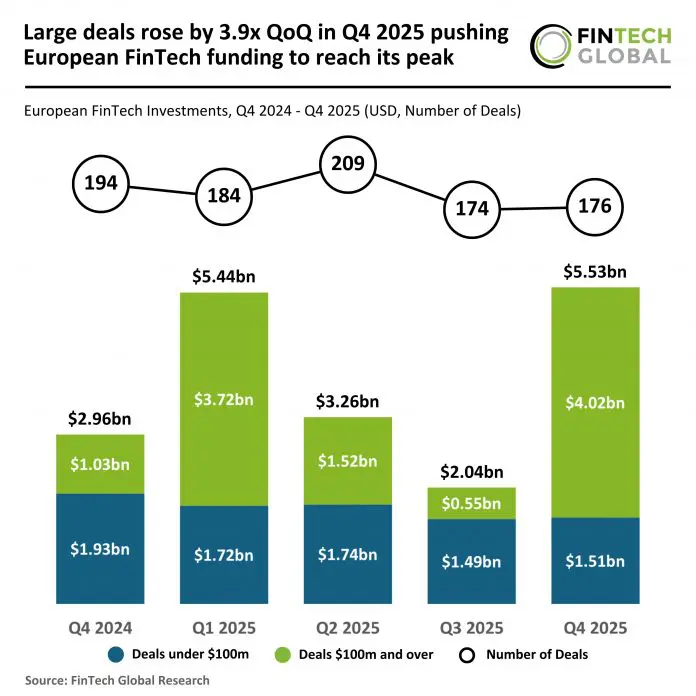
Recent research from FinTech Global found that in the fourth quarter of 2025, the European FinTech market saw a sharp rebound in funding alongside relatively stable deal activity, marking the strongest quarter of the period. Q4 2025 closed with 176 deals, broadly flat compared with the 174 deals recorded in Q3 2025 but down 9% from the 194 deals seen in Q4 2024.
In terms of sectors, CyberTech proved to be the flavour of the week with a total of seven. Aside from the five US deals already noted, France’s GitGuardian and Israel’s Backslash Security were the other two.
InsurTech came in second position this week with three deals (Lassie, Equal Parts and ManageMy), followed by PayTech (Waffo and Levl) and infrastructure and enterprise software (Uptiq and Bracket), with two deals apiece.
Finishing off the week were the WealthTech (Tembo), RegTech (Bretton AI), marketplace lending (Birch Hill) and PropTech (Safqah Capital), with a deal each.
Despite the only WealthTech deal of the week being raised by a UK-based company, recent research from FinTech Global found that the US has continued to dominate the sector.
The global WealthTech sector recorded 809 deals, representing a 47% decrease from the 1,533 deals completed in 2024 and a steep 90% decline compared with the 7,959 deals recorded in 2021. The US remained the dominant WealthTech market globally in 2025, recording 363 deals (45% share), although this represents a 37% decrease from 572 deals (37% share) in 2024.

Here are the 19 FinTech funding rounds covered by FinTech Global this week.
Lassie raises $75m in Series C to expand across Europe
Lassie, the prevention-first pet insurer, has raised $75m in Series C funding as it looks to scale across Europe and challenge traditional models of pet insurance with a stronger focus on preventive care and automation.
The round is one of the largest European InsurTech fundraises of the past year and included backing from Balderton Capital, Felix Capital, Inventure, Passion Capital and Stena Sessan. Investors are supporting Lassie’s ambition to combine insurance with everyday pet care, underpinned by AI-led automation.
Founded in Stockholm by Hedda Båverud Olsson, Sophie Wilkinson and Johan Jönsson, Lassie currently operates in Sweden, Germany and France. The company insures around one million paws, equivalent to approximately 250,000 pets, and reports more than $100m in annual recurring revenue.
Automation is a central part of the company’s operating model. Lassie says that around 60% of claims in Germany are now processed end to end in roughly six minutes, with customers uploading a photo of their vet bill and receiving near-instant payouts for straightforward treatments.
The business is targeting a fast-growing market driven by changing attitudes to pet ownership and rising veterinary costs. More than 90% of pet owners across Europe now consider their pets to be family members. The global pet insurance market is forecast to reach around $80bn by 2033, while the wider pet care market is projected to grow to approximately $428bn by 2032.
Lassie says its app-based approach encourages regular engagement beyond claims, with customers using the platform daily to track activity, access guidance and earn rewards. The company reports daily active usage of around 25%, compared with an industry average of 8–9%.
AI compliance firm Bretton AI lands $75m
Bretton AI has raised fresh capital as it rebrands from Greenlite AI and broadens its ambition to set a new benchmark for how artificial intelligence is deployed across regulated financial institutions.
The company secured $75m in a Series B round led by Sapphire Ventures, with continued backing from Greylock, Thomson Reuters Ventures, Canvas Ventures and Y Combinator.
TIAA Ventures joined as a new investor, and Rajeev Dham, partner at Sapphire Ventures, has taken a seat on Bretton AI’s board. The financing comes less than a year after its Series A.
Bretton AI develops AI agents designed to handle high-volume, mission-critical financial crime workflows. Its technology is already in use at banks regulated by the OCC, FDIC and Federal Reserve, as well as global financial platforms including Robinhood, Mercury, Gusto, Lead Bank and Coastal Community Bank. The platform supports processes such as KYC and KYB reviews, AML and sanctions investigations, and ongoing transaction monitoring.
At the heart of its system is a proprietary “Trust Infrastructure”, which embeds regulatory guidance, model risk management and continuous AI evaluation into every agent. The company says this ensures its tools are audit-ready, explainable and aligned with supervisory expectations from the outset. Its agents operate across multiple systems, synthesising fragmented data and completing investigations in minutes rather than days, helping institutions reduce manual workloads while maintaining regulatory standards.
The new funding will be used to expand the platform into additional financial crime domains, strengthen engagement with regulators and accelerate adoption among larger and more complex institutions. Bretton AI also plans to increase investment in product development and scale its engineering and go-to-market teams.
Secrets security platform GitGuardian bags $50m
GitGuardian, a France-founded cybersecurity company specialising in secrets detection and non-human identity (NHI) security, has raised fresh capital of $50m.
The company has secured $50m in a Series C funding round led by Insight Partners, with participation from Quadrille Capital and existing investors Balderton, BPI, Eurazeo, Fly Ventures and Sapphire Ventures. The backing brings together US and European growth capital as GitGuardian positions itself at the intersection of cybersecurity, compliance and AI infrastructure.
GitGuardian’s platform is designed to detect and remediate exposed secrets – such as API keys, tokens and credentials – embedded in code repositories and collaboration tools. As enterprises adopt automation and AI agents at scale, the company argues that the number of non-human identities, including service accounts and autonomous AI systems, is expanding rapidly. Unlike human identities, which are typically governed by mature identity and access management frameworks, NHIs are often left unmanaged, creating security blind spots.
According to the company, its platform continuously monitors more than 610,000 repositories and 210,000 collaboration sources including Slack, Jira and Confluence. In 2025 alone, it detected and remediated more than 350,000 secret exposures, marking fivefold year-on-year growth. GitGuardian says it now protects over 115,000 developers globally and serves Fortune 500 clients across sectors such as technology, financial services, healthcare, energy and manufacturing.
The new funding will be directed across three main areas. First, GitGuardian plans to deepen its AI agent security capabilities, expanding its ability to detect, monitor and govern credentials used by AI systems ranging from coding assistants to customer service bots.
Second, it intends to build out full NHI lifecycle management features for enterprises managing tens of thousands of machine identities, including automated discovery, credential rotation, usage analytics and compliance reporting. Third, the company aims to accelerate its geographic expansion, strengthening its presence in North America while growing further across DACH, the UK, France and the Nordics, and opening new markets in APAC, South America and the Middle East.
InsurTech firm ManageMy secures $45m to drive global growth
InsurTech firm ManageMy has secured $45m in new funding as it accelerates international expansion and steps up investment in artificial intelligence-driven capabilities.
The $45m raise includes $20m from a Series B round, which was jointly led by Ventura Capital and OCVC, the investment vehicle of Zilch co-founder Sean O’Connor, according to InsurTech Insights.
Additional funding came from BNF alongside a consortium of strategic investors linked to the insurance sector. The valuation at which the round was completed was not disclosed.
The company develops technology designed to help insurers sell, service, underwrite and manage insurance policies through a single platform. Its software aims to replace fragmented legacy systems with a unified solution that supports insurers and brokers across the full policy lifecycle. ManageMy operates globally and has an established presence in London, serving clients across multiple international markets.
The newly secured capital will be used to expand into new territories, with a particular focus on strengthening ManageMy’s footprint in North America. The funding will also support continued product development, including deeper investment in AI-driven functionality designed to improve automation, intelligence and scalability across the platform.
Beyond geographic expansion, ManageMy plans to use the investment to further embed its technology within enterprise insurance environments, helping firms modernise operations and adapt to changing customer expectations. The business is led by co-founder and chief executive Stephen Collins.
AI SaaS security platform Reco bags $30m
Reco, an AI SaaS security platform focused on protecting enterprise software environments, has raised fresh capital.
The company has secured $30m in a Series B round led by Zeev Ventures. The raise included participation from existing backers Insight Partners, boldstart ventures and Angular Ventures, alongside new corporate investors Workday Ventures, TIAA Ventures, S Ventures and Quadrille Capital. The latest injection comes less than 10 months after Reco’s previous funding round and brings its total funding to $85m.
Reco operates in the rapidly expanding AI SaaS security segment, helping organisations gain visibility and control over artificial intelligence tools delivered through SaaS platforms. As enterprises increasingly deploy AI applications and agents embedded within systems such as Salesforce, ChatGPT and Copilot, the attack surface has widened. Reco’s platform uses its own AI Agents to continuously monitor SaaS environments, mapping applications, identities, permissions and AI-driven interactions. This includes oversight of embedded AI features, SaaS-to-SaaS integrations and emerging standards such as Model Context Protocols (MCP), allowing security teams to track how data flows and where risk may arise.
The new funding will be used to accelerate Reco’s expansion, with plans to scale its engineering, product and go-to-market teams. The company said it will focus particularly on enhancing its capabilities to discover and secure AI apps and agents at enterprise scale, as organisations grapple with the growing challenge of shadow AI and autonomous digital agents.
The fundraising follows what the company described as exceptional growth. After expanding 500% year-on-year in 2024, Reco reported a further 400% increase in 2025 on a significantly larger base. The growth has been fuelled by rising enterprise AI adoption and the proliferation of shadow AI, where 71% of knowledge workers use AI tools without IT approval and 20% of enterprises have experienced data leaks linked to such activity. Reco now works with multiple Fortune 500 companies and global enterprises across financial services, healthcare, technology, pharma and manufacturing.
Global payments FinTech Waffo raises $30m Series A
Waffo, a unified global payments and monetisation platform, has secured a total of $30m in funding as it looks to accelerate the expansion of its international payment infrastructure and support digital businesses scaling across borders.
The latest Series A round closed at more than $15m and was co-led by London-based FinTech investment firm Illuminate Financial and existing investor Gaorong Capital. The round also saw participation from HSBC and BAI Capital, bringing the company’s total funding to $30m.
Waffo positions itself as a modern payments and monetisation infrastructure provider, designed to help digital businesses overcome the complexities of operating across multiple markets.
As companies expand internationally, they often face fragmented local payment methods, regulatory challenges and inconsistent checkout and subscription experiences. These issues are particularly acute for businesses in gaming, AI, SaaS and digital products, where seamless monetisation and dependable payment systems are critical to growth.
Waffo aims to address these hurdles by offering a scalable infrastructure that supports both start-ups and large global enterprises seeking to expand with greater efficiency, operational stability and regulatory clarity.
The new funding will be used to accelerate the development and global rollout of Waffo’s payment infrastructure, strengthening its capabilities in cross-border payments, subscription management and compliance support.
Uptiq secures $25m Series B to scale financial AI
Uptiq, an AI platform purpose-built for financial services, has raised $25m in a Series B round to accelerate the rollout of its industry-ready AI solutions and expand its new Qore platform for builders.
The $25m round was led by Curql, with participation from Silverton Partners, 645 Ventures, Broadridge, Green Visor Capital, Live Oak Ventures, First Capital, Epic Ventures, Tau Ventures, and Evolution VC.
Financial institutions have shown strong appetite for AI, but many struggle to move beyond pilot projects due to regulatory complexity, fragmented infrastructure and a shortage of domain-specific tools, it said. Uptiq aims to address this gap by delivering pre-packaged AI applications and digital workers designed specifically for financial services. Unlike horizontal AI platforms, its solutions are built to integrate with existing core systems and meet enterprise-grade compliance requirements from the outset.
The company’s AI offerings span multiple segments. In banking and credit unions, Uptiq provides AI-powered tools for commercial lending, covenant monitoring, servicing and banker co-pilots. In wealth management, it offers advisor co-pilots covering onboarding, compliance documentation, portfolio insights and client engagement. For FinTech and embedded finance providers, the platform delivers AI-driven underwriting, risk analysis and operational automation.
All solutions are powered by Qore, Uptiq’s AI orchestration platform. Qore combines document intelligence, a deep library of financial skills, multi-agent workflows and secure integrations in a single system. Developers can build financial AI applications using natural language prompts and pre-built financial capabilities, without assembling separate AI components or recreating compliance frameworks. Qore manages document processing, financial reasoning, permissions, auditability and integrations with core systems out of the box.
As part of the Series B, Uptiq plans to expand Qore into a self-serve environment, enabling FinTech startups, internal bank teams and independent developers to prototype and deploy financial AI applications in days rather than months.
Uptiq provides AI infrastructure for banks, credit unions, wealth managers and fintechs, enabling the deployment of intelligent applications and AI agents across lending, wealth, compliance and operations. The platform is built with enterprise-grade security, full auditability and deep financial domain expertise to help organisations move from AI experimentation to production deployment.
Supply chain security start-up Lema AI bags $24m
Lema AI, an agentic AI security platform focused on enterprise supply chain risk, has emerged from stealth with $24m.
The company has raised the investment in a Series A funding round led by Team8, with participation from Salesforce Ventures. The business was previously backed at seed stage by F2 Venture Capital, which led the earlier round.
Lema AI positions itself at the intersection of cybersecurity and third-party risk management, addressing what it describes as the limitations of traditional compliance-driven approaches. As enterprises increasingly rely on thousands of external vendors, from SaaS providers to payment platforms, these third parties often retain privileged access to internal systems and sensitive data. Industry research cited by the company suggests that many organisations now manage more than 1,000 vendors, significantly expanding their attack surface and exposing weaknesses in static, point-in-time compliance checks.
Rather than automating questionnaires and manual assessments, Lema AI applies an agentic AI model trained to operate like a vulnerability researcher. Its platform continuously analyses vendor behaviour, tracks access to critical assets, monitors data flows, and evaluates changes in permissions over time. By mapping realistic attack paths that could be introduced by third parties, the system aims to identify which vendors pose the greatest operational risk and why, allowing security teams to prioritise mitigation. According to the company, new vendors can be assessed in under five minutes.
The newly raised capital will be used to accelerate research and development of Lema AI’s autonomous vendor risk analysis engine, while also supporting the expansion of its go-to-market capabilities. The company is targeting demand from highly regulated and digitally driven enterprises seeking more dynamic approaches to third-party risk.
InsurTech platform Equal Parts bags $23m Series A funding
Equal Parts, an InsurTech platform focused on transforming independent insurance agencies through acquisition and technology, has raised $23m in fresh funding as it looks to scale rapidly across the US market.
The Series A round was led by Inspired Capital, with participation from Equal Ventures, Max Ventures, Genius Ventures and a group of lending partners.
The funding will support the company’s efforts to expand its footprint among independent agencies and strengthen its technology-driven operating model.
Founded in March 2025, Equal Parts acquires independent insurance agencies and integrates them into a shared operating platform designed to support growth while preserving agency culture and client relationships. The company positions itself as both an acquisition partner and an operational backbone for agency owners navigating succession and scale.
The business operates through a proprietary operating system built to ingest acquisitions, standardise workflows and automate back-office processes. By combining traditional relationship-based insurance practices with AI-powered tools, the platform aims to give agency owners more time to focus on clients, sales and expansion.
The newly raised capital will be used to accelerate the acquisition of independent agencies and to further develop the platform’s AI capabilities. Equal Parts said these investments are intended to extend the reach of its acquired agencies, increase operational efficiency and deliver stronger financial performance.
Since launch, the company said it has increased revenue growth for its acquired agencies by nearly 40% and delivered bottom-line improvements of almost 50%. Equal Parts has set bold growth targets, including acquiring 25 top-tier agencies this year and becoming the fastest insurance business to reach $1bn in premiums within the next 24 months.
Nucleus Security secures $20m Series C funding
Nucleus Security, a cybersecurity company specialising in unified vulnerability and exposure management, has secured fresh backing of $20m.
The company positions itself as a system of record for assets, vulnerabilities and exposures, helping organisations move from raw security data to concrete action.
The firm has raised $20m in a Series C funding round led by Delta-v Capital. Additional participation came from Arthur Ventures, whose existing relationship with the company underlines continued investor confidence in its strategy and execution.
Nucleus is seeking to reshape how businesses approach vulnerability management. Rather than relying solely on traditional scanning tools, the platform integrates data from more than 200 security and asset tools, layering in business context and AI-driven exploit intelligence. The result is a unified and continuously updated view of exposure across IT, cloud, application and operational technology environments. By orchestrating this data into prioritised actions, the company aims to help enterprises focus on the risks that matter most and reduce their attack surface in measurable ways.
The newly secured capital will be used to meet growing enterprise demand and support further platform development. As organisations contend with increasingly complex digital estates and mounting cyber threats, Nucleus plans to enhance its automation capabilities and scale its operations to support a broader customer base in 2026 and beyond.
Over the past year, the company says it has benefited from a significant replacement cycle among enterprise customers. Many organisations are moving away from costly, in-house vulnerability management systems that struggle to keep pace with modern cloud and AI-driven environments. Nucleus argues that its scalable system of record offers a more adaptable and future-proof alternative, creating what it describes as a compelling growth opportunity in the years ahead.
Backslash Security secures $19m Series A
Backslash Security, a cyber company focused on securing AI-native software development and so-called “vibe coding” environments, has announced fresh funding of $19m.
The company has raised $19m in a Series A round led by KOMPAS VC, with participation from Maniv, Artofin Venture Capital, and existing investors StageOne Ventures and First Rays Capital. The investment follows an earlier $8m seed round and reflects growing investor interest in tools designed to manage the risks emerging from AI-driven development practices.
Backslash positions itself as the first security provider dedicated entirely to protecting vibe coding and AI-native development. As organisations adopt tools such as Cursor, Claude Code and GitHub CoPilot, AI agents are increasingly being used to generate, modify and deploy production code. This shift, analysts say, is reshaping the software ecosystem and creating new vulnerabilities as large language models, integrated developer environments (IDEs) and Model Context Protocol servers become embedded into daily workflows.
The platform integrates multiple security control points into a single system, giving organisations visibility into their AI development ecosystems. It enables enterprises to apply guardrails across tools, conduct real-time granular event monitoring and deploy active protections to detect and respond to malicious behaviour.
The new capital will be used to expand Backslash’s R&D capabilities and operations, enhance the depth of its platform and scale its go-to-market presence across the United States and Europe. The company said demand from enterprise security teams has accelerated as AI-assisted coding evolves into more autonomous agent-based systems.
Alongside the funding, Backslash confirmed that Ron Zoran, formerly chief revenue officer at CyberArk, will join its board of directors as an independent member, strengthening its leadership team as it enters its next phase of growth.
Savings and mortgage app Tembo bags £16m ($21.8m)
Tembo, a digital savings and mortgage platform focused on helping first-time buyers onto the property ladder, has secured £16m in growth investment.
According to Business Cloud, the funding round was led by new backer Gresham House Ventures, with continued support from existing investors Goodwater Capital, Aviva Investors, McPike Family Office, Love Ventures and Ascension.
Tembo has positioned itself as a new type of savings and mortgage FinTech, bringing together deposit-building products and mortgage advice within a single digital platform. Through its app, customers can set aside money using a range of products including Lifetime ISAs, Cash ISAs and Fixed Rate ISAs, all structured to make progress towards a property deposit more transparent. The company has also introduced HomeSaver, a combined savings and mortgage product offering a 5.24% savings rate for customers who use Tembo’s free digital mortgage advice service to purchase or remortgage a home, linking saving and borrowing in a way that differs from traditional providers.
Beyond the initial purchase, the platform continues to support users after they have bought their home. Customers can track their mortgage in real time via the app, with visibility over remortgage rates available from their existing lender and across the wider market.
The newly raised capital will be used to enhance Tembo’s app and broaden its end-to-end homebuying proposition. Following what the company described as a breakout year in 2025, its savings arm expanded tenfold to reach £3bn in assets under administration, as more customers turned to the app to plan and finance their first home. Tembo says it is aiming to capture 20% of the UK first-time buyer market within the next two years.
Saudi FinTech Safqah Capital raises $15.2m seed round
Safqah Capital has emerged as one of the Kingdom’s most closely watched early-stage platforms following a significant seed round that underlines investor confidence in Saudi Arabia’s fast-evolving property and capital markets landscape.
The company has raised $15.2m in an oversubscribed seed funding round, one of the largest pure-equity seed raises in the Kingdom to date.
The round was led by anb Seed Fund, Shorooq and Rua Growth Fund, with participation from Sharaka Capital, COTU Ventures, Sadu Capital, 500 Global, Suhail Ventures, MEVP, Waad Invest, JOA Capital and other institutional and venture backers.
Safqah addresses a structural gap in Saudi Arabia’s real estate market by enabling faster, more transparent access to capital for small and medium-sized developers. While headline-grabbing giga-projects dominate international attention, thousands of SME developers are responsible for delivering much of the Kingdom’s housing and commercial stock, often facing slow approval cycles and rigid underwriting from traditional banks.
Over the past 18 months, Safqah has financed more than 70 development projects with a combined value exceeding $800m across Saudi Arabia. The company reports a zero-default track record to date, with loans collateralised at more than 248% and disbursed through a milestone-based framework designed to align funding with project delivery.
The platform offers Shariah-compliant debt financing tailored specifically to SME developers, a segment historically underserved by conventional lenders. Authorised by the Kingdom’s Capital Market Authority to offer and enable investment in debt instruments, Safqah combines real estate underwriting, structured finance and developer-centric software within a single digital workflow.
The fresh capital will be used to enhance Safqah’s product offering and digital platform, with a strong emphasis on building more sophisticated AI-driven tools for underwriting, risk assessment and project monitoring. The company also plans to expand its financing capacity to meet rising demand, increasing both the number and size of funded projects as development activity accelerates.
Bracket raises $7m to scale AI treasury platform
Bracket, an AI-powered FX, treasury and cash management platform for mid-market businesses, has raised $7m in Seed funding to accelerate international expansion following a year of rapid revenue growth.
The round was led by Macquarie Group’s Commodities and Global Markets business and Blackfinch Ventures, with participation from existing investor Failup Ventures. The capital will support further product development, expansion into Europe and Australia, and plans to double headcount over the next 12 months.
The investment follows a period of significant momentum for the company. In 2025, Bracket achieved 600% revenue year-on-year growth and onboarded major financial institutions and corporates.
The company said demand for modern treasury infrastructure is rising among mid-market firms, many of which continue to rely on spreadsheets and manual processes to manage FX exposure, cash visibility and banking connectivity.
Bracket’s platform uses AI to centralise bank accounts, automate FX workflows and provide real-time treasury intelligence, without the cost and complexity associated with legacy systems. The company has also introduced a bank distribution model, licensing its technology to global banks and financial institutions to help them serve mid-market clients with modern treasury tools.
Payments FinTech Levl secures $7m funding
Levl, a FinTech platform focused on unifying fiat and stablecoin global payments, has secured fresh capital as it looks to modernise cross-border money movement.
The company positions itself at the intersection of traditional banking infrastructure and blockchain-based settlement, aiming to simplify how businesses transact internationally.
The firm has raised $7m in a seed funding round led by Galaxy Ventures. Additional backing came from Protagonist, Deus X, Blockchain Builders Fund, OpenFX, FalconX, CMCC, Variant Fund, and a strategic angel network that includes leaders from Revolut, Brex and Comun, among others.
Levl operates a unified payments infrastructure designed to make stablecoin-powered transfers accessible and compliant for traditional businesses. It enables companies to collect, store, convert and move currencies across borders, supporting both fiat and major stablecoins including USDC and USDT. By abstracting the technical complexity of blockchain rails, the platform allows firms to integrate stablecoin capabilities without building in-house systems, compressing what could take years of development into a matter of days.
The newly raised capital will be used to broaden Levl’s product suite, which spans B2B cross-border transfers, card and stablecoin payment processing, and lending solutions. The company says it will also invest in scaling its international footprint, which currently covers London, New York, Canada and Switzerland.
Levl enters a cross-border payments market projected to reach $320bn in transaction volumes by 2032. Despite rapid growth, the sector remains constrained by legacy correspondent banking infrastructure, which often results in multi-day settlement cycles, fragmented money flows and elevated foreign exchange costs. The company claims to offer same-day settlement while beating the interbank rate, replacing the typical three-to-five day delays associated with traditional systems with near real-time processing.
Within four months of operation, Levl says it has surpassed an annualised transaction volume of $1bn. The platform supports payouts in more than 75 countries, with connectivity across emerging markets in Asia, Latin America and Africa. Through its client and partner network, which includes TerraPay, TapTap Send and Nala, Levl reports serving over one million end-users across mobile wallets, neobanks, merchants, remittance providers, brokers and FX platforms.
Enterprise AI security firm Airrived raises $6.1m seed round
Airrived, a cybersecurity and IT automation start-up focused on agentic AI, has emerged from stealth mode with $6.1m in seed funding.
The company announced it has raised $6.1m in seed funding, with the round led by Cannage Capital. Participation came from Plug and Play Ventures, Rebellion Ventures and Inner Loop Capital, alongside strategic investments from cybersecurity veterans Manoj Apte, Mahendra Ramsinghani and Saqib E. Awan.
Founded to address what it sees as deep structural weaknesses in enterprise AI adoption, Airrived is positioning its platform as an alternative to fragmented point solutions and legacy systems that rely on bolted-on automation. The company argues that many existing tools deliver shallow AI capabilities that focus on summarisation rather than decision-making, leaving human teams to manually connect workflows and manage operational complexity.
At the centre of Airrived’s proposition is what it calls the Agentic OS, a new operating layer designed to make agentic intelligence native to the enterprise. Rather than offering copilots or scripted automation, the platform enables organisations to fine-tune large language models, build deep-reasoning agents and orchestrate intelligence across multiple systems without requiring in-house AI specialists. The system brings together functions spanning security operations centres, governance, risk and compliance, identity and access management, vulnerability management, IT and wider business operations within a single agentic framework.
The newly raised capital will be used to accelerate product development, scale deployments across large enterprises and further build out the Agentic OS as a foundational layer for enterprise intelligence. Airrived also plans to expand its go-to-market efforts as demand grows for AI systems that can operate in production environments with governance and reliability built in from the outset.
Cybersecurity firm ZAST.AI raises $6m Pre-A round
ZAST.AI, an AI-powered code security startup focused on eliminating false positives in vulnerability detection, has completed a $6m Pre-A funding round, positioning itself at the forefront of a shift in cybersecurity standards.
The round was led by Hillhouse Capital and brings the company’s total funding to nearly $10m. The latest investment signals growing confidence from the capital markets in a new approach to code analysis—one that aims to ensure that every alert raised by security tools represents a genuine, verified threat rather than a speculative risk.
High false positive rates have long plagued traditional static analysis tools. Security engineers frequently spend hours validating alerts that ultimately prove to be harmless, creating operational inefficiencies and so-called “alert fatigue”. In such environments, genuine vulnerabilities risk being overlooked. ZAST.AI was founded to tackle that problem head-on, shifting the emphasis from reporting potential issues to verifying real ones.
The company’s proprietary “Automated PoC Generation + Validation” architecture underpins this ambition. Rather than merely flagging suspicious code patterns, its platform uses advanced AI to conduct deep code analysis, automatically generating Proof-of-Concept (PoC) exploits and executing them to confirm whether a vulnerability is real. This approach enables what the company describes as a “zero false positive” standard, marking a departure from conventional code scanning methodologies.
The fresh capital will be used to accelerate core technology research and development, as well as to support global market expansion. ZAST.AI said it is aiming to build an end-to-end AI-driven security platform capable of delivering high-quality security assurance at scale while lowering costs for development teams worldwide.
Birch Hill raises $2.5m for onchain lending
Birch Hill Holdings, an institutional digital asset infrastructure firm focused on onchain lending and tokenised asset markets, has closed a $2.5m pre-seed funding round co-led by ParaFi Capital and Castle Island Ventures to advance compliant access to blockchain-based credit.
The round drew backing from ParaFi Capital and Castle Island Ventures, with additional participation from Nascent, FalconX Ventures, Coin Operated Group, The Operating Group, JST Digital and Flowdesk, as well as industry executives including Ramin Kamfar, founder & CEO of Bluerock.
Birch Hill aims to provide fiduciaries with a compliant framework for generating income in blockchain-based credit markets. Its approach places risk management and governance at the forefront, leveraging institutional-grade risk modelling to support transparent and auditable participation. The firm’s initial strategies are launching through established blockchain lending platforms, with plans to expand into a broader range of institutional credit strategies tailored to differing compliance and risk requirements.
The founding team combines experience across traditional credit markets and digital asset infrastructure. CEO Bhavin Vaid began his career in structured credit at Goldman Sachs, later investing in private equity at Cerberus Capital, before moving into digital assets at 10T Holdings. CTO Jack Forlines and COO Connor Flanagan previously worked on institutional risk systems within BlackRock’s Aladdin platform before transitioning into digital asset data and infrastructure.
At the core of its offering is the Birch Hill Collateral Risk Framework, designed to reduce loss potential and strengthen governance. The framework incorporates real-time monitoring of collateral quality, liquidity conditions and pricing data integrity, forming the basis of its institutional risk oversight.
Read the daily FinTech news
Copyright © 2025 FinTech Global