
Global FinTech funding round activity stayed relatively stable this week, matching similar levels to last week.
A total of $570m was raised across 26 deals, while last week saw $544m raised through 22 deals.
One deal accounted for over a third of the total capital raised by FinTechs this week. This major investment was secured by Argentina-based neobank Ualá, which secured $195m in an equity financing round led by Allianz X. The investment round was supported by new and existing investors, including Stone Ridge Holdings Group, TABLE Holdings, Soros Fund Management and more. The investment round valued the company at $3.2bn on a post-money basis.
Ualá was the only funding round of the week to exceed the $100m mark. The second biggest deal was a $45m seed round secured by CyberTech startup Cylake. The US-based cybersecurity company is designed as an AI-native cybersecurity architecture built on a unified data foundation, enabling organisations to gain complete visibility across their infrastructure while maintaining full control over their systems and information.
It was a big week for US-based CyberTech companies. There were a total of six CyberTech deals this week, more than any other sector, of which, five of these were US-based businesses. These were Cylake, Fig Security, JetStream Security, Circadence and ArmorCode. The sixth CyberTech is Israel-based Reclaim Security.
In total, there were 13 US-based FinTech companies to secure funds this week. Aside from the CyberTechs, they are Crossover Markets, RenoFi, Levitate, Confido, Comeryx, Denki, IntelliGRC and Vor Systems.
The UK was the only other to see multiple deals this week, with a total of four deals (QFEX, Alpa, Payr and Vivox AI). The other countries represented this week are Argentina (Ualá), the Netherlands (Silverflow), Ireland (Evervault), Greece (Wealthyhood), Canada (Pluvo), Spain (TaxDown), Uganda (Platinum Credit Uganda) and Germany (DivTax).
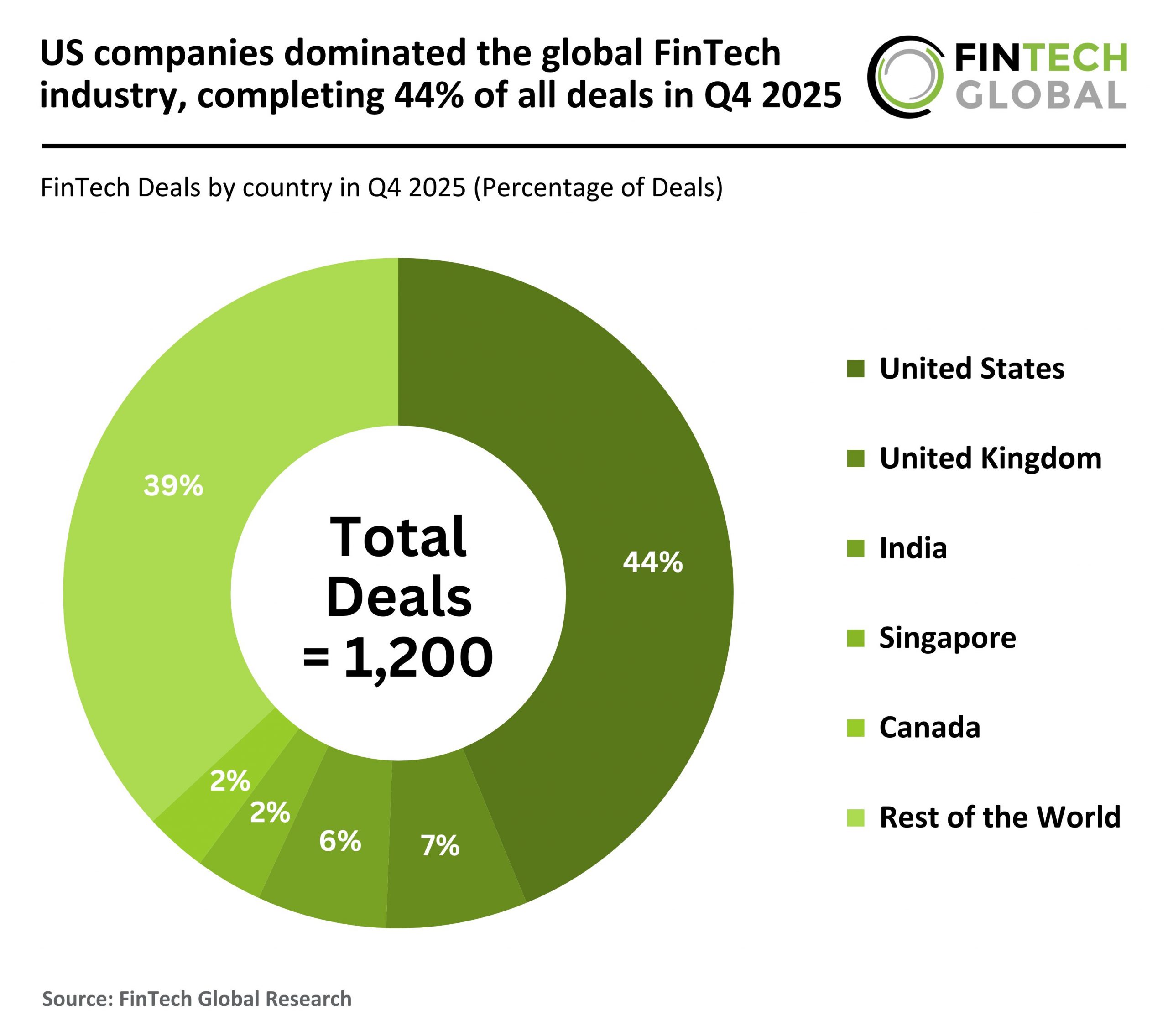
Recent research by FinTech Global found that US companies dominated the global FinTech industry in Q4 of 2024. The country housed 44% of the 1,200 global FinTech deals, marking a 25% increase from 421 deals (39% share) in Q4 2024.
Total global FinTech investment reached $31.1bn in Q4 2025, representing a 53% increase from the $20.3bn recorded in Q4 2024. Similarly, deals were up by 11% from 1,078.
In terms of sectors, close behind CyberTech was WealthTech with five. The WealthTechs are (Ualá, Crossover Markets, QFEX, Wealthyhood and Vor Systems). There were four infrastructure and enterprise software companies (Levitate, Confido, TaxDown and DivTax) and four RegTechs (Evervault, Denki, IntelliGRC and Vivox AI) to close rounds.
To finish off, there were three PayTechs (Silverflow, Alpa and Payr), and one deal each for InsurTech (Comeryx), marketplace lending (Platinum Credit Uganda), PropTech (Evervault) and Data & Analytics (Pluvo).
While there was only one deal in the InsurTech sector this week, February was a strong month for the sector. Over the course of the month the sector pulled in over $1bn, with a big interest placed on companies focused on AI solutions.
FinTech Global recently did a series of video interviews with leaders in the sector focused on trends shaping 2026. One of these focused on AI and the impacts it will have on the space over the next 12 months. For instance, Ido Deutsch, Chief Revenue Officer at Producerflow sees the technology helping to improve the employee experience through large language models.
Whereas, Simha Sadasiva, Co-founder and CEO at Ushur, sees the technology helping on the customer-facing side, with growing interest in group benefits, property and casualty, auto and homeowners insurance. Watch the full interview here.
The series of interviews also explored what innovations will define InsurTech, the biggest regulatory challenges facing InsurTech and how evolving customer expectations will change InsurTech
For more insights into the InsurTechs raising capital in February, read the story here.
Here are the 26 FinTech funding rounds covered on FinTech Global this week:
Ualá raises $195m in Allianz X-led funding round
Ualá, the Latin American neobank, has raised $195m in equity financing led by Allianz X, the strategic investment arm of Allianz Group, valuing the company at $3.2bn on a post-money basis.
The round also saw participation from new and existing investors including Stone Ridge Holdings Group, Tencent, TABLE Holdings, L.P., Soros Fund Management LLC and D1 Capital Partners. The raise follows Ualá’s Series E funding round in 2024, which totalled $366m and established Allianz as a key long-term partner.
The fresh capital will be used to accelerate Ualá’s growth and expand its financial ecosystem across Latin America, where the company currently serves more than 11 million customers and holds full banking licences across all its markets.
Operating through a single mobile-first platform, Ualá provides a fully digital banking experience encompassing debit and credit cards, lending, investments, insurance and merchant acquiring.
The investment also deepens the existing partnership between Ualá and Allianz, supporting Allianz’s strategy to expand its digital footprint and diversify distribution across Latin America. Together, the two companies entered the InsurTech space in Argentina in 2026 with the launch of fully digital life and personal accident insurance products embedded within the Ualá app. The products generated more than 300,000 quotes within weeks of launch, offering simple, transparent and customisable coverage with instant issuance and fixed pricing.
Cybersecurity firm Cylake secures $45m seed round
Silverflow closes $40m Series B to fuel global growth
Silverflow, a cloud-native payment processing company, has closed a $40m (€37m) Series B funding round as it approaches one billion transactions processed annually.
The round was led by Munich-based deep-tech investor Picus Capital, with participation from Rabo Investments – Corporate Venturing, alongside existing investors Inkef, GPT, Crane and Coatue.
The capital will be used to solidify Silverflow’s position in the payment processing market, accelerate global expansion, enhance its product suite and grow its global workforce by more than 50%.
The company has grown from processing around 180 transactions per day to almost 1.75 million daily over the past two and a half years. Silverflow’s customers span acquiring banks, payment companies and high-growth commerce platforms across Europe, North America and Asia-Pacific, including Deutsche Bank, Bolt, Payabl. and Buckaroo.
To support this growth, Silverflow plans to expand its global headcount from 85 to approximately 120 employees, with a particular focus on software engineering and product development. Geographically, the investment will support expansion in North America through its New York office, as well as a further push into Southeast Asia.
Silverflow is a cloud-native payment processing company offering a single API connection to card networks. Its platform is designed to reduce cost and complexity for acquiring banks, payment companies and commerce platforms, enabling them to accelerate time-to-market and grow revenue.
Enterprise security firm Fig Security secures $38m
Fig Security, a cybersecurity platform focused on strengthening enterprise security operations, has emerged from stealth with fresh backing.
The company has raised $38m across Seed and Series A funding rounds. The investment was led by Team8 and Ten Eleven Ventures, alongside a group of security industry leaders with experience building and operating large-scale security operations. Together, the investors are backing Fig’s ambition to close what it sees as a widening resilience gap in increasingly complex enterprise environments.
Enterprises are spending billions on security operations, yet many leaders responsible for those systems struggle with limited visibility into how their underlying infrastructure is functioning. As environments scale and grow more intricate, even small changes can disrupt detection and response processes. Fig’s platform is designed to uncover and resolve these hidden breakdowns, enabling teams to continuously validate the reliability and effectiveness of their security operations.
The technology integrates across any tech stack and autonomously maps detection and response workflows end-to-end. It traces data lineage from its source, through pipelines, SIEMs and data lakes, and into SOAR platforms and SOC AI agents. When changes threaten detection or response capabilities, the platform alerts teams, identifies root causes and evaluates the potential impact. It also allows teams to simulate fixes before pushing changes live, reducing the risk of introducing blind spots into production systems.
With the new funding, Fig Security plans to expand its go-to-market presence in North America and triple its headcount by the end of the year. The company, founded in March 2025, already counts multiple large enterprises among its customers, including Fortune 100 organisations.
AI security platform JetStream Security bags $34m funding
JetStream Security has raised $34m in seed funding as demand grows for stronger oversight of rapidly deployed AI tools.
The funding round was led by Redpoint Ventures, with additional participation from the CrowdStrike Falcon Fund. Angel investors in the round include CrowdStrike CEO George Kurtz, Wiz CEO Assaf Rappaport, and Okta co-founder Frederic Kerrest.
JetStream Security develops technology designed to give enterprises greater visibility and control over the artificial intelligence systems they deploy. As organisations increasingly roll out AI agents, copilots and custom models, many struggle to track how these systems behave, what data they access and who is responsible for their actions. JetStream aims to address these gaps by creating governance infrastructure that allows companies to monitor and manage AI systems at scale.
At the centre of the company’s platform is a system known as AI Blueprints™, which provides a dynamic map of how AI operates across an organisation’s environment. These blueprints visualise the connections between AI agents, the models they rely on, the data they interact with and the identities responsible for triggering actions. By tracking real-time behaviour rather than static architecture diagrams, the system aims to make AI workflows more transparent and auditable.
The newly secured funding will be used to accelerate the company’s growth, with plans to expand engineering, product development and go-to-market operations. JetStream also intends to grow its team as it works to build governance infrastructure that enables organisations to safely scale AI deployments.
Crossover Markets raises $31m Series B led by Tradeweb
RenoFi closes $22m to expand AI renovation platform
RenoFi, an AI-enabled renovation financing platform, has closed a $22m Series B funding round, bringing its total capital raised to $65m.
The round was led by Fifth Wall, an asset manager investing at the intersection of real estate and technology, with participation from Progressive Insurance alongside HighSage Ventures, Alumni Ventures, Flintlock Capital and Gaingels.
Existing backers Canaan, First Round Capital, Curql, TruStage Ventures also continued their support, joined by a network of credit union partners including Ardent Credit Union, Chartway Credit Union, First Community Credit Union and USALLIANCE Financial.
RenoFi intends to use the proceeds to more than triple its distributed retail team of renovation financing specialists over the next year, while deepening partnerships with credit unions and embedded financing platforms.
The company is also accelerating development of its platform, described as an orchestration layer for mortgage lending that combines modern credit underwriting with a proprietary AI-enabled renovation underwriting engine to unlock After Renovation Value (ARV) financing. The goal is to move towards near-real-time approvals for renovation loans, replacing what has historically been a slow and cumbersome process.
Founded in 2018 by Justin Goldman, Robert Shedd and Lee Miller and headquartered in Philadelphia, RenoFi created what it describes as the world’s first Renovation Home Equity Line of Credit (HELOC), a product that uses a property’s ARV rather than its current value to determine borrowing power. This approach allows equity-light homeowners — particularly recent buyers — to access on average 11 times more borrowing power without refinancing their existing mortgage. The company is now licensed in 48 states as a mortgage originator and attracts more than 10,000 new homeowners to its platform each month.
Circadence closes $16.4m round and launches RangeGPT
Circadence, a leader in AI-driven cyber readiness and advanced cyber range solutions, has closed a $16.4m investment round led by Seneca Partners, coinciding with the launch of RangeGPT and Project Ares GEN3.
The round follows strong revenue growth and accelerating adoption across defence and enterprise markets. The capital will be used to accelerate product innovation, expand global go-to-market execution, and deepen strategic partnerships across the United States, Asia Pacific, and allied markets.
RangeGPT is Circadence’s AI-native cyber readiness intelligence engine, using large language models and adaptive scenario synthesis to enable real-time creation of complex cyber environments. It compresses deployment timelines from months to hours and also powers digital twin modelling, advanced threat simulation, and vulnerability discovery across enterprise and defence architectures.
Levitate raises $16m to accelerate AI for small businesses
ArmorCode raises $16m to expand agentic AI platform
ArmorCode, a unified exposure management platform, has raised $16m in new strategic funding, bringing its total raised to $81m, alongside the appointment of cybersecurity veteran Phil Venables to its board of directors.
The round was led by Cheyenne Ventures, with backing from Ballistic Ventures, Highland Capital, Sierra Ventures, NGP Capital, Harmonic Growth Partners, Tau Ventures, and Cervin. Proceeds will accelerate growth of ArmorCode’s Agentic AI Platform, expand global go-to-market efforts, and drive continued product innovation.
The company has doubled year over year serving Global 2000 enterprises and reports that nearly 80% of its Fortune 500 and Fortune 1000 customers are pushing for expanded Agentic AI capabilities, including visibility into AI agents, MCP servers, and shadow AI.
ArmorCode’s platform processes over 200 billion findings annually across hundreds of native integrations, spanning Application Security Posture Management, Vulnerability Management, Software Supply Chain Security, and AI Exposure Management. It is powered by Anya, described as the industry’s first agentic AI framework for enterprise security.
QFEX launches with $9.5m seed round to disrupt global trading
QFEX, a global trading exchange start-up founded by University of Cambridge mathematics graduates and valued at $95m, has officially launched, offering high-leverage, 24/7 direct trading of traditional assets with no brokers, no expiry dates on futures, and no barriers.
The company recently closed a $9.5m seed funding round led by General Catalyst, with participation from Y Combinator and Paul Graham, the founder of Y Combinator. The round valued QFEX at $95m.
QFEX positions itself as the first traditional exchange in the world to offer 24/7 trading of traditional assets — a feature previously associated only with digital asset — alongside direct investor-to-investor trading and perpetual futures (“perps”) on traditional assets. These are contracts with no expiry dates, eliminating the rollovers that reportedly cost traders an estimated $5bn each year. The platform also offers leverage of up to 50x, built on infrastructure modelled after professional trading systems.
Confido raises $9m to scale legal embedded finance
Confido, the embedded financial infrastructure platform built for law firms and legal technology providers, has raised $9m in financing across two rounds, with the latest led by Aquiline Capital Partners.
The round also drew participation from The LegalTech Fund (TLTF), Breakwater Ventures, Live Oak Bank, and Context Ventures, which also led the initial round.
The funding will be used to strengthen Confido’s payments and disbursements infrastructure while expanding into additional embedded financial products designed for LegalTech providers and the law firms they serve. The company says the expansion reflects its broader goal of consolidating fragmented financial workflows into a single, compliant platform.
While the global legal industry moves more than $1trn annually, much of that volume continues to be managed through paper checks, manual reconciliation, and bank tools not designed for legal trust accounting, it said. Law firms must maintain strict separation of trust and operating funds, comply with state bar and IOLTA rules, and often manage multiple trust accounts across banks — requirements that generic payment and FinTech products are not built to support. As LegalTech platforms increasingly become systems of record for firms, these limitations have created a material operational and compliance bottleneck.
Confido was built to address this gap, designing its platform around bar rules and trust accounting requirements from the outset. Through a single GraphQL-based API, the company allows platforms and firms to accept card and ACH payments, route funds across multiple trust and operating accounts, execute intra-firm transfers, and send real-time digital disbursements, while automatically maintaining compliance with bar and IOLTA rules.
Comeryx launches with $7.5m seed round
US commercial insurance startup Comeryx Insurance has officially launched alongside a $7.5m seed funding round led by Altai Ventures.
Additional backing came from American Family Ventures, Intact Ventures, Boulder Ventures, Arch Capital Group and Echelon, according to the Coverager.
The MGA is led by Dax Craig, co-founder of Pie Insurance, and is building an AI-native infrastructure supported by AI agents designed to eliminate manual underwriting processes.
Its model replaces traditional, paper-heavy workflows with what the company describes as a zero-touch, automated underwriting experience.
Initial focus is on the small business artisan contractor segment, which Comeryx estimates includes more than 500,000 U.S. businesses generating under $10m in revenue.
Distribution will be handled exclusively through wholesale brokers, with underwriting expected to begin later this year.
Wealthyhood raises €6m ($6.9m) from Bank of Cyprus for EU growth
Wealthyhood, a WealthTech app designed to help younger investors build wealth, has closed a €6m funding round led by the Bank of Cyprus Public Company Limited.
The round also saw participation from Genesis Ventures, which had previously led Wealthyhood’s pre-seed round and followed on during its seed stage.
Alongside the capital injection, the deal establishes a strategic partnership between Wealthyhood and the Bank of Cyprus, creating commercial synergies that will combine Wealthyhood’s WealthTech platform with the bank’s established market presence.
The fresh capital will be used to accelerate Wealthyhood’s European expansion, building on its existing presence in the UK and a recent launch in Greece. The company plans to enhance its AI capabilities to deliver a more personalised investing experience and broaden its reach across the continent.
The funding also supports Wealthyhood’s B2B ambitions, with the company positioning its end-to-end WealthTech stack as a solution for banks and financial institutions seeking to modernise their digital investment offerings.
Wealthyhood is a wealth-building app aimed at younger investors, offering tools across financial education, saving, investing and automation. The platform has attracted over 60,000 users in the UK and more than 10,000 in Greece within months of its local launch. Users can invest in companies from €1, with zero commissions and fractional shares, while the app’s Autopilot feature automates saving, investing and portfolio rebalancing. Its educational offering includes more than 50 interactive lessons alongside AI-powered market analysis and insights.
FinTech Pluvo raises $5m seed for AI finance platform
Pluvo, an AI-native financial analysis FinTech built for CFOs and FP&A teams, has announced a $5m seed funding round as it looks to accelerate development of its decision intelligence platform and expand its commercial reach.
The $5m round saw backing from Andreessen Horowitz’s a16z speedrun, Deel, The Perseverance Fund, StandUp Ventures and AltaIR Capital. A number of strategic angel investors also took part, including several of Pluvo’s own customers. The raise follows the company’s recent acceptance into a16z speedrun, the flagship early-stage programme run by Andreessen Horowitz, which was confirmed earlier this year.
Founded to tackle what it describes as a structural weakness in financial analysis, Pluvo argues that modern finance teams are still struggling to turn data into actionable decisions. While systems such as ERPs, CRMs and HRIS platforms have improved the accuracy and accessibility of data, the company believes a significant gap remains between visibility and insight.
Pluvo’s platform uses agentic AI orchestration to deploy specialised digital agents capable of analysing financial models, stress-testing forecast assumptions and evaluating scenario performance in real time. The aim is to provide structured, model-grounded insights within minutes, enabling finance leaders to move more quickly from analysis to action.
The newly secured capital will be directed towards enhancing the company’s agentic analysis engine, expanding its product and engineering teams and strengthening integrations across ERP, CRM, HRIS and billing systems. Pluvo also plans to invest in its go-to-market strategy, targeting finance leaders at growth-stage and mid-market companies. Its architecture is built around model-grounded reasoning, auditability and enterprise-grade data integrity, with a focus on augmenting, rather than replacing, finance teams.
BBVA Spark backs TaxDown with €4m ($4.6m) financing deal
BBVA Spark, the banking arm for high-growth innovative companies, has granted €4m in financing to TaxDown, a FinTech specialising in digital taxation, to accelerate its growth and expand its artificial intelligence capabilities.
The financing will fund the development of new AI-based solutions and the expansion of TaxDown’s technological team.
The deal benefits from the support of the European Union’s NextGenerationEU programme and the European Investment Fund, with Spain backing it through the InvestEU State compartment.
TaxDown was founded in 2019 by Enrique García, Álvaro Falcones and Joaquín Fernández. The platform combines proprietary technology with artificial intelligence and expert advice to help individuals plan, optimise and file their taxes.
Denki raises $4.1m to bring AI to financial auditing
Platinum Credit Uganda secures $4m to boost MSME lending
Platinum Credit Uganda, a subsidiary of The Platcorp Group and a microfinance lender serving over 100,000 clients, has secured $4m in investment from Symbiotics, a Swiss asset manager, to expand financing for low-income households and micro, small, and medium enterprises (MSMEs) across Uganda.
The $4m investment was provided over a term of 24 months and disbursed on 22 December 2025. Following the disbursement, Platinum Credit Uganda launched a phased offering of enhanced loan products. New loan applications under the expanded MSME and Household programmes are now open at all Platinum Credit Uganda branches and digital channels.
MSMEs account for over 90% of private sector firms in Uganda, yet they and low-income households continue to face significant barriers to accessing traditional finance. The new capital will allow Platinum Credit Uganda to offer flexible loan products tailored to the needs of MSMEs, as well as support low and middle-income households in managing essential expenses including education, health, and housing.
Platinum Credit Uganda currently serves over 100,000 clients, with 55% based in rural areas, 28% being youth clients, and 23% female clients. Additionally, 47% of the lender’s MSME clients are women. These figures reflect the company’s focus on reaching underserved and marginalised communities.
Alpa raises $3.5m to bring real-time P&L to hospitality
Alpa, a London-based FinTech building a real-time financial operating layer for the hospitality sector, has raised $3.5m in a pre-seed funding round led by European venture fund Daphni.
The round also saw participation from True Capital, 2100 Ventures, Firedrop, Oprtrs Club, Kima Ventures, and Sonorcap.
Angel investors include Voodoo founder Alexandre Yazdi and former Burger King France chief executive and McDonald’s Europe CFO Jerome Tafani, who has joined the company’s board.
The $3.5m will be deployed to strengthen Alpa’s core product and engineering capabilities, spanning financial data infrastructure, native supplier integrations, automation, AI-driven classification, and operator-grade financial workflows. The company intends to invest primarily in engineering and product to build a scalable, hospitality-native financial platform aimed at long-term category leadership.
Alpa addresses a structural gap in the hospitality sector, where most restaurant groups only gain an understanding of their profitability weeks after the end of the month, once accounting has closed. The platform structures fragmented financial data from point-of-sale (POS) systems, banking infrastructure, and direct supplier integrations into a live operational profit and loss (P&L), giving operators continuous visibility into gross margin, labour, overheads and cash flow — without requiring bookkeeping, reconciliation or accounting workflows.
GRC platform IntelliGRC bags $3.5m to scale compliance tech
IntelliGRC, a GRC platform designed for MSPs and MSSPs, has secured fresh capital to accelerate its growth and product development.
The company focuses on helping service providers manage complex cyber frameworks and regulatory requirements through an automated compliance platform.
The firm confirmed it closed a $3.5m seed funding round on 31 January 2026. The round was co-led by Huntress co-founder and CEO Kyle Hanslovan and venture capital firm Blu Ventures. As part of the investment, Blu Ventures venture partner and former Huntress CFO Marcos Torres will join IntelliGRC’s board. Legal advisory firm Cooley assisted in structuring the round. Additional investors included SaaS Ventures, Early Light Ventures, Hypershift Technologies and several cybersecurity operators, MSP leaders, angels and advisors.
IntelliGRC develops a governance, risk, and compliance (GRC) platform tailored for service providers working with highly regulated cyber frameworks. The platform is built to support organisations navigating demanding security standards such as the Cybersecurity Maturity Model Certification (CMMC), which applies to companies operating within the US Defense Industrial Base (DIB). By embedding automation, AI-driven tools and continuous monitoring capabilities, the company aims to simplify the traditionally complex compliance lifecycle.
The new funding will support the expansion of IntelliGRC’s AI capabilities and further development of its Intelligent Control Library. The company also plans to expand integrations across the MSP ecosystem and enhance automation features such as parameter-driven remediations. Beyond product development, the capital will be used to grow its sales, customer success and enablement teams while investing in partner and education programmes designed to help MSPs deliver compliance services more effectively.
Vor Systems raises $3m to streamline renewable energy deals
Vor Systems, an AI-enabled transaction platform built for complex renewable energy deals, has raised $3m in pre-seed funding led by Gigascale Capital, with participation from Virta Ventures and a group of notable technology and energy industry figures.
The round also drew backing from tech leaders Christopher Payne, Hank Couture, and Badrul Farooqi, alongside energy industry executives Joe Song, Paul Grana, and Titiaan Palazzi.
The funding will support continued product development, foundational engineering hires, and early partnerships with developers, independent power producers, and infrastructure investors.
Vor’s platform reviews and organises large volumes of transaction documents, mapping them against a deep understanding of industry-specific nuances — from parcel-level land use constraints to interconnection queue volatility.
Payr raises $2.1m seed to modernise UK rent payments
London-based FinTech startup Payr, which has built payments infrastructure allowing tenants to pay rent via credit card, has raised $2.1m in seed funding to target the $165bn UK rental market.
The round was led by Ingenii Capital, with participation from Haatch, Velocity Capital, the British Business Bank and a group of strategic angel investors.
The capital will be directed towards expanding integrations, deepening product infrastructure and accelerating distribution partnerships across the residential sector.
Payr describes its offering as the first one-sided payments infrastructure of its kind, enabling tenants to use their existing credit cards to pay rent while landlords continue to receive the full amount via standard bank transfer. The company says landlords and agents are not required to onboard, integrate new systems or change their existing workflows, removing a key barrier to adoption.
RegTech firm Vivox AI secures £1.3m ($1.7m) funding
Vivox AI has secured £1.3m in its first funding round to accelerate the growth of its enterprise platform and expand its product capabilities for regulated financial institutions.
The investment round attracted backing from a number of prominent figures and industry participants, including Axel Weber, former president of Germany’s central bank and chairman of UBS Group, as well as Dan Cobley, former managing director at Google UK.
Additional investors include senior executives from Barclays, Onfido co-founder Kos Stiskin, Finom co-founder Kos Stiskin, Startup Wise Guys, Printify and Printful founder and executive chairman James Janis Berdigans, Venture Together and a group of strategic FinTech and technology investors.
The company develops regulator-ready AI agents designed specifically for AML, KYB/KYC and broader financial crime compliance processes. Unlike general-purpose AI tools, Vivox AI’s technology is structured around what it calls “atomic” AI agents—independent and auditable systems that each perform a clearly defined task within compliance workflows.
These tasks can include corporate registry analysis, ultimate beneficial owner identification, sanctions and politically exposed person screening, adverse media analysis and enhanced due diligence review.
This modular approach is intended to allow financial institutions to deploy AI in operational environments while maintaining strong governance and regulatory oversight. Each agent can be monitored and validated independently, allowing organisations to maintain auditability and operational accountability while introducing automation into sensitive compliance functions.
Vivox AI plans to use the newly secured capital to expand its core technology platform and continue developing this new category of specialised AI agents aimed at regulated financial institutions. The funding will also support the scaling of its enterprise platform and the expansion of engineering and product teams as the company rolls out the next generation of its technology.
DivTax raises €1m ($1.1m) to help investors reclaim dividend tax
DivTax, a Germany-based FinTech startup that helps stock investors reclaim overpaid withholding tax on foreign dividends, has raised reportedly €1m in a pre-seed financing round to accelerate product development and institutional partnerships.
The round drew backing from Angel Invest, CapCircle, Superangels, ING COO Dr Ralph Müller, and lemon.markets founder Max Linden, according to a report from EU Startups.
DivTax operates a fully digital platform that automatically reviews a user’s dividends from the past five years, calculates how much overpaid withholding tax may be reclaimed, and submits the refund application on their behalf — without the need for any printed or manually completed forms.
The company says it is the first service to handle the entire refund process end-to-end, and offers a 100% money-back guarantee on its fee should a refund application be denied.
The platform is aimed at anyone receiving foreign dividends, who the company says will typically be paying more withholding tax than they are entitled to. DivTax positions itself as the solution to ensure investors recover what they are owed from foreign tax authorities.
Copyright © 2025 FinTech Global