
Global FinTech firms raised $955m across 26 deals this week, marking a near 70% increase in funding from the figure raised over the previous seven days.
While deal volume remained unchanged week-on-week, total capital deployed climbed by a shade under 68% from the $570m last week, reflecting growing investor appetite for AI-driven cybersecurity and financial infrastructure platforms.
Four deals surpassed the vaunted $100m mark this week. The largest was secured by cybersecurity startup Armadin, which raised $189.9m in a combined Seed and Series A funding round led by Accel to develop its AI-driven cyber defence platform.
The second-largest deal came from Uzbekistan-based digital ecosystem Uzum, which secured more than $130m in strategic investment from sovereign entities in the Sultanate of Oman to expand its digital banking, payments and consumer finance ecosystem.
Another major round was announced by AI cybersecurity firm Kai, which emerged from stealth with $125m in funding, while Paris-based InsurTech Alan also broke the nine-figure mark, pushing its valuation to €5bn.
RegTech-related companies dominated activity this week, accounting for 12 of the 26 deals announced, the highest share of any subsector. Infrastructure and enterprise software providers followed with seven deals, while three funding rounds were recorded in both the FinTech and InsurTech sectors. In contrast, only one WealthTech deal was announced this week, indicating a short-term slowdown in activity within the segment.
However, recent research from FinTech Global suggests investor confidence in the WealthTech sector remains strong.
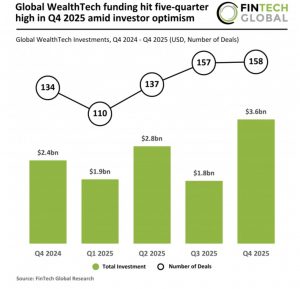
In Q4 2025, the sector recorded 158 deals globally, an 18% increase year-on-year, while total funding reached $3.6bn, up 49% from $2.4bn in Q4 2024, marking the highest funding levels in five quarters.
The United States remained the most active FinTech funding hub this week, accounting for 13 of the 26 deals announced.
The UK continued its position as the perennial bridesmaid of the funding world, landing three deals, while France, Israel and the Netherlands each secured two deals.
Other countries represented this week include Italy, Uzbekistan, Ireland and South Africa, highlighting the continued global spread of FinTech investment activity.
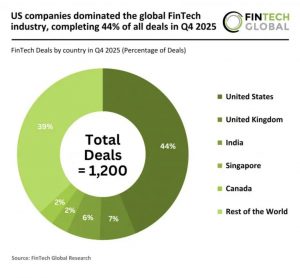
This trend broadly reflects wider market dynamics. According to FinTech Global data, the US dominated global FinTech investment in Q4 2025, accounting for 525 deals and a 44% share of the global market, up from 421 deals in Q4 2024. The UK ranked second with 82 deals, while India placed third with 75 deals
Here are this week’s FinTech funding rounds:
Armadin lands $189.9m for AI-driven cyber defence
Armadin has announced a record-breaking $189.9m combined Seed and Series A funding round aimed at helping organisations defend against increasingly sophisticated AI-driven attacks.
The investment was led by Accel, with participation from Google Ventures, Kleiner Perkins, Menlo Ventures and In-Q-Tel. Existing investors 8VC and Ballistic Ventures also joined the round with follow-on backing. According to the company, the deal represents the largest combined Seed and Series A funding round ever recorded in the cybersecurity sector.
Armadin is developing a platform designed to help organisations identify and respond to security risks at machine speed.
As cyber threats evolve through the use of artificial intelligence, the company argues that traditional human-led defences are struggling to keep pace. Its platform aims to bridge this gap by using autonomous systems capable of detecting vulnerabilities, validating potential exploits and supporting remediation before attackers can act.
The technology centres around what the firm describes as an “agentic attacker swarm”, a network of specialised AI agents that emulate the behaviour of advanced human threat actors. Instead of simply scanning for weaknesses, the system continuously analyses and adapts to an organisation’s infrastructure, identifying real-world exploit paths and presenting decision-ready intelligence to executives and security leaders.
Uzbekistan FinTech Uzum lands $130m strategic investment
Uzbekistan’s leading digital ecosystem, Uzum, has secured a strategic investment exceeding $130m in a deal that underscores growing international confidence in the country’s rapidly expanding digital economy.
The company operates a broad digital platform that combines e-commerce, digital banking, payments and consumer finance services for millions of users across the country.
The funding round was anchored by sovereign entities from the Sultanate of Oman, which led the strategic investment.
The transaction combines primary equity and structured capital and establishes a $2.3bn pre-money valuation reference point for the company. Conversion terms for the structured capital are linked to Uzum’s next qualified financing round. The investment also attracted participation from existing international shareholders VR Capital, Tencent and FinSight Ventures, signalling continued support from global investors.
Uzum has developed a fully integrated ecosystem that blends commerce and financial services on a national scale. Its portfolio of platforms includes Uzum Market, an online marketplace, Uzum Tezkor, a rapid delivery service, Uzum Bank, a digital banking platform, and Uzum Nasiya, which offers consumer lending solutions.
Together, these services are used by more than 20 million people, representing over half of Uzbekistan’s population, positioning the company as one of the most influential players in the region’s digital transformation.
The newly secured capital will be used to accelerate the next stage of the company’s expansion across its core verticals, including e-commerce, digital banking, payments and lending. Uzum intends to deepen its product offerings, enhance its infrastructure and broaden nationwide access to digital financial services.
Cybersecurity firm Kai secures $125m for AI defence
Kai, an AI-driven cybersecurity company focused on autonomous threat defence, has emerged from stealth with up to $125m in funding.
The company announced it has raised $125m in funding, led by Evolution Equity Partners, with participation from N47 and a group of strategic investors.
Kai has developed what it describes as the first agentic AI cybersecurity platform designed to operate autonomously at machine speed. The platform uses intelligent agents capable of reasoning, acting and adapting across multiple cybersecurity functions, including threat intelligence, exposure management, detection and incident response. By bringing these capabilities together into a single pipeline, the platform aims to eliminate fragmented tools, data silos and manual workflows that often slow down security operations.
The company believes traditional security processes are struggling to keep up with the pace of modern cyber threats, particularly as attackers increasingly leverage artificial intelligence to scale attacks. Many enterprise security teams still rely on human-driven workflows and a growing number of specialised point solutions, which can create complexity and slow decision-making. Kai’s platform aims to address this by replacing siloed tools with autonomous AI agents that continuously perform security tasks across the enterprise.
The newly raised funding will be used to expand Kai’s go-to-market operations, accelerate research into advanced AI capabilities and scale its platform to meet rising global demand from enterprises facing AI-driven cyber threats.
Alan valued at €5bn after €100m funding round
Parisian InsurTech Alan has reached a valuation of €5bn following a €100m funding round, strengthening its position as one of Europe’s most valuable insurance startups.
The round was led by existing investor Index Ventures and included new participants Greenoaks, Kaaf, SH, and strategic partner Belfius, as well as angel investors Shopify founder Tobi Lütke and French footballer Antoine Griezmann, according to InsurTech Insights.
Founded in 2016, Alan now serves more than one million customers, including employees, freelancers, and retirees. Its digital platform allows users to manage reimbursements, consult doctors, and track health and wellness activities directly through the mobile app.
Looking ahead, Alan intends to prioritise international expansion and further product development, targeting $1.16 billion in ARR by 2026, even if this delays full profitability. Investor support appears strong as the company continues to scale its digital health and insurance platform globally.
Stablecoin FinTech KAST raises $80m Series A
KAST, a global financial platform built on stablecoin rails, has secured fresh backing as investors increasingly look to digital dollar infrastructure as the next phase of modern financial services.
The company was founded by former Circle executive Raagulan Pathy and is positioning itself as a neobank designed for a global, digitally native user base that relies on faster and more flexible financial tools than traditional banking systems can offer.
The company has raised $80m in a Series A funding round co-led by QED Investors and Left Lane Capital. The round also included participation from returning investors Peak XV Partners, HSG and DST Global Partners, signalling continued investor confidence in stablecoin-based financial infrastructure.
Founded in July 2024, KAST offers USD-denominated accounts, global pay-in and payout capabilities to more than 190 countries, and a growing range of financial tools designed for both consumers and businesses.
Unlike many traditional financial platforms, the company’s infrastructure is built on stablecoin rails rather than legacy payment and settlement systems, allowing users to move funds internationally in dollars more quickly and efficiently.
The newly raised capital will be used to support the firm’s international expansion strategy, with plans to grow its presence across Latin America, North America and the Middle East. The investment will also support licensing efforts, compliance capabilities, product development and the expansion of its workforce as the platform continues to scale.
Data security firm Jazz lands $61m to reinvent DLP
Jazz, a cybersecurity startup focused on transforming DLP into an AI-driven intelligence platform that understands how corporate data is used, has emerged from stealth with new funding of $61m.
The company has raised $61m across seed and Series A funding rounds. The investment was led by Glilot Capital Partners and Team8, with additional participation from Ten Eleven Ventures (1011vc), Merlin Ventures, Encoded Ventures and MassMutual Ventures, alongside several cybersecurity entrepreneurs.
Jazz is building a platform designed to rethink how organisations manage data loss prevention. Traditional DLP tools are typically built on rigid rules designed to block sensitive information—such as product roadmaps, source code, customer databases or financial documents—from leaving an organisation through routine employee activity. However, these systems have long been criticised for producing excessive alerts and creating operational friction for security teams.
The company’s platform instead aims to interpret how data is used inside organisations. Rather than relying on manually written rules, Jazz’s technology analyses user behaviour, data interactions and business processes to determine whether an action represents legitimate activity or a genuine risk.
The new capital will be used to expand the company globally, accelerate enterprise adoption and build out its engineering, research and go-to-market teams. Jazz also plans to further develop its platform as it seeks to position itself as a leading provider of next-generation DLP technology.
Digital asset data platform Cryptio lands $45m round
Cryptio, a company specialising in financial data transformation and ERP solutions for digital assets, has secured fresh funding of $45m.
The firm announced a $45m Series B funding round co-led by BlackFin Capital Partners and Sentinel Global. The round also attracted participation from existing and new investors including 1kx, Alven, BlueYard Capital and Ledger Cathay Capital.
Cryptio provides infrastructure designed to address the growing complexity of accounting and financial reporting for blockchain-native assets. As banks, asset managers and exchanges move deeper into digital assets, traditional accounting systems have struggled to accommodate real-time blockchain data, custody models and token lifecycle activity.
Cryptio’s platform tackles this challenge by standardising and reconciling both on-chain and off-chain data across a range of fragmented sources, including blockchains, exchanges, custodians and brokerages.
The company’s architecture has been designed to meet institutional governance standards and support audit processes conducted by major global accounting firms such as Deloitte, EY, KPMG and PwC.
Cybersecurity company Bold bags $40m funding round
Bold, an enterprise cybersecurity company focused on preventing user-based threats at the endpoint, has emerged from stealth after securing a $40m funding round to support the launch of its AI-powered security platform.
The funding round brought in $40m from investors including Bessemer Venture Partners, Picture Capital and Red Dot Capital Partners, providing the company with fresh capital as it introduces its technology to the market.
Bold develops endpoint security technology designed to reduce user-related risks across enterprise systems. The company focuses on protecting what it describes as the “last mile” of the enterprise — employee devices that connect internal systems with the outside world. Traditionally, organisations have relied on a mix of legacy tools such as data loss prevention (DLP), insider risk monitoring and application oversight to address these risks. However, many of these systems operate in isolation and struggle to detect threats in real time, particularly as enterprise workflows become increasingly decentralised and AI-driven.
The company’s platform aims to address this challenge by transforming endpoints into active security layers rather than passive risk points. Bold’s technology runs AI models locally on each device, allowing enterprises to monitor behaviour, classify sensitive data and enforce security controls directly on the endpoint. By analysing user actions and contextual information in real time, the platform can identify and intervene when risky activity occurs, such as unauthorised data transfers or attempts to move sensitive information outside the organisation.
Bold plans to use the newly secured funding to accelerate its go-to-market strategy and further develop its edge AI platform.
Cybersecurity FinTech Onyx Security secures $40m funding
Onyx Security has launched with $40m in funding as it seeks to address emerging risks tied to the rapid adoption of agentic artificial intelligence across organisations.
The company confirmed it raised $40m from investors including Conviction Partners and Cyberstarts. The funding accompanies the firm’s public launch and positions the business to capitalise on growing enterprise demand for tools capable of monitoring and controlling increasingly autonomous AI systems.
Onyx Security is developing what it describes as a secure AI control plane designed to oversee the deployment and operation of AI agents within enterprises. As organisations integrate AI agents into workflows spanning engineering, customer service and internal operations, these systems are gaining access to critical infrastructure and sensitive information. However, their ability to operate autonomously introduces new operational and cybersecurity risks, including reasoning errors, hallucinations and potential manipulation through malicious prompts.
To address these challenges, the company’s platform is designed to continuously discover AI agents operating within an organisation, monitor each stage of their reasoning processes and approve, modify or block actions when necessary. By doing so, the system aims to ensure enterprises can enforce governance and security policies while still enabling rapid adoption of AI-driven automation.
Qevlar AI secures $30m to build autonomous AI SOC platform
Qevlar AI, an autonomous AI security operations centre (SOC) platform, has raised $30m to push its technology beyond alert investigations and towards organisation-wide security insights.
The round was co-led by Partech and Forgepoint Capital International, the latter having also backed the company in its previous 2025 funding round, with EQT Ventures participating.
The capital will fund further development of the platform’s ability to surface intelligence about the root causes of recurring security issues, enabling teams to address problems at source. Qevlar AI has built a global customer base that includes enterprise names such as Mercedes-Benz and Sodexo, as well as MSSPs including Orange Cyberdefense, ECI and Atos.
PactFi raises $25m Series A to modernise private credit
PactFi, a secure end-to-end operational platform for private credit, has raised $25m in a Series A funding round led by 7RIDGE Ecosystem Impact Fund (EIF), with participation from Vestigo Ventures.
The round will be used to accelerate PactFi’s position as core infrastructure for the private credit ecosystem across four key areas: product expansion, go-to-market growth, continued research and development alongside artificial intelligence integration, and team expansion. The company is actively hiring across product, engineering, and client-facing roles.
PactFi was founded by industry practitioners who experienced firsthand how disconnected tools introduced risk, inefficiency, and control gaps across the transaction lifecycle.
The platform provides cross-counterparty workflows within a shared operating environment, capturing and structuring data across the private credit lifecycle and enabling straight-through processing with centralised visibility. It holds ISO 27001 certification and SOC 2 Type II attestation, underscoring its commitment to enterprise-grade security and governance infrastructure.
Since launching in 2023, PactFi has processed more than $300bn in deal volume across more than 250 counterparties. It has more than 2,600 users representing 3,000 fund entities, and already supports eight of the top 20 credit asset managers, representing a combined $3.4tn in assets under management. All of the top 20 have participated on the platform as lenders.
Security data platform Scanner secures $22m funding
Scanner, a cybersecurity company building a data platform designed for modern security operations, has announced new funding of $22m.
The company has raised $22m in a Series A funding round led by Sequoia Capital, with additional participation from CRV and Mantis VC. The investment is intended to accelerate the company’s mission to deliver faster and more scalable security data infrastructure for enterprise security teams.
Scanner develops a platform that allows organisations to search and analyse large volumes of security log data quickly, even when that information is stored in cost-efficient object storage systems. Traditionally, security teams have faced a trade-off: they can store data in security information and event management (SIEM) tools where it can be searched rapidly but only retained for short periods, or keep it cheaply in object storage where searching the data can take hours or even days. Scanner aims to bridge this gap by enabling teams to analyse years of log data at high speed without incurring the costs associated with traditional SIEM ingestion.
The company’s platform is built around a specialised indexing system designed specifically for object storage. When a query is initiated, the system temporarily scales its computing resources to retrieve results quickly before scaling back down when the task is complete. According to the company, this approach allows security teams to run investigations across months or years of logs and numerous data sources while only paying for the computing power used during the query.
Scanner said the newly secured capital will be used to expand the platform’s capabilities and bring its technology to a wider range of security teams. The firm is particularly focused on supporting the growing use of AI agents within security operations, where automated systems continuously analyse security data, investigate alerts and hunt for potential threats.
Escape raises $18m Series A for AI offensive security
Escape, an AI-native offensive security engineering platform trusted by more than 2,000 security teams globally, has raised $18m in a Series A funding round led by Balderton Capital.
Uncorrelated Ventures joined the round alongside existing investors IRIS and Y Combinator.
The funding will be used to deepen the platform’s AI agent capabilities, expand agentic pentesting functionality, and grow the team across engineering, research, and go-to-market in the US and Europe. The announcement coincides with a new brand identity for the company.
Escape’s platform delivers three products: Attack Surface Management, which provides continuous visibility across code and cloud environments; Business-Logic-Aware DAST, which replaces legacy scanning with continuously improving, context-aware testing; and AI Pentesting, which offers the depth of a senior pentester running continuously at scale.
The company counts BetterHelp, PandaDoc, CyberCube, and Arkose Labs among its customers. One customer reported a 393% ROI after reducing its security testing cycle from five days to five hours.
Outpost raises $17.5m Series A to simplify global trade
Outpost, the AI-powered payments and compliance infrastructure platform for cross-border commerce, has raised $17.5m in a Series A funding round led by Ribbit, the venture firm behind category-defining companies such as Revolut, Coinbase, and Stripe.
The round also received backing from existing investor Better Tomorrow Ventures, which previously led a $3m seed round less than a year ago. Angel investors participating in the raise include executives from Revolut, Uber, Affirm, Airwallex, Checkout, and others.
The funding comes against a backdrop of growing complexity in international trade. Global trade reached record levels in 2025, with UNCTAD projecting it would surpass $35 trillion for the first time. However, a shift towards protectionism — driven by rising US tariffs and a broader rewiring of supply chains and regional trade alliances — has created a more fragmented trading environment. Governments are also tightening enforcement and updating tax regimes more frequently, with more than 20,000 indirect tax jurisdictions worldwide now actively revising rates and compliance requirements.
Cleafy raises €12m to fight banking fraud in Europe
Cleafy, a Milan-based enterprise cybersecurity company specialising in banking fraud prevention, has raised €12m in a Series B round co-led by United Ventures and eCAPITAL, bringing total funding to €22m.
The capital will be used to develop its predictive capabilities, scale threat analysis, and expand across Europe and Latin America.
The company serves more than 150 financial institutions — including ING, BCC Iccrea Group, Illimity Bank, and BPS (Suisse) — and protects over 250 million end users.
Founded in 2014, Cleafy detects hostile attacker infrastructure and intent before fraud materialises, using a proprietary engine backed by more than 85 international patents. Its newly launched Cleafy for Workforce product extends this to insider threats within corporate systems.
Stake closes $8m round and acquires UMoveFree
Stake, the network for renters that connects properties, financial services, and neighbourhoods through a Cash Back platform, has closed $8m in new debt and equity financing following 4x revenue growth in 2025, alongside the acquisition of Lighthouse and its subsidiary UMoveFree, the largest apartment locating platform in Texas.
The strategic financing was led by LAGO, with equity participants including RET Ventures, Bluefield Capital, Hamilton Ventures, Gaingels, Hub Angels, and Second Century Ventures, the venture capital arm of the National Association of Realtors.
The proceeds will be used to integrate and expand UMoveFree’s search and demand engine, scale Cash Back rental discovery into new markets, and accelerate product development across Stake’s renter savings platform.
The acquisition of UMoveFree positions Stake as the first vertically integrated, AI-powered renter network built entirely for renters, spanning apartment search through to lease signing, rent payments, lease renewal, and everyday financial wellness.
UMoveFree has previously served over 5 million renters and delivered more than $35m in Cash Back.
DiligenceSquared targets PE due diligence with $5m raise
DiligenceSquared, a New York-headquartered AI platform built to overhaul how investment teams conduct commercial due diligence, has secured $5m in seed funding in a round spearheaded by RELENTLESS, with Y Combinator joining as a participant.
The fresh capital will be channelled into accelerating the company’s growth as appetite builds among private equity firms for smarter, faster alternatives to conventional consulting engagements.
At present, funds routinely spend between $500,000 and $1m per project with firms to carry out this work. DiligenceSquared’s approach cuts through that model by combining AI voice agents, automated synthesis and a fully traceable interactive reporting interface, giving investors the ability to assess a greater number of deals, at an earlier stage, and at a fraction of the traditional cost.
The company, which began taking on clients in October, has already built a client base spanning prominent private equity and mid-market funds across the US and Europe. Those clients collectively oversee more than $2 trillion in assets under management, pointing to swift uptake across the industry.
Coreworks raises $5m seed round to automate reporting
Coreworks, an artificial intelligence-powered business reporting platform, has raised $5m in a seed funding round led by Together Fund.
The round will be used to accelerate product development and expand early access to teams looking to overhaul how reporting is produced within their organisations. The company is also opening an early waitlist and inviting companies to help shape the future of reporting.
Coreworks has developed what it calls an AI SuperAnalyst, which connects to data sources including ERPs, CRMs, and spreadsheets to generate structured reports, presentations, and financial models directly from underlying source data. Every metric remains traceable to its original source, allowing numbers to be verified instantly during discussions or decision-making processes.
Prepaid payments startup raises $4m pre-seed round
finperks, a prepaid payments infrastructure startup has raised $4m in a pre-seed funding round, backed by investors including Carsten Maschmeyer, seed + speed Ventures and Motive Partners, as it looks to build the global payment infrastructure for prepaid.
Just six months after its first employee joined, finperks has already made significant strides. It has onboarded its first banking and FinTech partners, including FLIZpay, and is in the process of onboarding its first HR SaaS partners, paylo and Recardy. It has also enabled more than 1,000 brands across 30 markets, with names such as Zalando and Flix among them.
The company is building prepaid payment rails designed to power a wide range of use cases, including cashback and rewards, employee benefits and perks, loyalty point conversion, crypto off-ramp and agentic prepaid wallets. The startup positions itself as addressing a gap in the global payments landscape, arguing that the infrastructure for prepaid payments globally does not yet exist in the form it should.
It offers a single API that aggregates global and local brands into a single platform.
InsurTech Loxa raises £2.7m seed round to fund EU expansion
UK InsurTech Loxa has raised £2.7m in seed funding across three tranches to support European expansion, grow its retail partner network, and broaden its embedded insurance platform.
The round was backed primarily by angel investors and family offices, including the Lazaroo-Hood Group. Introductions were facilitated by Angel Investment Network, FundMyPitch, and the Entrepreneur’s Collective, according to Business Cloud.
Capital from the round will be used to expand Loxa’s presence in Europe, increase its retail network to 150 live partners, and extend its platform to support every insurable product category.
Fraud detection FinTech Orca Fraud secures $2.35m
Orca Fraud has raised new funding of $2.35m as it looks to strengthen its real-time fraud detection capabilities and expand its presence across global payment ecosystems.
Orca Fraud develops technology designed to detect and prevent financial crime in payment systems, particularly in regions where traditional fraud tools struggle to operate effectively. Many legacy solutions were built for markets with more structured datasets, predictable user behaviour and slower fraud feedback cycles.
These systems typically rely on identity verification at onboarding and static identifiers to stop fraudulent activity. However, such approaches can be less effective in emerging markets, where financial ecosystems often evolve faster and user behaviour is less predictable.
Across Africa and similar markets, the fraud landscape presents distinct challenges. Informal economies, rapid digital transformation and fragmented regulatory frameworks create environments where adversaries can adapt quickly.
As digital financial services expand, fraud tactics are becoming increasingly complex and coordinated. If payment systems fail to adequately protect users, consumer trust can decline and broader financial growth may be impacted.
NjiaPay secures $2.1m to scale payment performance in Africa
NjiaPay, a payment performance platform serving African businesses, has closed a $2.1m seed funding round led by Newion, a European B2B SaaS investor.
The round follows a year of commercial growth that saw NjiaPay expand its merchant base to include high-growth startups and established global franchises such as Talk360, Anytime Fitness, and Melon Mobile.
The newly raised capital will be used to grow NjiaPay’s engineering and commercial teams to address the payment challenges merchants encounter in their day-to-day operations.
A key focus for the company is the subscription and recurring payment sector, where one in five transactions fail due to expired or stolen cards — a significant source of revenue leakage, it said.
To tackle this, NjiaPay is bringing European infrastructure tools such as Card Account Updater to the South African market. The capability, which has been standard in Europe and other global markets for over a decade, automatically refreshes stored card credentials, reducing involuntary churn and preventing avoidable payment failures.
Dutch health AI startup Delphyr raises €1.75m
Healthcare AI startup Delphyr has raised €1.75m to expand its platform for medical professionals, with backing from the founders of Hugging Face and DEGIRO.
The Amsterdam-based company will use the funding to support product development and deployment across hospitals, primary care and mental health settings, according to Beinsure.
Founded in 2023, the Dutch firm develops AI agents designed to support clinicians by reducing the time spent on documentation and information retrieval.
The platform aggregates patient data from clinical notes, laboratory results and correspondence into a single interface, allowing physicians to search records and access clinical information more quickly.
Embedded insurance startup Kayna raises $1.7m
Embedded insurance platform Kayna has raised €1.5m ($1.7m) in a seed funding round to support expansion in the UK and US markets.
The round was led by Delta Partners, with participation from existing investors MiddleGame Ventures and Aperture. New investors Leo Capital, Enterprise Ireland and Digital Irish also joined the funding round.
Kayna develops infrastructure that allows vertical SaaS (VSaaS) platforms to embed insurance directly into their software products used by small businesses.
The platform provides AI-powered policy analysis tools designed to identify coverage gaps while connecting software platforms to multiple insurers and brokers.
This allows businesses to access quotes and tailored insurance coverage through the operational software they already use.
Vertical SaaS platforms typically serve specific industries such as franchise networks, restaurants, construction companies and field service providers.
Kayna said embedded insurance is expected to represent 16% of the global insurance market, equivalent to around $1.5tn in value, within the next decade.
BrightPlan lands new funding to fuel global AI expansion
BrightPlan, an AI-powered financial well-being platform for global enterprises, has secured a new investment from Riverside Acceleration Capital (RAC), with participation from existing investors, as the company reports 41% year-over-year recurring revenue growth.
The funding will support continued global expansion, enterprise distribution, and product innovation. BrightPlan now serves more than 9.2 million employees across more than 50 countries and advises on $7.6bn in assets under advisement (AUA). The company also reported a customer churn rate of just 1.2%.
BrightPlan closed 2025 having achieved a 68% compound annual growth rate (CAGR) over the past five years, driven by expansion within its existing customer base and new global employer wins. The company has continued to grow through strategic partnerships and AI-driven personalisation, reinforcing its position in the global financial well-being market.
The new capital will be directed towards scaling BrightPlan’s global enterprise distribution and partner network, accelerating AI-driven personalisation across the platform, and strengthening its global infrastructure, compliance, and data security capabilities to better serve multinational employers.
Adaptive secures strategic investment from Citi and HSBC
Adaptive, a provider of custom trading technology solutions, has secured strategic investment from global financial institutions Citi and HSBC to accelerate its growth and product innovation roadmap.
The funding will enable Adaptive to scale its delivery of high-performance, cloud-native solutions centred around its suite of Aeron® products, as liquidity and trading infrastructure increasingly migrate to the cloud.
The investment also positions the firm to meet growing demand for client-owned, differentiated and bespoke trading technology amid evolving market dynamics and heightened competition.
The capital will support Adaptive’s growth plan by boosting product development and delivery capabilities, building on its track record of developing sophisticated trading platforms that offer competitive advantage through technological differentiation.
Spin.AI secures K1 backing for AI cloud protection
Spin.AI, an AI-powered cloud security and data protection platform, has received an investment from K1 Investment Management (K1), one of the largest investors in small-cap AI-powered software.
Spin.AI’s SpinOne platform combines SaaS security posture management, ransomware detection and response, data loss prevention, and backup and disaster recovery into a single AI-powered solution, offering an industry-leading two-hour ransomware recovery service level agreement.
Spin.AI’s SpinOne platform currently protects more than 1,500 organisations and over two million users worldwide, including Domino’s, DHL, and Vimeo, across Google Workspace, Microsoft 365, Salesforce, and Slack.
Quantro Security unveils AI cyber defence platform from stealth
Quantro Security has emerged from stealth mode with the launch of its first product, an AI-driven security agent designed to help organisations respond faster to cyber threats.
The company also confirmed it has secured seed backing from Gradient, an investment fund focused on artificial intelligence start-ups. The exact amount of funding raised was not disclosed.
Quantro Security was founded by cybersecurity veterans with experience at companies including CrowdStrike, Tenable and Qualys. The firm is building a new approach to cyber defence built around autonomous agentic AI systems capable of reasoning across large volumes of security data.
Its first product, VM.Analyst, is designed to support security teams by analysing vulnerability information, identifying real threats and helping organisations respond before attackers can exploit weaknesses.
The company argues that the cybersecurity landscape has reached a tipping point, with organisations struggling to keep pace with machine-generated threats. Modern security teams often face an overwhelming number of alerts and risk findings from multiple tools, making it difficult to determine which vulnerabilities present genuine risk. Quantro aims to address this challenge by using AI agents capable of analysing complex datasets and prioritising remediation actions in real time.