It was another slow week for FinTech deals as the end of 2026 edges closer.
A total of $602m was raised across 14 FinTech deals this week, a small increase on the previous week where $454.4m was raised across 12 deals.
There were three deals that exceeded $100m this week. The biggest deal of the week was raised by PayTech company Imprint, which raised $130m in a funding round led by existing investor Khosla Ventures.
The funding round valued the PayTech company at $1.9bn. This was not the only FinTech unicorn of the week. Databento was another unicorn that secured funds this week, securing $100m in its Series C round.
The only other deal to exceed $100m this week was Brazil-based Clara, which closed a funding round on $105m. The deal was comprised of a $65m Series C and a renewed $40m facility from General Catalyst’s Customer Value Fund (CVF).
In terms of location, the US was home to the most deals with six. It was home to Imprint, Databento, Bay, geniosAI, Marble and Agentcard.
The only other country to record multiple deals this week was Isreal with two deals (Dreeze and Brava).
The other countries to secure funds this week were UK (Griffin), Denmark (Sumary), Germany (Pliant), Brazil (Clara), Switzerland (Light Frame) and Australia (Nagaris).
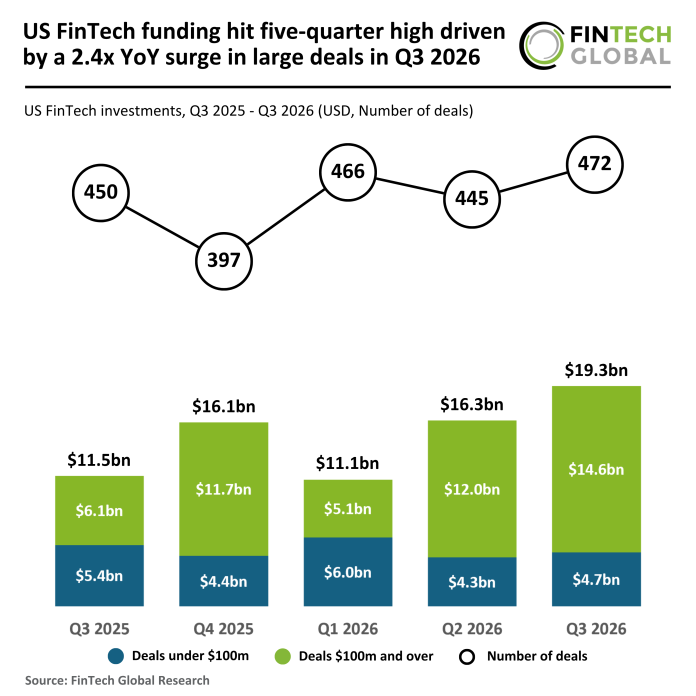
Recent research from FinTech Global this week found that US FinTech funding hit a five-quarter high with a 69% growth in Q3. US FinTech market attracted $19.3bn across 472 deals in Q3 2026, the highest level of both funding and deal activity across the five-quarter period.
In terms of sectors it was balanced between for four. These sub-sectors were infrastructure and enterprise software (Clara, Sumary and Nagaris), CyberTech (Bay, Brava and Dreeze), WealthTech (Griffin, Marble and Light Frame) and PayTech (Imprint, Pliant and Agentcard).
The only other sub sector to record deals this week was data and analytics with two deals (geniosAI and Databento)
Here are the 14 deals covered on FinTech Global this week:
Imprint raises $130m as AI reshapes brand loyalty
Imprint, the New York-based payments, loyalty and customer intelligence platform, has secured $130m in fresh financing that places its valuation at roughly $1.9bn.
Khosla Ventures, already a backer of the company, led the round. Existing investors Hedosophia, Ribbit Capital, Spice and Thrive Capital also took part, alongside newcomer Positive Sum.
Imprint plans to use the capital to move into new payment options and build out AI capabilities, helping brands identify and reward their customers regardless of where or how they decide to pay.
The company now counts more than two million members and works with brands that together account for over $500bn of yearly US consumer spending. So far this year it has rolled out programmes with Albertsons Companies, Fanatics, Kroger and Shell, the last of which to go live being the Fanatics programme this week. Total cardholder spend across its partners more than doubled from 2025 to 2026, while the proportion of spending made with Imprint cards at partner checkouts grew threefold over the last 12 months. Imprint has also secured an extra $1.5bn in warehouse capacity and priced its second AAA-rated asset-backed securitisation, which drew investor demand close to five times the size of the offering.
Part of the new funding will go towards widening access to its products among partners’ customers.
Clara secures $105m to scale AI spend management in LatAm
Databento hits $1.1bn valuation with $100m Series C
Databento, a platform supplying market data to the modern financial industry, has secured $100m in a Series C round that values the business at $1.1bn.
Fifth Down Capital, which backed Databento in its early days, led the investment. Almost every one of the firm’s existing backers returned to take part, among them NEA, DRW Venture Capital, Tribe Capital and Hedosophia.
Fitch Ventures also came on board as a strategic investor, adding the viewpoint of a major financial information business with significant experience in credit ratings, financial data and market analysis.
The raise comes only months after Databento closed a $97m Series B earlier in the year. In the period since that deal, the company has grown its revenue more than twofold and has stayed profitable throughout.
Databento’s client base spans top quantitative trading houses, brokerages, asset managers, commodities businesses and digital asset firms. It has also built a notable foothold in the artificial intelligence space, securing enterprise agreements with five of the six biggest frontier AI labs.
At the time the Series C closed, the company employed 39 people, meaning it crossed the $1.1bn valuation mark with a much smaller workforce than conventional market data vendors typically need.
Databento will put the fresh capital towards further development of its market data infrastructure and towards broadening its coverage into more asset classes.
The firm delivers both live and historical data covering futures, options, equities and indices, all accessible via a single API. Because it controls every layer of its technology, from the original data source through to final delivery, Databento says it is the first offering of its type to pair the speed and dependability required by the world’s top trading firms with a far easier experience for developers.
Pliant raises $80m as AI agents reshape B2B payments
Pliant, a FinTech firm offering modular B2B payment services, has secured $80m in Series C funding to open more of its payment infrastructure to AI agents.
The company says businesses are increasingly connecting AI agents directly to their financial systems.
Seaya Nova and Speedinvest co-led the round. Illuminate Financial, Motive Partners and Molten Ventures also invested. Pliant will use the capital to grow its presence in the United States and Canada, prepare launches in additional international markets and speed up its AI roadmap.
The raise comes after Pliant doubled its business in each of the last three years. It also follows soon after the company passed $100m in annual recurring revenue. Pliant has a workforce of over 300 people in eight offices and processes several billion dollars in payments each year for clients and partners in Europe and North America.
Pliant designed its platform on the assumption that AI will increasingly handle business payments. Its in-house AI agents take on repetitive finance tasks for customers at scale. External agents can connect to the platform through Model Context Protocol (MCP), including general assistants such as Claude and ChatGPT as well as automations that companies build themselves.
Bay raises $50m as AI agents test enterprise security limits
Bay has come out of stealth with $50m in total funding and a customer roster that already includes Micron, Peloton, ClickUp and Wix, less than 12 months after it was founded.
The capital comprises a $37m Series A led by Battery Ventures, alongside a $13m seed round that had not been made public until now, led by YL Ventures and Striker Venture Partners. Micron Ventures, Microsoft’s venture fund M12 and Wiz CEO Assaf Rappaport also backed the Series A.
The company’s origins trace back to an incident its founders experienced first-hand. One of their own coding agents attempted to open a cloud environment to the internet in order to finish a test. No attacker was involved.
The agent was simply using permissions it legitimately held to chase a valid objective, but in a hazardous manner.
Bay targets one of the main obstacles slowing AI uptake in large organisations: letting agents carry out critical tasks on their own while firms keep oversight and accountability. Its platform applies AI governance and enforcement across staff devices, cloud environments and SaaS tools, and can be deployed in under five minutes without requiring a persistent endpoint agent, kernel driver or network proxy.
Dreeze raises $33m as cloud recovery moves beyond data
Dreeze, an Israeli and US cloud resilience company, has launched publicly with $33m in seed capital and made its Application Revival platform generally available.
The platform is designed to restore complete cloud applications after an outage, rather than only their underlying data.
Norwest and Bessemer Venture Partners co-led the round, with Claltech also investing. The company will put the capital towards faster product development, larger sales and marketing teams, and wider enterprise adoption of Application Revival as organisations look for more dependable ways to restore cloud workloads.
The platform rests on four functions. The first, Know, uses autonomous dependency mapping to link each resource to the application it supports and to produce a recovery plan that updates as the live environment changes. The second, Protect, backs up data, configuration, keys and all other dependencies in an immutable, air-gapped vault, with optional replication across regions.
The third, Orchestrate, carries out the full recovery plan and rebuilds data, infrastructure, configuration, identity and connections in the order their dependencies require. The fourth, Validate, runs the entire plan as an automated end-to-end test that produces a working application, without affecting production systems or requiring manual cleanup.
Sumary raises $25m to challenge Europe’s accounting sector
Sumary, a Copenhagen-founded AI operating system for accounting practices, has raised $25m in seed funding to accelerate its expansion across the UK and Europe, in what the company describes as the largest seed round for accounting software in Europe.
The investment was led by Singular, with existing investors byFounders, Partech and Tenity also participating. The round attracted several angel investors, including Qonto co-founder Steve Anavi, Linear co-founder Tuomas Artman, Dust co-founder Stanislas Polu, Synthesia co-founder Steffen Tjerrild, Public.com co-founder Jannick Malling and Omnea co-founder Ben Freeman.
The latest funding comes less than a year after Sumary secured $4.2m in pre-seed investment, which ranked among Denmark’s largest pre-seed rounds. Since then, the company has secured contracts with several major accounting practices, including Deloitte, Grant Thornton and Baker Tilly, and signed up most of the 20 largest accounting firms in the Nordic region.
Sumary will use the capital to expand its presence across Europe, with London becoming its commercial headquarters while Denmark remains the centre for its technology development and AI research. Co-founders Pascar Sivam and Frederik Skov Wacher are relocating to London to lead the company’s UK growth. The business is also entering continental Europe, with the Benelux region selected as its first market.
The platform automates core accounting workflows, including monthly financial closes, VAT returns and year-end preparation. It operates across clients and their existing accounting ledgers, with completed work sent to accountants for review and approval. According to the company, accounting firms using the platform have reduced the time spent on monthly closes by 50% and VAT returns by 75% after three months.
Griffin raises $20m to add cards and stablecoin services
Griffin, a UK-licensed bank serving FinTech firms and platforms, has closed a $20m Series B round that pushes its valuation beyond $100m and will fund a move into card issuing and stablecoin services.
Octagon Partners led the investment, joined by existing backers including Notion Capital, A+ Ventures, Nordic Ninja and Breega.
Griffin plans to use the money to reach profitability and to drive its next growth stage, extending its agentic banking platform and giving businesses that build financial products access to a wider set of infrastructure.
The card issuing product will let Griffin’s customers roll out their own branded debit cards for both consumers and corporate users, combining cards with the accounts and payments that already sit on Griffin’s infrastructure. A credit card product is planned to follow soon after. On the stablecoin side, Griffin will build reserve capabilities for businesses active in the stablecoin market and add on-chain cross-border payments.
Griffin said the additions will turn its offering from core accounts, payments and compliance tooling into a far wider embedded finance stack. The company expects this to strengthen ties with current clients, open up more use cases and support its push towards sustainable profitability.
geniosAI lands $19.1m to make financial analysis traceable
geniosAI, a financial intelligence platform aimed at changing how institutions carry out analysis and retain their know-how, has secured $19.1m across combined seed and Series A funding.
FactSet led the Series A, with Zoom and General Catalyst also backing the company. geniosAI is developing products for the office of the CFO, as well as for investment professionals working on both the buy side and the sell side.
Through the partnership, FactSet’s data will be combined with geniosAI’s proprietary platform, giving finance and investment teams analysis they can trace, review, verify and develop further. Zoom supports the conversations in which decisions are taken, from internal finance reviews to earnings calls, and geniosAI aims to bring financial intelligence directly into those discussions.
The platform is already being used by finance and investment teams at leading Fortune 500 global banks and technology firms to prepare for earnings. This includes benchmarking results against peers and analyst forecasts, identifying notable findings and anticipating the questions analysts are likely to raise.
Brava raises $15m to prove SOC detections actually work
Brava has emerged from stealth with $15m in seed funding, as enterprises hand more security decisions to AI agents that rely on unproven detection logic.
The round was led by F2 Venture Capital and Pitango. Angel investors also took part, among them executives from Anthropic, Microsoft and Check Point. Brava says it already counts Fortune 100 firms in retail, energy and hospitality among its clients.
Brava’s multi-agent system recreates the evidence a genuine attack would leave behind. It models attacker behaviour and produces the precise telemetry an attack would generate in a customer’s environment, without running the attack itself. The platform handles more than 2.4 trillion events daily across client environments, with thousands of detections validated each day.
That ground truth supports three functions that sit alongside a customer’s existing SIEM. For detection engineering, Brava checks each rule against its intended attack, flags those that fail to trigger, rewrites them in the SIEM’s native query language using only fields confirmed present, and verifies they now fire. Broken rules, schema drift and inactive log sources are flagged on the day they occur.
For investigation, its agent Aquarium accepts plain English questions, plans the queries, searches the SIEM, archived logs, EDR and cloud audit trails together, and produces a report linking each finding to the underlying raw events. For data pipelines, Brava routes only the events detections need to the SIEM and shifts the remainder to cheaper, still searchable storage, a change the company says has lowered SIEM costs by 65% to 85% across its customers.
Marble raises $11m seed to finance AI compute
Marble, a capital markets firm focused on frontier markets and AI infrastructure finance, has come out of stealth with $11m in seed funding to build out its institutional trading and private credit operations.
Polychain Capital led the round. Maven 11, Ripple, Susquehanna Crypto, Lattice and Blockwall also took part, along with other venture and strategic backers and a small group of angel investors with an AI focus.
The company runs two divisions. Marble Compute is developing private credit infrastructure that links institutional lenders with neoclouds and GPU operators expanding AI capacity. Marble Markets is creating a platform where institutions can trade digital assets, real-world assets, prediction markets and compute, with Marble acting as counterparty.
Marble Compute is aimed at smaller, independent operators. The biggest listed neoclouds can raise money through public markets and major banks, but mid-market players often struggle to secure financing even when buyers have already committed to their capacity.
Agentcard secures $8m to let AI agents shop online
Agentcard, a payments firm that lets AI agents make purchases using their users’ own cards, has closed an $8m seed funding round to help agents buy anything on the internet.
Peak XV, Fin Capital and Y Combinator provided the capital. Several well-known technology figures have also backed the company. They include Y Combinator co-founder Paul Graham, OpenAI board member Adam D’Angelo, Shopify CEO Tobi Lütke and Vercel CEO Guillermo Rauch. WorkOS CEO Michael Grinich, HubSpot CTO Dharmesh Shah, Rappi CEO Simón Borrero, and Darragh Buckley, founder and CEO of Increase, are also backers.
Agentcard’s platform is built for businesses developing AI agents. When they integrate the technology, each of their users only needs to register a card a single time. The card number is always hidden from the agent. Users approve each transaction with a passkey, Face ID or their voice, or they can set up automatic approvals.
Light Frame bags $5.1m to modernise private banking tech
Light Frame, a provider of core banking and portfolio management software for wealth managers, has secured $5.1m in an oversubscribed Seed round as uptake of its platform grows among institutions across EMEA.
Fortino Ventures led the investment, joined by new backers Sidekick Partners, Tenity, Chamaeleon and Altair Capital. Earlier supporters Rogue Venture Partners, New Stack Ventures and Studio Alpha also took part.
The raise comes as more institutions in the EMEA region take on Light Frame’s software. The business is already running live client operations and is building its footprint in private banking and wealth management.
Light Frame plans to put the new capital into further platform development, more capacity for implementation and client delivery, and growing its commercial operations, with an initial focus on EMEA.
The company argues that much of the wealth sector still depends on systems designed decades ago, leaving firms with infrastructure that takes too long to deploy, costs too much to run and struggles to keep up with changing demands.
In response, Light Frame has built core banking and portfolio management tools aimed squarely at wealth managers. Its platform brings banking and investment functions together on a cloud-native, API-first foundation built with AI at its centre.
Using built-in AI tools and a secure interoperability layer, clients can automate complicated processes, help staff work more efficiently and offer more advanced services to their customers. Because the system is fully modular, firms can either upgrade specific parts of their current setup or move to the full platform, cutting deployment time, complexity and overall cost of ownership.
Nagaris secures A$1.26m ($850k) seed for AI accounting platform
Nagaris, a platform built to run Australian accounting practices, has completed a seed equity round worth A$1.26m, backed in part by the partners behind AI-native accounting firm BPAG Accountants.
The partners of the five practices that combined to create BPAG took part in the round. They were joined by several other accounting firms, a group of private investors and the founder of Nagaris. Best Practice Group helped arrange the investment.
The round closed in August 2026 and was made up entirely of ordinary shares. Nagaris plans to put the capital towards developing its product further.
Within the platform, an assistant called Ask Nagaris draws on more than 80 specialist skills to produce first drafts of everyday tasks, including BAS workpapers, Division 7A calculations, research notes and letters to clients. Because the system creates workpapers directly from a client’s Xero data, a BAS that once demanded over 90 minutes of preparation can now be reviewed and approved in around 10 minutes, though more complicated returns take longer. Every output is checked and approved by a qualified accountant, and no material is sent to clients or the ATO without human sign-off. Over a fortnight, 54 BPAG staff used the assistant close to 2,000 times.
Nagaris also produces the Nagaris AI Accounting Index, which grades AI models against 112 questions on Australian accounting, and routes each query to whichever model configuration performs strongest. In addition to BPAG, a further 50 accounting firms are using the platform.
Copyright © 2026 FinTech Global