

Tag: Agentic AI

93% of firms plan to adopt agentic AI by 2027
Over a quarter of financial services firms expect to save more than $4m annually in compliance operations by adopting agentic AI, according to new...

Accounts Payable AI firm Xelix raises $160m Series B
Xelix, a London-based FinTech firm specialising in agentic AI for Accounts Payable (AP), has raised $160m in a Series B funding round.

AI agents explained: From confusion to clarity
As the adoption of AI agents accelerates, definitions remain fragmented. WorkFusion, which introduced its first AI agents for financial crime compliance in 2022, has...

Inspecting GenAI outputs for safer AI adoption
When it comes to adopting generative AI tools like Zoom AI Companion and Microsoft Copilot, many organisations focus their attention on setting up robust...

How SaaS elevates financial crime defences
The financial services industry is witnessing a rapid shift towards software-as-a-service (SaaS) as institutions prioritise agility, security and operational efficiency in their compliance frameworks.

FinTech DataBahn.ai secures $17m Series A funding
DataBahn.ai, a FinTech building security-native data pipelines for enterprises, has raised $17m in a Series A funding round.

Spinwheel raises $30m to boost real-time consumer credit AI
Spinwheel, a U.S.-based FinTech company specialising in real-time consumer credit data and payments, has secured $30m in a Series A funding round aimed at transforming how liabilities are accessed and resolved across the financial ecosystem.
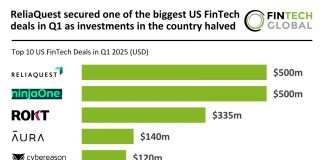
ReliaQuest secured one of the biggest US FinTech deals in Q1...
US FinTech investment stats in Q1 2025: US FinTech investments halved YoY in Q1
Average deal value dropped to $27.4m as investors grew cautious
...

Spinwheel raises $30m to tackle outdated credit systems
Spinwheel, a FinTech company focused on consumer credit infrastructure, has secured $30m in a Series A funding round to drive the transformation of credit...

Smarter policy review with IntellectAI’s Magic Placement
In a fast-evolving insurance landscape, traditional manual methods for policy comparison are increasingly inadequate.
© FinTech Global © Copyright 2024. All rights reserved.
