The combined volume of FinTech investments declined week over week. A total of $898m was raised through 20 deals, compared to the $1.5bn raised through 25 deals.
The largest fundraise of the week was secured by UAE-based WealthTech company Mal. The AI-native Islamic digital bank secured $230m in funding led by Abu Dhabi-based BlueFive Capital. The investment will support the launch of the bank, which is set for Q1 2026 and will aim at underbanked communities, with a focus on ethical finance delivered through a modern, app-led experience.
The second biggest deal, and the only other deal to surpass $100m, was raised by US-based PayTech Duetti. The music-tech and financial services company, which helps independent music creators get value from their catalogues, raised $200m. The investment consisted of $50m Series C funding from Raine Partners and a $125m private credit securitisation.
Another deal worth highlighting is Juspay, a global payments infrastructure provider. The PayTech company raised $50m in its Series D, which was backed by WestBridge Capital. The investment round valued Juspay at $1.2bn.
In terms of countries, the US was home to the lion share of deals. The country was home to eight of the FinTechs to close deals this week. These are: Duetti, Datarails, Benepass, ZBD, Armilla AI, Xbuild, OneDosh and CyberNut.
Close behind was the UK with five deals: Stream, Fimple, Asymmetric Security, Karavel and Wrisk. All the other countries represented this week housed one deal each. These were the UAE (Mal), Argentina (Pomelo), India (Juspay), France (Stoïk) and Germany (Stoïk).
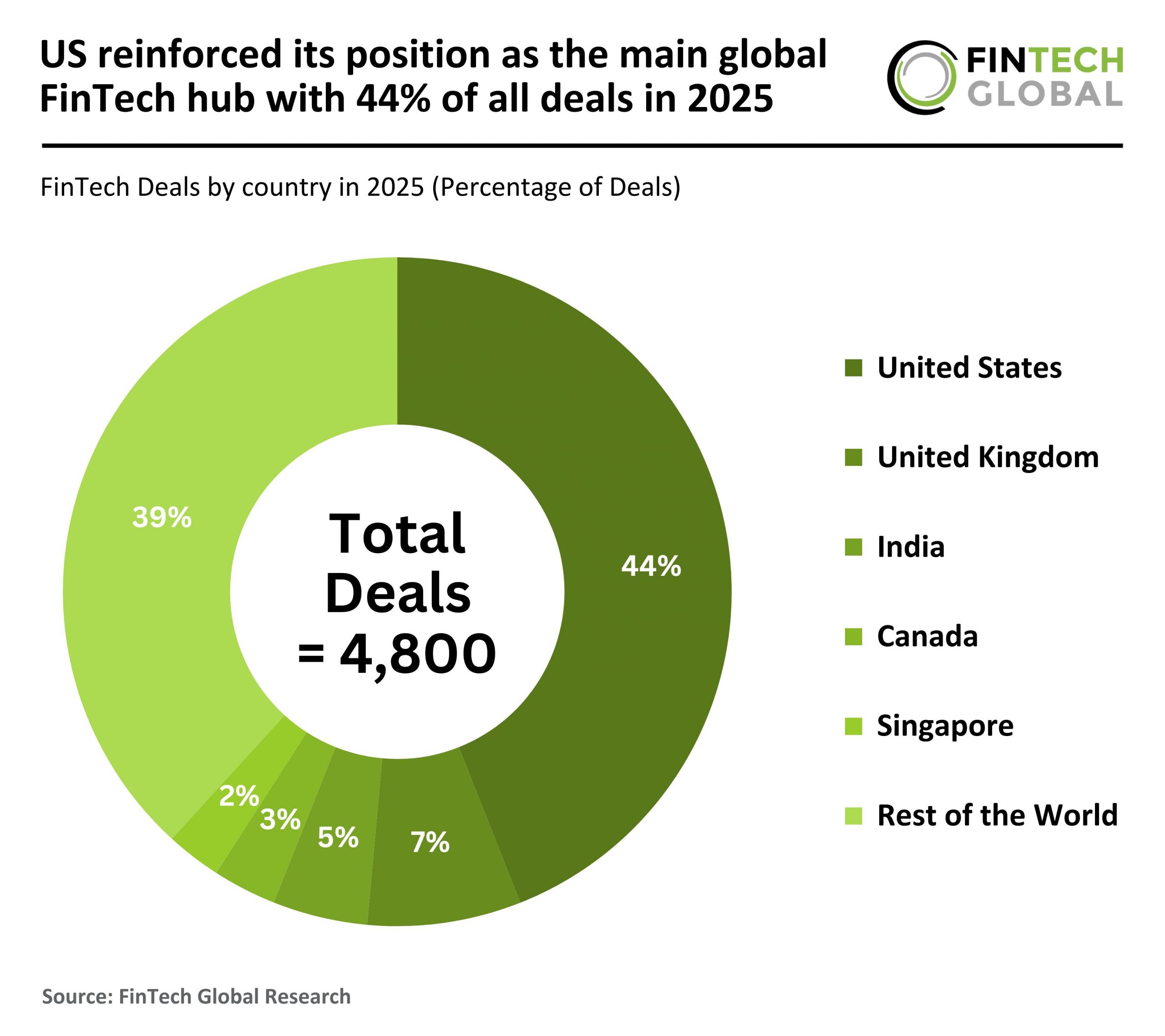
The dominance of US deals is a consistent trend each week and recent research from FinTech Global shows the country continued to lead the way for deal activity in 2025.
Total global FinTech investment reached $96bn in 2025, a 7% increase from the $89.7bn raised in 2024. Despite this growth, there was a decline in deal activity with a total of 4,800 transactions completed, representing a 24% decline from 6,331 deals in 2024.
Of the 4,800 deals, the US held a 44% share, recording 2,112 deals; however, this was a notable 15% dip on the 2,492 deals completed in 2024. The second biggest market for deals was the UK with 357 and India in third with 274 deals.
As for sectors, PayTech led the pack with five deals (Duetti, Pomelo, Juspay, ZBD and OneDosh) and was followed closely by InsurTech with four deals (Armilla AI, Stoïk, Xbuild and Wrisk).
Elsewhere, both WealthTech (Mal, Stream and Project Eleven) and CyberTech (Asymmetric Security, Dam Secure and CyberNut) saw three deals apiece. Finishing off the week were two deals for RegTech (Sinpex and Karavel) and infrastructure and enterprise software (Benepass and Fimple) and one data & analytics company (Datarails).
In another research piece from FinTech Global, it found that the UK cemented its place as the leader in the European WealthTech market with 47% of all deals in 2025. The UK remained the leading WealthTech hub in Europe in 2025, with companies in the country completing 74 deals (47% share), although this represented a 39% decline from the 121 deals (32% share) recorded in 2024.
FinTech Global recently spoke to several players in WealthTech to get their thoughts on whether 2025 was a good year for the sector. Watch their interviews here and here.
Here are the 20 FinTech funding rounds covered on FinTech Global this week:
AI-native Islamic digital bank Mal raises $230m round
Mal, an AI-native Islamic digital bank in development, has announced plans to launch as a mobile-first financial platform headquartered in Abu Dhabi, following a $230m investment round.
The company said it has closed its first investment round at $230m, led by Abu Dhabi-based asset manager BlueFive Capital, according to FinTech Finance.
Set to launch in Q1 2026, Mal is being built to serve underbanked communities, with a focus on ethical finance delivered through a modern, app-led experience.
The start-up said the platform will offer AI-powered tools to help users manage, move and grow their money, aiming to provide the core capabilities people expect from a digital financial service while tailoring products to local market needs.
Mal said the new funding will accelerate product development, support licensing efforts and help drive its go-to-market strategy as it prepares for launch.
The roll-out is expected to happen in phases, beginning in the UAE before expanding into other regions where there is demand for accessible, values-driven financial solutions, with localised offerings designed around each region’s financial landscape.
Duetti secures $200m to scale independent music catalog deals
Duetti, a music-tech and financial services company focused on helping independent music creators unlock the value of their catalogues, has secured $200m in new funding to accelerate acquisitions and enhance its platform capabilities worldwide.
The financing package is led by a $50m Series C equity investment from Raine Partners, the growth equity fund of The Raine Group. This is complemented by a $125m private securitisation and a $25m increase to an existing credit facility, taking the total capital raise to $200m.
The Series C investment is intended to support Duetti’s continued expansion in music rights acquisition, with funding earmarked for team growth, technology infrastructure upgrades and enhanced marketing services. The company said it will also use the capital to strengthen its global footprint as demand from independent artists continues to rise.
Since launching more than three years ago, Duetti has raised over $635m in total funding, including more than $100m in equity. The company has partnered with over 1,100 artists, songwriters and music creators across more than 40 countries, purchasing and managing portions of their music rights catalogues.
Duetti is currently signing more than 80 deals per month, representing over 2.5x growth compared with the same period last year. This momentum follows the company’s expansion into publishing rights alongside master recording rights, as well as increased activity in international markets. As part of the Series C financing, Joe Puthenveetil, partner at The Raine Group, will join Duetti’s board of directors.
The company employs a 65-person team across New York City, Los Angeles, Miami, Nashville, London and Rio de Janeiro. More than 30% of its 2025 deals originated outside the US, including transactions in France, the UK, Germany, Brazil and Mexico.
Stream raises £67m ($91.1m) to scale its workplace finance platform
Stream, the workplace finance platform formerly known as Wagestream, has secured fresh backing after completing a £67m Series D round.
According to UKTN, the London-based FinTech, which partners with employers to offer flexible wage access and broader financial tools, was founded in 2018 to provide workers with alternatives to high-cost payday lending.
The latest £67m raise was led by Sofina, with participation from Ascension Ventures, Balderton, Northzone, Smash Capital, LocalGlobe Latitude, the British Business Bank, and Better Society Capital. The capital injection follows several years of growth for the company as it expands its suite of services for employees.
Stream began by enabling workers to draw down earnings early, but has since broadened its remit into a platform offering budgeting tools, financial planning support and access to affordable credit. The firm is increasingly positioning itself as an end-to-end workplace finance provider as employers look for ways to support staff wellbeing and retention.
With the new funding in place, Stream plans to fast-track its international expansion, with the US among its priority markets. The firm also intends to strengthen its pension offering, which it recently expanded through its acquisition of Zippen in 2025.
The company said the latest round will help it widen the impact of its workplace finance tools and support more employees in building long-term financial stability. The push into pensions is expected to deepen that reach, while international growth will bring its model to new employer partners abroad.
AI finance platform Datarails raises $70m Series C
Datarails, an AI-native financial platform built to give the CFO’s office a single source of truth across core finance workflows, has secured fresh capital as it looks to accelerate growth outside its home market.
The company raised $70m in a Series C round led by One Peak, with participation from Vertex Growth, Vintage Investment Partners, Zeev Ventures, Innovation Endeavors, Joey Low, Qumra Capital and Claltech.
Datarails positions itself around an Excel-first model, aiming to modernise finance operations without forcing teams to abandon the spreadsheet software many still rely on day to day. It offers a multi-product suite spanning FP&A, month-end close, cash management and spend control, with the firm describing its FinanceOS as the decision engine underpinning the CFO’s office.
The company says the pitch is to reduce the time finance teams spend piecing together fragmented data and manually maintaining spreadsheets, freeing up capacity for higher-value analysis and decision-making. Datarails argues that important workflows often remain split across tools and datasets, creating delays and limiting visibility across financial planning, closing processes and spend management.
With the new funding, Datarails said it will push forward with geographic expansion across North America and EMEA, increase investment in research and development, and leave the door open to acquisitions in the coming months.
The fundraise comes after what the company described as rapid momentum, including 70% year-over-year revenue growth and a global headcount that nearly doubled to more than 400 employees in 2025. It also said more than half of its growth in 2025 came from product solutions launched within the previous 12 months, as it widened its platform beyond FP&A.
Latin America payments platform Pomelo bags US$55m
Pomelo, a payments infrastructure platform focused on Latin America, has announced a fresh funding round as it looks to broaden its product suite and deepen its reach across the region.
The company said it has raised US$55m in a Series C round co-led by Kaszek and Insight Partners, with participation from Index Ventures, Adams Street Partners, S32, Endeavor Catalyst, monashee, and TQ Ventures.
Pomelo positions itself as a modern technology stack for firms that need to issue and manage payment products, targeting banks, large corporates and fast-growing FinTechs across Latin America.
The business says it now operates across the continent, processing billions of dollars in payments volume, while pointing to strong customer retention and satisfaction as indicators of product-market fit.
With the new capital, Pomelo said it plans to strengthen its card issuance and credit card capabilities, while accelerating development across additional payment “rails” and methods. Its roadmap includes expanding global product offerings such as a native global stablecoin card, payment tokenisation, and AI-powered chargeback management, alongside the creation of new business units focused on modern payment methods.
The company framed the raise as the start of a new growth phase, aimed at expanding beyond its existing footprint and adding global products designed for the complexity of Latin American markets and regulatory environments.
Juspay raises $50m from WestBridge Capital in Series D follow-on
Juspay, a global payments infrastructure provider for enterprises and banks, has secured fresh capital.
The company announced that it has raised $50m in a Series D follow-on round from WestBridge Capital. The transaction, which combines both primary and secondary investments, values Juspay at $1.2bn.
The secondary portion of the round provides liquidity to early investors and employees holding ESOPs, marking the second such liquidity event facilitated by the company within a year.
The funding comes after a year of sustained growth for Juspay. The company’s annualised total payment volume has now crossed $1tn, with its platform processing more than 300 million transactions each day.
Juspay supports a broad roster of global brands, including Agoda, Amazon, Flipkart, Google, HSBC, IndiGo, Swiggy, Zepto and Zurich Insurance.
Juspay continues to expand its footprint across multiple regions, including Asia-Pacific, the Middle East, Latin America, Europe, the UK and North America.
Benepass raises $40m Series B to tackle rising healthcare costs
ZBD secures $40m funding to scale gaming payments
ZBD, a payments innovator powering real-money transactions for games and apps, has announced a new funding round of $40m.
The company has secured $40m in Series C financing, with the round backed by Blockstream Capital Partners (BCP), which will support ZBD’s ambition to become a core payments infrastructure provider for game developers and digital platforms.
ZBD uses the Bitcoin Lightning Network to enable real-money embedded payments at scale, providing what it describes as a compliant and frictionless layer for money movement within games. The company already processes more than 120 million transactions each year and has doubled the number of games integrated with its software development kit over the past 12 months. Its technology is currently used by developers including TapNation, Fumb Games and PlayEmber, which distribute rewards to players in fiat currencies, bitcoin and gift cards.
Unlike traditional gaming payments models that focus primarily on monetising player spending, ZBD’s approach is centred on enabling real-time payouts directly within gameplay. The company argues that instant real-money rewards can improve player engagement and lifetime value, creating a two-way value exchange between publishers and users. By embedding compliant payment rails into games, ZBD aims to make money movement a native part of the gaming experience rather than an external add-on.
The new funding will be used to build out a full-stack, compliance-ready payments platform for console, PC and mobile games. ZBD plans to give publishers greater control over how money flows through their platforms, expanding into services such as card issuance, bank transfers, virtual IBANs and currency exchange. The company also sees opportunities across the wider creator economy, including user-generated content and livestream tipping.
Armilla AI raises $25m to expand AI liability coverage
Armilla AI, a US-based InsurTech specialising in AI liability coverage, has raised $25m to expand its insurance offerings amid growing demand for protection against generative AI risks.
The company intends to use the $25m to further scale and distribute its expanded AI Liability Policy, according to FF News.
The upgraded coverage now includes traditional general liability while offering protection for AI regulatory violations, non-breach privacy incidents, data leakage, AI model error liability, harmful outputs, AI agent failures, AI-driven property damage, and defence costs under new AI regulations such as the EU AI Act and Colorado AI Act.
The firm provides purpose-built insurance policies for AI systems, designed to cover failures, inaccuracies, and misadvice caused by generative AI or autonomous agents.
Unlike traditional coverage retrofitted from cyber, errors and omissions, or general liability policies, Armilla’s solutions address the specific ways AI systems fail, providing clear, affirmative protection where conventional policies fall short.
Post-quantum firm Project Eleven bags $20m
Project Eleven, a post-quantum cryptography startup focused on safeguarding digital assets, has raised $20m in a Series A round.
The round was led by Castle Island Ventures, with participation from Coinbase Ventures, Fin Capital, Variant, Quantonation, Nebular, Formation, Lattice Fund, Satstreet Ventures, Nascent Ventures and Balaji Srinivasan. It also reported continued investment from Variant, Quantonation, Nebular and Formation.
Project Eleven is building tools designed to help major digital asset networks transition away from cryptography that could be broken by a future fault-tolerant quantum computer capable of running Shor’s algorithm, which could allow private keys to be derived from public keys. The company argues that, without preparation, the concept of on-chain “digital ownership” could be undermined as quantum capabilities advance.
Stoïk raises €20m ($23.5m) to boost AI-powered cyber coverage
Paris-based Stoïk, a European InsurTech specialising in cyber risk protection for businesses, has completed a €20m Series C funding round, aiming to strengthen its position in the European cyber risk market.
The round was co-led by new investor Impala and existing investor Opera Tech Ventures. Current investors Alven and Andreessen Horowitz also participated, backing the company’s expansion plans, according to Tech.EU.
Founded in 2021 by Jules Veyrat, Alexandre Andreini, Nicolas Sayer, and Philippe Mangematin, Stoïk provides cyber insurance for companies with revenues of up to €1bn. The company combines insurance coverage with active prevention and response capabilities, creating an integrated model designed to manage cyber threats end-to-end.
Stoïk helps small and medium-sized enterprises before, during, and after cyber incidents, aiming to maintain business operations, limit financial losses, and ensure rapid recovery. Its approach leverages an AI-enabled 360-degree framework that blends insurance, risk detection and prevention, and in-house incident response teams, increasingly supported by proprietary AI agents.
The funding will be used to expand Stoïk’s offerings across Central and Southern Europe, further develop its AI-driven cybersecurity capabilities, and scale its integrated cyber risk model.
XBuild raises $19m to scale AI estimating platform
XBuild, a construction-tech startup, with an AI-native estimating and proposal platform for contractors and insurers, focused initially on residential roofing and insurance restoration work, has raised $19m in Series A funding.
The funding round was led by N47, with participation from Rackhouse Ventures and Andreessen Horowitz, marking a major investment in construction-focused AI solutions, according to Beinsure.
The firm develops software that automates the creation of carrier-aligned repair estimates, helping contractors and insurers reduce manual estimating work.
Since its 2025 launch, the platform has processed over 15,000 completed projects, representing roughly $250m in construction volume. Adoption has been strongest in property insurance claims, particularly residential roofing, where XBuild customers avoided more than 40,000 hours of manual estimation work.
The platform has recently introduced Roofing Proposals, a tool for residential contractors that generates detailed, editable estimates in under 15 minutes. It integrates PDF measurement reports from providers such as EagleView, Hover, and Roofr, alongside standard job-site photography, converting these inputs into structured proposals ready for client delivery.
The new funding will allow XBuild to expand into additional verticals including HVAC, concrete, and window installation, while continuing to support insurers and insurance-focused contractors through its Insurance Estimation Copilot, which remains in active use across claims environments.
Fimple raises $10m to accelerate GCC expansion
Fimple, a core banking technology provider, has raised $10m in a follow-on investment round to accelerate its international expansion, with a strategic focus on the MENA region and GCC markets.
The $10m follow-on investment was led by Ak Asset Management VC Fund, with continued backing from existing investors DN Capital, Smartfin, and APY Ventures.
The funding is intended to strengthen the company’s capital structure while supporting its growth across international markets.
Founded in 2022 and headquartered in London and Istanbul, Fimple has developed a fully composable, cloud-native core banking platform that can be deployed both in the cloud and on-premise. The platform enables banks, FinTechs, and financial institutions to rapidly build, launch, and scale next-generation financial products.
The new investment will support Fimple’s accelerated expansion across the GCC, following the recent launch of its commercial offices in Dubai, UAE, and Riyadh, Saudi Arabia. The company plans to further scale its regional presence, strengthen local partnerships, and expand delivery capabilities across the region.
Designed by a founding team with decades of combined experience in core banking, Fimple’s platform addresses the limitations of traditional banking systems. It offers flexible deployment options, rapid configurability, and a broad suite of banking and lending solutions, including support for alternative and participation-based financial models.
Sinpex secures €10m ($11.8m) to expand AI KYB compliance platform
Sinpex, an AI-powered platform for KYB/KYC lifecycle management, has secured fresh funding to grow its compliance automation business across Europe.
The company raised €10m in a Series A financing round led by BlackFin Capital Partners, with participation from existing backers ACE Ventures and TX Ventures.
Sinpex positions itself as an end-to-end SaaS platform covering the customer and regulatory lifecycle for business onboarding and ongoing compliance. It brings together document collection, UBO identification, risk assessment, AML screening, ID&V and continuous reviews, with AI-driven analysis of registers and ownership structures designed to produce audit-ready reporting across multiple jurisdictions.
The company said the new capital will be used to accelerate growth, reinforce its push to become a category-defining Know Your Business automation provider in Europe, and expand in key international markets including France and the Netherlands.
Sinpex is also pitching its technology as a way for firms to keep pace with tougher compliance expectations, including preparation for the 2027 EU AML Regulation. It said its platform supports transparency and KYB requirements across rules and frameworks such as AMLD5/6, PSD2/3 and DAC7, aiming to reduce manual workload for compliance teams while improving consistency and regulatory robustness.
AI cybersecurity firm Asymmetric Security secures $4.2m
Asymmetric Security, a cybersecurity startup specialising in digital forensics and incident response, has emerged from stealth following a successful pre-seed raise.
The company secured $4.2m in an oversubscribed funding round led by Susa Ventures, with participation from Halcyon Ventures, Overlook Ventures and a group of angel investors.
Founded in 2025, Asymmetric Security focuses on applying AI-driven automation to digital forensics and incident response, aiming to speed up investigations while significantly reducing the cost and manual effort typically associated with complex cyber incidents.
At the core of the platform is an autonomous system that collects artefacts across email, identity and cloud applications, analysing multiple data points to reconstruct how an attack unfolded. The technology then generates recommendations and delivers clear findings to security teams, helping responders make informed decisions on edge cases and risk scenarios.
The new capital will be used to expand Asymmetric Security’s engineering and incident response teams as it looks to scale its platform and deepen its technical capabilities. Over the longer term, the company plans to broaden its services beyond its current focus to cover insider threat investigations, ransomware incidents and nation-state attacks.
AI security startup Dam Secure raises $4m seed round
Dam Secure, an AI security start-up focused on securing AI-generated code for enterprises, has raised fresh capital as organisations race to adopt generative AI in software development.
The company has secured $4m in a seed funding round led by Washington, D.C.-based cyber and AI investor Paladin Capital Group.
Founded by Patrick Collins and Simon Harloff, Dam Secure is building an AI-native platform designed to help organisations spot and manage security risks created when machine-written code is pushed into production at scale. The firm says traditional application security tools are struggling to keep up, particularly when AI systems generate code that works as intended but contains dangerous logic flaws that can slip past pattern-based scanners.
Dam Secure’s approach is centred on allowing teams to set security requirements in plain English and then enforce those rules across large code bases during the development process. The company positions this as a way to reduce noise, tighten controls and catch issues earlier, rather than relying on a “scan-and-patch” model once code is already deployed.
The start-up said it will use the new funding to accelerate product development and expand go-to-market efforts throughout 2026, as it looks to convert early demand into wider enterprise adoption. Paladin Capital’s managing director Mourad Yesayan is also set to join Dam Secure’s Board, according to the announcement.
OneDosh raises $3m pre-seed to build stablecoin payments
OneDosh, a FinTech startup focused on borderless payments, has raised $3m in pre-seed funding, according to a report from TechAfrica News.
The funding represents an early milestone for the company as it targets long-standing inefficiencies in cross-border payments.
OneDosh’s platform enables instant cross-border transfers with stablecoins or cash, helping users avoid the delays and high costs typically associated with bank-based international payments.
The company emphasises transparent pricing, with no hidden charges or unexpected foreign exchange costs.
Karavel raises £1.25m ($1.6m) pre-seed to modernise AI-driven compliance
Karavel, an AI-powered compliance platform built for highly regulated industries, has secured £1.25m in pre-seed funding to support product development and commercial expansion.
The round was led by Fuel Ventures and will help Karavel accelerate growth across the UK and Europe while advancing its mission to modernise regulatory compliance workflows.
Karavel’s platform combines AI-driven marketing and advertising reviews, real-time horizon scanning, regulatory gap analysis and actionable guidance in a single interface. The technology is designed to help organisations meet increasingly stringent regulatory and advertising standards while reducing friction between compliance, legal and marketing teams.
The funding comes as compliance teams across financial services, FinTech, insurance and other regulated sectors face mounting pressure. Regulatory frameworks are expanding, expectations are rising and fines for non-compliance continue to grow. Despite this, many organisations still depend on manual and fragmented processes to track rule changes and approve materials, creating inefficiencies and increasing reliance on external legal support.
Karavel’s AI analyses regulatory updates as they happen, flags relevant changes and extracts requirements, enabling teams to respond more quickly. The company says its AdCheck technology allows financial promotion reviews to be completed three times faster, achieving a 91% first-pass approval rate. Its horizon scanning tools also replace bi-weekly manual reports with daily automated alerts, delivering significant efficiency gains and reducing external legal spend.
The new capital will be used to further develop the product and support Karavel’s continued expansion as regulatory scrutiny intensifies.
CyberNut raises funding to expand AI security for K-12
Read the daily FinTech news
Copyright © 2025 FinTech Global