
A total of $1.5bn was raised across 21 FinTech deals this week due to a colossal $1bn investment round raised by WealthTech platform Kalshi.
The mega deal, which was led by Coatue Management, put Kalshi’s valuation to $22bn. The WealthTech company was founded in 2018 to help investors trade on real-world outcomes, such as sports games and elections. It previously raised $1bn in its Series E round in December 2025.
Putting the Kalshi deal to the side, the remaining 20 FinTech companies raised a total of $566m in funding. Cents, a PayTech company, was the only other deal raised more than $100m this week. The company, which offers a fully integrated software, hardware, and payments technology platform built for the laundry industry, raised $140m.
This was the second week in a row when over $1bn was raised. Last week, a total of $1.1bn was raised across 23 deals, with the largest deal being a $375m Series B secured by Cloaked.
In terms of location, the US reigned supreme. The country was home to 14 of the deals to close this week, including eight of the biggest deals of the week. The US-based companies were Kalshi, Cents, Shepherd, Spade, Adonis, Worth, Notch, BlueFlag, Eclypsium, Onit Security, Trayd’s, M1X Global, CurrentClient and Bedrock Data.
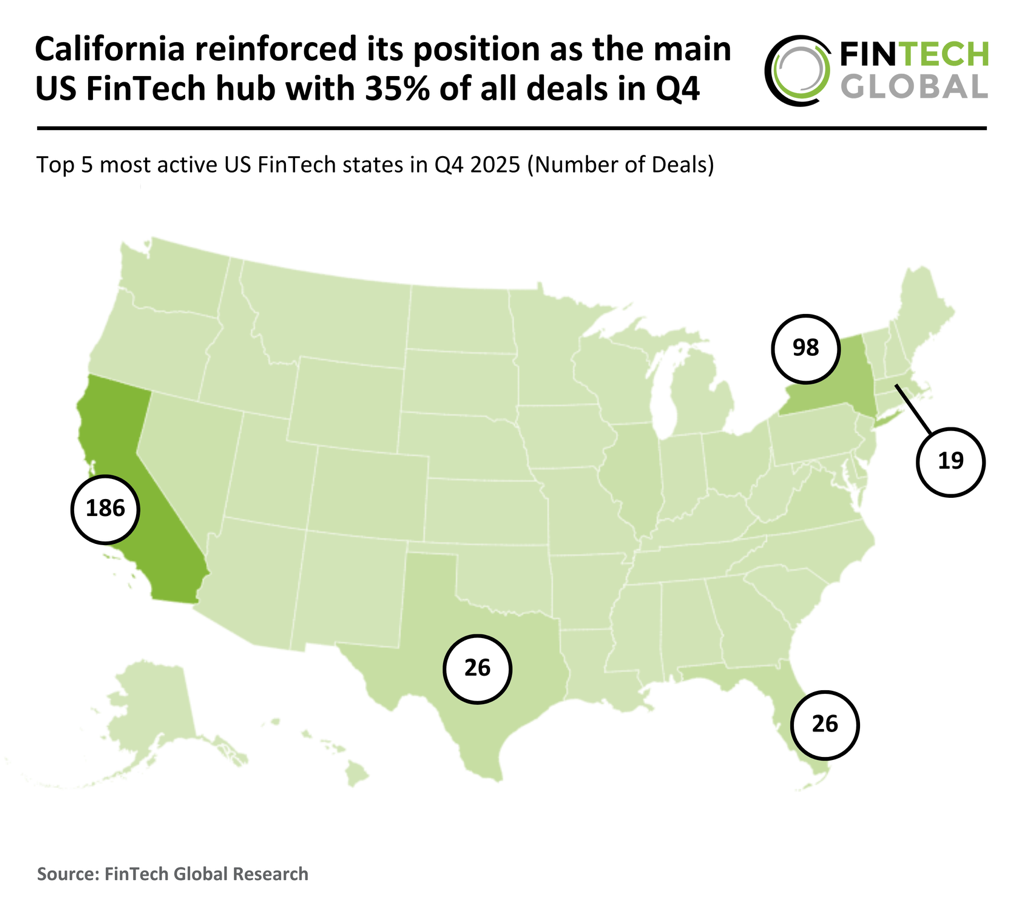
Recent research from FinTech Global found that California maintained its position as the US FinTech hub. The state was home to 186 FinTech deals in Q4 2025, accounting for 35% of deals in the country.
During Q4 2025, companies in the US secured a total of $16.1bn in funding, representing a 31% increase from the $12.3bn raised in Q4 2024. In contrast, deal activity saw more moderate growth over the same period, with 525 deals recorded in Q4 2025, marking a 25% increase from the 421 deals completed in Q4 2024.
There were three UK-based FinTech companies to raise funds this week. The largest of these was a £56m funding round secured by Vuelo, an FCA-regulated London-based travel PayTech. The company helps build a personalised payment plan for travel. The other two UK deals were closed by Theia Insights and Eunice.
No other countries recorded more than one deal this week. The final four deals of the week were raised by Singapore-based Tazapay, India-based Plum, Canada-based Chexy and Ireland-based Grand.
In terms of sectors, the PayTech sector proved to be the most popular. There were five PayTech companies that secured funds this week, with Cents being the largest with its $140m Series C round. The other PayTechs were Vuelo, Tazapay, Chexy and Grand.
Close behind were the WealthTech and data & analytics sectors with four deals apiece. The WealthTech companies were Kalshi, Eunice, M1X Global and CurrentClient, while the data & analytics companies were Spade, Worth, Theia Insights and Bedrock Data.
Elsewhere, there were three CyberTechs (BlueFlag, Eclypsium and Onit Security), three InsurTechs (Shepherd, Notch and Plum), and two infrastructure and enterprise software companies (Adonis and Trayd’s).
Here are the 21 FinTech deals to be covered by FinTech Global this week.
Kalshi reportedly hits $22bn valuation after $1bn raise
Kalshi, a WealthTech platform that offers a prediction market for investors to trade on outcomes in real-world events, has reportedly raised around $1bn, according to a report from WSJ.
The close of the investment round brings the company’s valuation to $22bn, which WSJ sites with sources familiar to the matter. The deal was led by Coatue Management.
Kalshi, founded in 2018, transformed prediction markets into a recognised asset class. Users can trade on real-world outcomes, such as sports games or elections.
The company closed its Series E funding round in December 2025, raising $1bn. The investment was led by Paradigm, with contributions also coming from Sequoia, Andreessen Horowitz, Meritech Capital, IVP, ARK Invest, Anthos Capital, CapitalG, and Y Combinator.
Following the close of the round, the company had been valued at $11bn.
Its plans for the funding was to support the adoption of its next 100 million customers, expand brokerage integrations, form partnerships and widen its product range.
Cents raises $140m in Series C led by Sumeru Equity
Cents, the fully integrated software, hardware, and payments technology platform built for the laundry industry, has closed a $140m Series C funding round — the largest single software investment ever made in the laundry vertical, it claimed.
The round was led by Sumeru Equity Partners, with additional participation from Series B lead Camber Creek. The raise is intended to accelerate Cents’ mission to bring modern technology to one of the most enduring and underserved small business sectors in the US.
Proceeds from the investment will be directed towards accelerating Cents’ AI-powered product suite, deepening investment in customer support and experience, expanding its product line for laundromats and dry cleaners, and strengthening partnerships with route operators and equipment distributors.
The funding will also support development of new payment hardware infrastructure — proprietary technology designed to improve affordability and accessibility of modernised payment experiences for end customers.
As part of the investment, Sumeru managing partner and co-founder Sanjeet Mitra will join Cents’ board of directors.
Vuelo raises £56m to launch AI-native travel booking platform
Vuelo, an FCA-regulated London-based travel FinTech, has raised £56m in seed funding to expand its AI-native travel booking and financing platform.
The round comprises £6m in equity funding led by Backed VC and Play Ventures, with £50m in debt financing provided by Viola Credit. The capital will be used to accelerate Vuelo’s development into a fully integrated platform capable of planning, booking, financing, and supporting customers throughout their travel journey — a first of its kind in the UK market.
Vuelo’s platform replaces the traditional search bar with a proprietary AI engine designed to understand travel context at an individual level. Every trip recommendation is presented with an embedded, personalised payment plan generated before the customer views any travel options, displaying costs in terms such as “Barcelona, 5 nights, £74 per month over 6 months.”
Where an initial offer is not suitable, the company’s Adaptive Offers Engine recalibrates repayment terms, deposits, or instalment structures to find a workable arrangement, allowing Vuelo to approve a higher share of applicants than conventional alternative payment providers. The company received FCA authorisation in 2025 and is already onboarding thousands of new travellers each month.
AI is also embedded across Vuelo’s back-end operations, handling customer support, managing refunds, and helping customers manage their finances, with the system growing more precise with each customer interaction.
Shepherd raises $42m to boost commercial insurance
Shepherd, an AI-native commercial insurance platform, has raised $42m in a Series B round led by Intact Private Capital, bringing total funding to $67m.
The company provides commercial insurance for large construction and infrastructure projects, including data centres, semiconductor facilities and energy assets supporting the expansion of artificial intelligence infrastructure.
Shepherd said revenue has grown more than sevenfold over the past 24 months. The platform now insures more than $400bn in project value across 1,500 policies for over 600 customers, including contractors, technology companies and energy developers building physical infrastructure for AI systems.
The funding round included participation from Spark Capital and Costanoa Ventures, alongside additional investors. Intact Private Capital, the investment arm of global insurer Intact, will also provide expanded underwriting capacity through the partnership.
Spade raises $40m Series B to power AI-driven finance
Spade has raised $40m in a Series B funding round to accelerate its mission of transforming how financial institutions use transaction data.
The round was led by Oak HC/FT, with participation from Andreessen Horowitz, Flourish, Gradient, NAventures, National Bank of Canada’s corporate venture arm, and Y Combinator.
Founded in 2021, Spade helps banks and FinTechs make sense of the vast volumes of messy transaction data they generate every day. Across card programmes, ACH, and wire transfers, financial institutions process billions of transactions, yet the underlying data is notoriously difficult to interpret without enrichment.
Raw transaction strings are often indecipherable, contributing to high dispute volumes, poor user experiences, and weak reward attribution. Spade addresses this by matching raw data to verified businesses held within its proprietary database, enabling clients to pinpoint exactly where and with whom a transaction took place.
The platform boasts 99.9% coverage of US and Canadian merchants with accuracy exceeding 99%, and its API infrastructure delivers a P99 latency of under 40 milliseconds, positioning it as one of the fastest solutions on the market.
The fresh capital will be used to deepen the platform’s capabilities, grow the team, and meet rising demand from financial institutions and FinTechs that rely on Spade’s transaction data to underpin their AI initiatives.
At the heart of the platform is a proprietary matching engine powered by advanced AI agents that continuously scan the web and external data sources to plug metadata gaps and remove duplicate records. This self-reinforcing system grows more intelligent with every transaction processed, delivering granular attributes such as precise geolocation and verified merchant categories independent of merchant category codes (MCC).
Looking ahead, Spade intends to broaden its offering beyond transaction enrichment towards a full payments intelligence platform, enabling clients to build, manage, and automate workflows that address business-critical challenges — from personalised rewards attribution and real-time customer notifications to behavioural user segmentation.
Adonis bags $40m to transform AI revenue cycle management
Adonis, an AI orchestration platform for RCM, has raised $40m in a Series C funding round led by Quadrille Capital, with continued backing from existing investors General Catalyst and Bling Capital.
The raise brings the New York City-based company’s total funding to over $95m since its founding in 2022. The round follows a strong 2025 for the business, in which it recorded more than fourfold revenue growth and net retention exceeding 130%, reflecting growing investor confidence in technology designed to address the structural pressures facing healthcare providers’ revenue operations.
Adonis offers a platform that combines AI intelligence and autonomous agent tools to help healthcare organisations manage the increasingly complex reimbursement landscape. Its technology proactively monitors revenue cycle activity, identifies issues, recommends tailored actions and autonomously moves claims towards resolution — allowing providers to better compete with payers, stabilise income and reduce administrative burdens on staff.
The funding comes at a pivotal moment for the US healthcare industry. Recent policy shifts, including the passage of the One Big Beautiful Bill, have altered Medicaid and ACA subsidies, pushing up the number of uninsured and self-pay patients whilst introducing additional complexity around reimbursement.
With denial rates climbing and payer policies in constant flux, revenue cycle teams face mounting pressure to navigate an environment where shifting rules and evolving patient coverage make securing payment harder than ever.
The company plans to use the fresh capital to accelerate product innovation across its Intelligence, AI Agents and Orchestration platform, deepen its footprint within the health system market, and continue expanding its workforce.
Tazapay closes $36m Series B to scale emerging market payments
Tazapay, a regulated cross-border payment infrastructure provider for emerging markets, has closed a Series B extension led by Circle Ventures, bringing its total Series B funding to $36m.
The extension sees new investors CMT Digital and Coinbase Ventures join the round alongside existing backers Peak XV Partners, GMO Venture Partners, and January Capital, with Ripple, Norinchukin Capital, ARC180, and RTP Global continuing their support as existing investors in the company.
The fundraise will be used to fund licensing expansion across multiple jurisdictions globally, accelerate go-to-market efforts across Asia, LATAM, the Middle East, and the Americas, and develop agentic payment infrastructure designed to support autonomous, AI-driven payment flows built on fully compliant, licensed rails.
Tazapay has demonstrated consistent growth, doubling revenues for three consecutive years and now serving over 1,000 enterprises and FinTechs across 30 countries. The company currently holds licences and registrations across Singapore, Canada, Australia, and the United States, with active applications underway in the UAE, EU, and Hong Kong.
Tazapay operates as a regulated last-mile infrastructure layer for businesses across APAC and emerging markets. Its modern payment rails and per-transaction funding model, powered through digital-native settlement technology, are designed to replace legacy banking infrastructure with faster, more capital-efficient alternatives, enabling real-time cross-border settlement at scale across 70 markets globally.
Worth bags $30m to redefine small business financial services
Worth, a FinTech platform modernising onboarding and underwriting for SMBs across financial institutions, has closed a $30m Series A funding round.
The round was led by Fulcrum Equity Partners, with participation from Amex Ventures and TTV Capital.
The company is tackling what it sees as a long-standing inefficiency in financial services: whilst consumers can be approved for credit in a matter of seconds, small business owners are often stuck in onboarding workflows that can take days or even weeks.
Worth’s platform uses patented crosswalking technology to enable high match rates across business identity in real time, allowing institutions to onboard customers in seconds. Its artificial intelligence (AI)-powered solution consolidates credit assessments, Know Your Business, Know Your Customer, banking and fraud detection into a single, seamless platform — enabling faster and more accurate credit decisions at scale.
The company says it is already seeing adoption among global financial institutions, with a growing enterprise client base spanning payment processors, financial institutions and FinTechs, all using Worth to reduce operational inefficiencies and accelerate access to capital for small businesses.
The Series A proceeds will be directed towards refining Worth’s existing technology, introducing Know Your Agent frameworks, and rolling out new product updates — most notably its Decision Intelligence tool. The agentic AI system combines verified identity data, network intelligence, risk signals, machine learning models and customisable decision workflows to generate real-time decisions across onboarding, underwriting and fraud prevention. All decisions made through the platform are auditable and traceable in line with compliance and regulatory requirements.
Notch raises $30m Series A for AI agents in insurance
Notch, an AI platform for regulated industries, has raised $30m in a Series A funding round, bringing its total funding to $45m.
The round was led by Headline, with participation from Lightspeed Venture Partners, Jibe Ventures, Illuminate Financial, and Phoenix Insurance. The investment reflects growing demand from regulated industries for AI automation that delivers business results without compromising accuracy or oversight.
The funding will be used to accelerate Notch’s expansion in the US and support continued development of its platform as the AI operating system for regulated industries.
Over the past 12 months, the company has grown its annual recurring revenue (ARR) by 12x, with adoption across leading global insurers, financial services firms, and other organisations operating complex operational workflows.
Notch deploys AI agents that automate and execute operational workflows end-to-end, spanning both conversational and back-office processes. On the conversational side, the platform supports broker, partner, and policyholder interactions — including policy servicing requests, document and data collection, structured intake for claims and underwriting submissions, and system-level inquiry execution.
It also functions as a co-pilot for operations teams, enabling adjusters, underwriters, and service representatives to query claim files, policy documents, and submission materials in natural language, receiving structured, traceable answers grounded in source data.
For back-office operations, the platform automates high-volume workflows by ingesting documents and communications, extracting structured data, classifying and routing submissions or claims, and prioritising time-sensitive requests for the appropriate teams.
AI security firm BlueFlag bags $28m Series A funding
BlueFlag Security, an identity-centric software development lifecycle (SDLC) security platform, has announced a significant milestone, revealing it has raised $28m to date alongside posting 300% year-on-year revenue growth in 2025.
The company’s Series A financing round was led by Maverick Ventures and Ten Eleven Ventures, with the funds earmarked for accelerating platform development and broadening its footprint across the US and EMEA, particularly within regulated industries and technology organisations embracing AI-driven software development at scale.
Founded in 2024, BlueFlag Security targets a critical blind spot in modern software development: the risk posed not by vulnerable code, but by the compromised, manipulated, or malicious identities that have legitimate access to development environments. The company’s own analysis found that more than 75% of SDLC risk remains invisible to existing application security tooling.
This challenge is underscored by broader industry data — the 2025 Verizon Data Breach Investigations Report found that 68% of breaches involve compromised credentials, while software supply chain failures entered the OWASP Top 10 2025 at number three, with half of all security experts citing supply chain risk as their primary concern.
The fresh capital will be used to drive continued platform development and support expansion into new markets, as BlueFlag looks to capitalise on growing enterprise demand. The company reported a fivefold increase in Fortune 500 enterprise customers over the past year, and has recently formed strategic partnerships with Obsidian Systems, catworkx, and knowmad mood.
Eclypsium raises $25m to expand AI infrastructure security
Eclypsium, a cybersecurity company specialising in hardware and AI infrastructure protection, has raised an additional $25m in strategic financing.
The round was led by PEAK6 Strategic Capital, with participation from a top-three US bank. Previous backers include Ten Eleven Ventures, Andreessen Horowitz, Pavilion Capital (Seviora Group), Qualcomm Ventures, and Madrona Ventures.
The company focuses on securing foundational hardware infrastructure across enterprises and government agencies, covering everything from GPU core compute systems to intelligent edge devices. Its platform addresses supply chain security for IT infrastructure, helping organisations build cyber resilience against sophisticated threat actors, including nation-states.
Eclypsium intends to use the new capital to expand its platform to cover a broader range of critical hardware and devices. This includes continued coverage of NVIDIA-based GPU servers in AI data centres, as well as network edge appliances and intelligent edge devices used by enterprises and public agencies.
The funding comes as organisations rapidly accelerate their transition to AI applications, making trust in underlying hardware infrastructure an increasingly pressing concern. Eclypsium has established a growing presence in financial services, insurance, government, AI data centres, energy, and public safety sectors.
Plum raises Series B to scale claims experience in India
Plum, an Indian employee health and corporate insurance platform, has raised a Series B round of ₹193 crore ($20.6m) to scale its claims experience to millions of employees across India.
The funding will be used to accelerate the company’s reach to 10 million people, deepening integrations, expanding security capabilities, and advancing its full health journey product — spanning prevention through primary to critical care.
Central to Plum’s growth story is its claims experience, which the company says is the best in the world, underpinned by an industry-leading net promoter score (NPS) of 79.
The company has built its claims proposition around four principles: speed, seamlessness, value, and ease. Plum describes itself as a comprehensive employee health company, offering corporate and personal insurance, primary care, mental wellness, telehealth, and flexible benefits.
Looking ahead, Plum says it intends to function as an HR co-pilot rather than a helpdesk — a system that manages operational complexity in the background and surfaces decisions only when genuinely required. The company is targeting enterprise-grade capability for companies of all sizes, with a lean HR team at a 500-person company able to operate with the same ease as a large, well-resourced enterprise.
Chexy raises $14m Series A led by Khosla Ventures
Chexy, a Canadian payments platform that allows tenants to earn credit card rewards on everyday expenses, has raised $14m CAD in a Series A funding round.
The round was led by Silicon Valley venture firm Khosla Ventures, according to a report from BetaKit. Returning investors Crossbeam, Venrex, and Air Canada — which previously partnered with Chexy for its Aeroplan programme — also participated.
Chexy said the fresh capital will be used to scale its payments platform across Canada, broaden its partnership ecosystem, and grow its team.
The company is also looking to expand beyond rent into additional everyday expenses, including business payments, with ambitions to “become a financial hub for households.”
Chexy enables Canadians to pay rent, bills, and taxes using their credit card, even in cases where card payments would not ordinarily be accepted. The platform aims to turn routine payments into financial opportunities, helping users unlock rewards, build credit, and elevate their lifestyle.
Onit Security lands $11m to automate vulnerability remediation
Onit Security, an agentic exposure management company, has raised $11m in seed funding as it looks to overhaul how organisations detect and respond to cybersecurity vulnerabilities.
The round was led by Hetz Ventures and Brightmind Partners, with additional participation from a number of prominent angel investors.
The company’s platform is designed to close the gap between identifying a security exposure and actually resolving it — a problem that has plagued enterprise security teams for decades.
Unlike most existing tools, which stop at generating tickets, Onit’s AI agents prioritise vulnerabilities based on real business context rather than generic severity scores. The platform also automatically determines asset ownership by drawing on institutional knowledge spread across fragmented data sources, and executes remediation without relying on manual hand-offs between teams.
Critically, once a resolution strategy is defined, Onit applies it automatically to all similar future exposures, meaning remediation compounds over time and operates at machine speed.
The $11m raise will be used to accelerate product development and expand the company’s go-to-market efforts as it moves into additional sectors.
Trayd’s $10m raise targets construction payroll chaos
Trayd, a construction payroll and workforce management platform for specialty trade contractors, has raised $10m in a Series A funding round.
The round was led by White Star Capital, with follow-on investments from Suffolk Technologies and Y Combinator, and a new strategic contribution from RXR, the New York-based real estate and technology investment firm.
Founded in 2021, Trayd offers an all-in-one back-office operating system designed specifically for specialty trade contractors. The platform combines payroll, HR, scheduling, and field tracking tools, handling wage calculations by trade type, multi-state tax obligations, compliance reporting, union rules, and project scope distinctions between state, federal, and private work.
Since launching, Trayd says it has cut average weekly payroll processing time from 14 hours to just 27 minutes — a reduction the company frames as returning nearly two full working days to back-office staff each week.
The fresh capital will be used to accelerate product development and support Trayd’s national expansion.
Theia Insights raises $8m to remap financial markets
Theia Insights, a Cambridge-based deeptech company building a dynamic classification system for global financial markets, has raised $8m in Series A funding, bringing its total raised to $14.5m.
The round was led by MiddleGame Ventures, an early-stage FinTech fund, with participation from Further Ventures and Unusual Ventures. The fresh capital will be used to drive expansion into new asset classes — beginning with private markets — as well as to deepen research and engineering capabilities and scale the company’s global commercial presence.
The funding addresses a structural gap Theia was built to solve: the absence of a real-time, accurate map of the global economy. Most financial institutions currently rely on static classification systems that assign each company a single industry label, which can remain unchanged even as the business fundamentally evolves.
Theia’s proprietary technology instead reads a wide range of company information — including regulatory filings, earnings transcripts, press releases and financials — and produces a continuously-updated, multidimensional breakdown of what a company actually does. Rather than a single label, a company might show varying percentage exposures across semiconductors, AI, data centres, cloud computing and autonomous vehicles, with those weightings updating automatically as new information emerges.
The company’s core products include its Dynamic Industry Classification system, the Concept2Universe tool for translating investment ideas into evidence-backed company universes, Thematic Factor Models, and Theme Watch Indices. These are already in use at a leading global index provider, a major bank, large asset managers and multi-billion-dollar hedge funds, powering research, portfolio construction, analytics and trading workflows.
Eunice raises $8m to transform alternative asset due diligence
Grand raises $5m pre-seed to build AI trade trust network
Grand, an AI-powered FinTech building a payment network for the construction, manufacturing and trade supply industries, has raised $5m in pre-seed funding led by 20VC, with participation from NAP and firedrop.
The round will support the development of Grand’s core proposition: replacing static credit reports with a continuous, real-time view of how businesses actually behave. The company’s first product, Grand Profile, surfaces early signals of risk and growth to help businesses understand who they are trading with and act sooner on that intelligence.
Grand points to the scale of the problem it is targeting: B2B trade across construction, trade and supply chain industries exceeds $15 trillion globally, yet the credit decisions underpinning those transactions still rely on data that is months or years out of date. In the UK alone, over 25,000 company insolvencies were recorded in 2023 — the highest figure in three decades — with unsecured creditors typically recovering nothing, it said.
The company is building what it describes as an AI-powered trust network that monitors risk, growth and stability across trade partners in real time, flagging early signals of both rising risk and improving reliability as they occur. Over time, Grand intends the platform to evolve into a full payment network where businesses can extend credit, move money and transact with confidence across the trade supply chain.
M1X Global raises $3m to scale on-chain sovereign finance
M1X Global, a sovereign financial infrastructure and technology company operating under a public-private partnership with the Republic of the Marshall Islands (RMI), has announced its public launch and the close of an oversubscribed $3m angel round.
The funding, which spans strategic investments and grants, will support platform development and accelerate institutional adoption of USDM1 — the first fully collateralised sovereign debt instrument issued natively on blockchain infrastructure.
Proceeds will also fund pilot programmes with derivatives and capital markets participants, as well as continued development of M1X Global’s platform for sovereign issuers operating in on-chain markets.
The round drew participation from prominent figures across global capital markets and digital asset infrastructure, including Balaji Srinivasan, former CTO of Coinbase; Tama Churchouse, CEO of Cumberland Labs; Richard Gorelick, former head of market structure at DRW; and Dan Robichaud, former CIO at Intel. Institutional participation came from FJ Labs, alongside grant funding from the Stellar Development Foundation, reflecting alignment between private capital and mission-driven partners advancing blockchain-based financial infrastructure.
CurrentClient bags $1.25m seed round for advisor comms
CurrentClient, a communications platform built specifically for financial advisors, has raised $1.25m in a seed funding round.
CurrentClient offers a compliant, integrated phone and messaging system designed for registered investment advisors (RIAs) and financial planners. The platform is positioned as a direct response to a growing regulatory problem: since 2021, regulators have levied fines exceeding $2.7bn against dozens of firms for breaching federal securities laws through the use of off-channel communications.
CurrentClient aims to address this by giving advisors a purpose-built tool that keeps client interactions compliant, streamlined, and in line with modern expectations.
The fresh capital will be used to accelerate the company’s growth as it looks to expand its reach among financial advisors seeking to reduce compliance risk and modernise the client experience.
Alongside the funding announcement, CurrentClient has appointed Austin Guest as head of sales. Guest previously served as head of sales at FINNY, where he built experience scaling go-to-market teams in FinTech and advisor-focused SaaS businesses, with a record of driving adoption across RIAs, broker-dealers, and enterprise wealth platforms.
Bedrock Data secures Snowflake Ventures investment
Bedrock Data, a platform provider for data-centric security, governance and management, has secured a strategic investment from Snowflake Ventures, alongside a deeper technical integration with Snowflake’s AI Data Cloud and a go-to-market partnership.
The investment will see Bedrock Data’s AI-powered data classification and governance capabilities delivered within Snowflake Horizon, giving Snowflake customers a unified view of their data estate.
As part of the announcement, Bedrock Data also unveiled a new ArgusAI integration with Snowflake Cortex AI, designed to provide enterprises with deeper visibility into AI agents and the data they access, enabling them to govern generative AI with reduced exposure and greater confidence.
The partnership brings Bedrock Data’s patented Metadata Lake — a continuously updated graph knowledge base that maps every dimension of enterprise data, including sensitivity, lineage, entitlements, access patterns and business context — to Snowflake Horizon. The Metadata Lake functions as a single source of truth for data sensitivity and risk context across an organisation’s entire data landscape, supporting Snowflake adoption across all workflows, including AI and agent-driven applications, without the need for manual tagging.
Bedrock Data’s platform delivers continuous, petabyte-scale visibility and security for Snowflake environments, autonomously discovering and classifying sensitive data — including personally identifiable information (PII), protected health information (PHI), intellectual property and other high-value assets — across structured, semi-structured and unstructured datasets.
Copyright © 2026 FinTech Global