
Global FinTech funding continued its strong surge over the past two weeks, with approximately $2.17bn raised across 23 deals, as cybersecurity firms saw a swathe of investment.
Across subsectors, RegTech firms accounted for over a third of the total transactions recorded during the past two weeks, with eight. The companies focused primarily on cybersecurity, identity governance, fraud detection and compliance infrastructure, reflecting sustained investor interest in platforms designed to address growing regulatory complexity and digital security risks.
Infrastructure and enterprise software providers followed with six deals, while four FinTech platforms focused on capital markets, treasury and digital asset services also secured funding. Elsewhere, LendTech platforms accounted for three deals, while the InsurTech sector recorded three transactions, led by Malaysia-based embedded insurance platform PolicyStreet, which raised $21m to expand its operations across Asia.
Over the past two weeks, one transaction accounted for roughly half of the capital raised during the period. German insurer Talanx secured €1bn ($1.09bn) through a dual bond issuance designed to refinance existing debt and strengthen the group’s capital structure, highlighting continued institutional demand for financial sector debt.
Excluding the Talanx issuance, FinTech startups raised just over $1bn in venture and growth funding, indicating steady deal flow across lending platforms, infrastructure providers and RegTech firms.
The largest venture round was secured by India-based lending platform KreditBee, which raised $280m in Series E funding at a $1.5bn valuation as it prepares for a potential initial public offering. The company plans to use the capital primarily to strengthen its lending book and balance sheet.
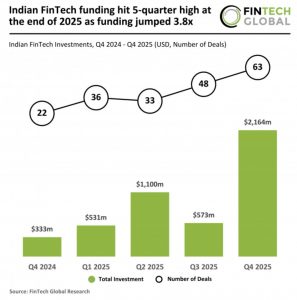
The super tranche also reflects the broader trend regarding momentum in India’s FinTech ecosystem. According to research from FinTech Global, Indian FinTech funding reached a five-quarter high at the end of 2025, with total capital raised jumping 3.8x compared with the previous quarter.
Another major round came from debt market intelligence platform 9fin, which raised $170m in Series C funding to expand its artificial intelligence capabilities and accelerate growth in the United States. Meanwhile, US consumer lender Braviant Holdings secured $145m in new credit facilities to fund loan originations across its bank partnership model.
Artificial intelligence-driven cybersecurity platforms also attracted significant investment. Applied AI security lab DepthFirst raised $80m in Series B funding, while internet intelligence platform Censys secured $70m to expand its threat intelligence capabilities.
Geographically, the United States remained the most active FinTech funding hub, accounting for 11 of the 26 deals recorded over the two-week period. The United Kingdom followed with six deals, reinforcing its position as the leading European FinTech hub.
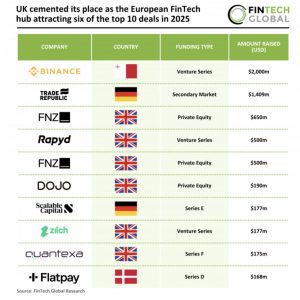
Recent research from FinTech Global highlights the UK’s growing dominance within the region. UK companies secured six of the top 10 FinTech deals globally in 2025, up from five in 2024, further cementing the country’s leadership within Europe.
Beyond North America and Europe, three Asian nations recorded deals during the period — India, Malaysia and Singapore — highlighting the continued growth of the region’s FinTech ecosystem.
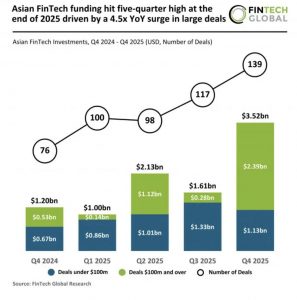
This trend aligns with broader market dynamics identified by FinTech Global. In Q4 2025, Asian FinTech funding reached a five-quarter high, with 176 deals completed and $3.5bn raised, representing a 2.9x increase year-on-year in funding levels.
Taken together, the latest funding activity underscores a broader shift in the FinTech landscape. Capital is increasingly flowing toward AI-driven security, compliance and financial infrastructure platforms, as financial institutions and enterprises invest heavily in technologies designed to modernise operations and manage the rising complexity of digital financial systems.
Here’s a fortnightly roundup of the latest FinTech funding rounds:
Talanx raises €1bn through dual bond issuance
Talanx AG has raised €1bn through a dual bond issuance aimed at strengthening its capital structure and supporting long term financial flexibility.
The financing consists of a €500m senior unsecured bond placed with a wide group of institutional investors in Germany and international markets, according to InsurTech Insights.
At the same time, the group’s majority shareholder, HDI V.a.G., subscribed to a further €500m tranche through a private placement under the same terms.
Both euro-denominated bonds carry a fixed coupon of 3.75 percent and will mature on 9 April 2033. According to the company, the proceeds will mainly be used to refinance existing debt that is due in July 2026, helping to optimise the group’s balance sheet and strengthen its liquidity position.
The issuance received a strong AA- rating from S&P Global Ratings and will be listed on the Luxembourg Stock Exchange, reflecting investor confidence in the insurer’s financial position and long term strategy.
The transaction was supported by a group of major financial institutions acting as joint bookrunners. These included Barclays, Deutsche Bank, ING, Natixis, and BNP Paribas.
The move highlights Talanx’s ongoing approach to proactive capital management as the group continues to strengthen its financial resilience while investing in growth and innovation across its global insurance operations.
KreditBee raises $280m Series E at $1.5bn valuation
KreditBee, an India-based online credit solutions provider, has reportedly raised $280m in a Series E funding round, achieving unicorn status at a $1.5bn valuation as it prepares for an initial public offering (IPO).
The round was co-led by Hornbill Capital and Motilal Oswal, with additional participation from Advent International, Premji Invest, MUFG, and other institutional investors, according to a report from FinTech Futures.
According to co-founder and CEO Madhusudan Ekambaram, the capital will primarily be deployed to strengthen the company’s lending book and balance sheet ahead of its IPO, rather than towards product development.
KreditBee is currently in the process of merging its technology and non-banking financial company (NBFC) entities, with the combined entity expected to serve as the vehicle for the listing.
KreditBee is a leading online credit solutions provider in India, serving a user base of over 180 million individuals, predominantly young professionals including both salaried and self-employed workers.
9fin raises $170m Series C at $1.3bn valuation
9fin, an AI-native platform for global debt markets founded by former J.P. Morgan banker Steven Hunter and Deutsche Bank engineer Hussam EL-Sheikh, has raised $170m in Series C funding at a $1.3bn valuation.
The round was led by HarbourVest, with participation from Canada Pension Plan Investment Board (CPP Investments) and existing investors Redalpine, Highland Europe, Spark Capital, and Seedcamp. Total funding raised by the company now exceeds $250m.
The fresh capital will be used to accelerate development of 9fin’s AI capabilities, expand its proprietary dataset, and support continued growth in the United States. Notably, CPP Investments was already a client of the platform before joining the round as an investor.
9fin centralises information spread across data rooms, emails, and PDFs, using it to power next-generation AI technology that enables credit professionals to identify, analyse, and act on opportunities within a single platform.
The company serves more than 300 banks, asset managers, law firms, and advisory firms, helping them source deals, analyse risk, and monitor global debt markets. 9fin has delivered multiple consecutive years of 100% ARR growth and industry-leading retention, with particularly strong expansion in the United States.
Braviant Holdings closes $145m credit facilities
Braviant Holdings, a Chicago-based technology-driven consumer lending platform has secured approximately $145m in committed capacity across two new revolving asset-backed credit facilities, alongside the renewal of an existing forward flow arrangement.
The two facilities are backed by the company’s consumer loan receivables and will be used to fund new loan participations on a rolling basis. Each carries a two-year revolving period, with the option to extend, before moving into an amortisation phase lasting between 12 and 18 months.
Braviant said the facilities were obtained at competitive capital costs and advance rates, with standard eligibility and concentration requirements, portfolio performance triggers and financial covenants in place.
Alongside the new revolving arrangements, the company has also renewed a forward flow facility, which allows defaulted assets to be liquidated at a fixed price. That facility is structured to support the optional wind-down of more than $90m in annualised defaulted balances.
Braviant Holdings operates as a technology-driven consumer lender, using a proprietary underwriting platform and bank partnership model to extend credit to non-prime borrowers across 28 US states.
PremFina expands Waterfall funding deal to £100m

PremFina, which claims to be the UK’s fastest-growing insurance premium finance provider, has announced the expansion of its funding partnership with Waterfall Asset Management to £100m, upsizing and extending its junior capital facility to support continued growth.
The amended facility increases PremFina’s balance sheet capacity and provides long-term runway for the company’s growth strategy.
The business has more than doubled its loan book over the past year, with its performance attributed to a proprietary technology platform, disciplined credit processes, and deep broker relationships that have delivered strong conversion rates and resilient portfolio metrics across market cycles, it said.
AI security lab depthfirst raises $80m Series B round
DepthFirst, an applied AI lab focused on securing software infrastructure, has raised $80m in a Series B funding round.
The round was led by Meritech Capital, with participation from Forerunner Ventures and The House Fund, alongside existing backers including Accel, Box Group, Liquid 2 Ventures, Alt Capital, and Mantis VC.
The latest raise comes fewer than 90 days after the company emerged from stealth mode with a $40m Series A, bringing its total capital raised to $120m.
The speed of the follow-on round reflects growing investor appetite for AI-native approaches to cybersecurity, a sector that has long been dominated by legacy platforms.
DepthFirst was founded on the premise that success in high-stakes AI domains requires two things: products that address genuine customer problems, and specialised models fine-tuned to the most critical tasks within each domain.
Its platform is designed to reason across entire software systems, identify real risk, and deliver precise fixes directly within developer workflows — enabling organisations to secure software at the pace it is produced.
Alongside the funding announcement, the company unveiled its first in-house security model, dfs-mini1. Initially focused on securing cryptocurrency smart contracts, the model was built on an open-source foundation and post-trained through reinforcement learning in security-specific environments.
Apax Digital invests $60m in MillTech at $325m valuation
MillTech, a risk management platform specialising in next-generation FX hedging and cash investments for fund managers and corporates, has secured a $60m minority investment from the Apax Digital Funds, the growth equity arm of Apax Partners LLP, valuing the company at $325m.
The deal sees MillTech’s ultimate group holding company retain its majority shareholding.
Apax is also an existing MillTech client, deploying the platform across a number of its funds to support investment operations. Sir Ronald Cohen, co-founder of Apax, was an early backer of MillTech.
The capital will be used to accelerate MillTech’s North American expansion and further develop its treasury management capabilities. The firm has reported approximately $500bn in annual trading volume, supporting client hedging programmes totalling over $35bn. Revenue growth reached 79% in 2024, followed by 73% in 2025.
Founded in 2019 and rooted in over three decades of currency management expertise inherited from Millennium Global Investments, MillTech has built a unified platform that brings together the full lifecycle of FX operations — from trade calculation and execution through to settlement, reporting and transaction cost analysis.
The company connects clients directly to the wholesale multi-bank market through its agency ISDA network, a model it says typically cuts costs by more than half when compared to custody, prime brokerage or single-bank alternatives. Crucially, MillTech sits outside the counterparty banking structure, while still integrating with the systems clients already use, spanning bank accounts, fund administrators and portfolio and treasury management platforms.
Censys bags $70m to expand internet intelligence platform
Censys, the internet intelligence and insights platform, has raised $70m in a combined funding round to accelerate the development of its AI-driven security solutions.
The raise comprises a $40m Series D led by Morgan Stanley Expansion Capital, alongside $30m in debt financing. The round also saw participation from Decibel Partners, Greylock Partners, GV, Intel Capital, and a number of other undisclosed investors.
The company provides internet intelligence capabilities, helping enterprises, governments, and critical infrastructure providers track and respond to threats across their internet exposure. Its platform is used by more than 300,000 security practitioners worldwide, including organisations representing over 50% of the Fortune 500, and is positioned as a foundational source of first-party internet intelligence for security and threat intelligence teams globally.
Censys intends to use the fresh capital to accelerate the development of AI-driven solutions for modern security operations, building on its recently launched internet intelligence platform, as well as to drive faster innovation and pursue global expansion.
The funding arrives at a moment when internet infrastructure has become the primary attack vector targeting organisations, with remediation windows tightening as adversaries increasingly harness AI. Governments and businesses alike are seeking real-time intelligence to proactively block threats, manage supply chain risk, and protect critical infrastructure.
Linx Security raises $50m Series B to tackle identity risk
Linx Security, an identity security and governance platform, has raised $50m in a Series B funding round led by global software investor Insight Partners, with continued participation from existing backers Cyberstarts and Index Ventures.
The round brings the company’s total funding to $83m, and comes as identity-related failures are emerging as one of enterprise security’s most pressing challenges. The 100-person startup has already secured multimillion-dollar contracts with banks, healthcare companies, and Fortune 500 firms, with its platform governing millions of identities across those organisations.
Founded in 2023 by cybersecurity veterans Israel Duanis and Niv Goldenberg, Linx Security offers an AI-native platform that continuously maps, monitors, and governs all identities across an enterprise — spanning employees, machines, services, and AI agents.
The company says the number of non-human identities now outpaces human ones by roughly 80 to 1, driven by enterprise adoption of cloud infrastructure, automation, and artificial intelligence. Traditional identity governance tools, built for smaller and more static environments, have struggled to adapt, leaving security teams with limited visibility and growing exposure at a time when close to 90% of security incidents involve identity-related failures.
Lucky secures $23m to scale credit and neo-banking push
Lucky, an Egyptian consumer credit and financial technology platform, has closed a $23m Series B funding round, combining equity and debt, as it prepares to expand into North Africa and advance its neo-banking ambitions, according to a report from Wamda.
The round was led by existing and new investors, including Disruptech Ventures and DPI Venture Capital via its Nclude fund, alongside new strategic participation from Suez Canal Bank and OneStop, chaired by tech investor Mohamed Farouk. As part of the deal, Farouk has also been appointed chairman of Lucky’s board.
The capital will be directed towards scaling Lucky’s credit offering, expanding into select North African markets, and strengthening its infrastructure, licensing, and regulatory readiness as it moves towards becoming a neo-banking-ready platform.
The company has already started work towards obtaining a payment service provider (PSP) licence, it said.
Lucky offers a mobile app to manage finances, such as real-time account balance and transaction history, pay bills, transfer money, and top up the account.
Variance bags $21.5m to power AI compliance agents
Variance, which builds agentic AI tools for risk and compliance workflows, has raised $21.5m in a Series A funding round to expand its platform for financial institutions and Fortune 500 companies.
The round was led by Ten Eleven Ventures, with additional backing from 645 Ventures, Y Combinator, Urban Innovation Fund, and Okta Ventures.
Variance’s platform is designed to address a growing challenge facing compliance and fraud teams: fraudsters are increasingly deploying generative AI to manufacture synthetic identities, while the evidence required to conduct thorough investigations remains fragmented across disparate systems.
The company’s AI agents tackle both problems at once, reasoning over complex and disjointed data before returning fully auditable decisions within minutes. Its tools cover mission-critical workflows including KYC, KYB, AML, transaction monitoring, and fraud detection — investigations that would typically demand teams of analysts and several days to complete.
The fresh capital will be directed towards deepening investment in the infrastructure underpinning its investigative AI agents, as well as broadening the company’s partnerships with financial institutions.
PolicyStreet lands $21m to expand Asian InsurTech platform
PolicyStreet has secured $21m in the first close of its Series C round as the Malaysian InsurTech scales its embedded insurance platform across Asia.
The funding round was led by Cool Japan Fund and included participation from existing investors Altara Ventures and Gobi Partners, alongside additional investors, according to FinTech News Malaysia.
The deal brings PolicyStreet’s total backing to more than $100m and adds a second sovereign wealth fund to its investor base.
Malaysia’s sovereign wealth fund Khazanah had previously backed the company in a RM67m ($15.3m) Series B round in 2023.
PolicyStreet plans to use the new capital to accelerate regional expansion, invest further in its technology platform and deepen partnerships across sectors including mobility, travel, logistics, telecommunications and gig economy platforms.
The InsurTech said it recently reported more than $1m in profit for FY2025, positioning the company among a small group of profitable InsurTech firms operating at scale in the region.
AccuQuant raises $20m to boost AI financial infrastructure
AccuQuant, a FinTech platform focused on artificial intelligence and data-driven technologies, has secured $20m in a new funding round led by investors from the digital asset and FinTech sectors.
The round will be used to advance the company’s development across artificial intelligence technology, system architecture and automated infrastructure, with a focus on strengthening data analysis capabilities, execution efficiency and overall system stability.
More specifically, the funds are earmarked for improving AI and data analysis capabilities, optimising system architecture scalability, strengthening automated execution and risk control mechanisms, and enhancing product experience and feature design.
AccuQuant said it will continue to increase investment in technology and products to adapt to changing market demands and support the application of related technologies across a wider range of scenarios.
AccuQuant is a FinTech platform dedicated to building automated and systematic decision-making infrastructure using artificial intelligence and data-driven technologies. The company develops a scalable technology system by integrating machine learning and multi-dimensional data analytics capabilities to support evolving digital financial applications.
Trent AI bags $13m to secure AI agents and workflows
Trent AI, an agentic security company focused on protecting AI-driven systems and autonomous workflows, has emerged from stealth with the announcement of a $13m seed funding round.
The round was led by LocalGlobe and Cambridge Innovation Capital, with additional participation from prominent angel investors including OpenAI member of technical staff Joaquin Quiñonero Candela, Databricks distinguished engineer Ippokratis Pandis, former head of Stripe data infrastructure and current director at AWS Avinash Bhat, and former Spotify VP engineering and head of AI/ML Tony Jebara, among others.
The company has built what it describes as the first multi-agent security solution designed to protect AI agents throughout their entire lifecycle. Its layered, unified platform is built for developers and security teams that want to ship agents quickly without compromising on security.
The offering operates through four distinct agent types: scanning agents that continuously monitor code, infrastructure and runtime behaviour; analysis agents that assess business impact and distinguish genuine risk from noise; remediation agents that patch vulnerabilities and validate fixes; and security posture agents that benchmark performance against standards and track risk trends over time. The system is designed to become more accurate with each cycle, tightening its feedback loop and improving the quality of its mitigations over time.
Qover secures $12m growth facility from CIBC
Embedded insurance platform Qover has secured a $12m growth capital facility from CIBC Innovation Banking, bringing its total funding since launch to more than $100m.
The financing comes as the Brussels-based insurtech marks its 10th anniversary and continues expanding its embedded insurance infrastructure across Europe and international markets.
Founded in 2016 by Quentin Colmant and Jean-Charles Velge, Qover provides orchestration technology that enables companies to embed insurance directly into their digital products and services. The platform currently supports programmes for partners including Revolut, Mastercard, BMW, Monzo, bunq, Canyon and Trust Travel, a brand of TUI, across more than 32 countries.
Qover said its platform now protects around 15 million users and expects that number to reach 55 million by the end of 2026, driven by new partner programmes currently being implemented.
The company has also recorded threefold revenue growth over the past four years and generated more than $173m in gross written premiums through its embedded insurance programmes.
Cyberhill Partners lands $11m to bring AI to enterprises
Cyberhill Partners, a professional services firm specialising in enterprise artificial intelligence solutions for Fortune 500 organisations and US government agencies, has secured a strategic investment of up to $11m from Baleon Capital.
The funding will be used to accelerate growth across several areas of the business. The company plans to expand its go-to-market organisation, grow its engineering and delivery teams, and speed up solution development as it looks to bring its offering to a broader range of clients.
At the heart of Cyberhill’s proposition is what it calls its AI Factory — a platform designed to deploy enterprise-grade AI solutions within weeks and at a significantly lower cost than traditional implementation approaches.
The company argues that most organisations currently find themselves caught between consumer-facing AI tools that fall short of enterprise requirements and large-scale platform deployments that can take years and cost millions to complete.
According to figures from Gartner, enterprise AI spending is projected to surpass $3 trillion by 2027, yet research from MIT suggests that 95% of AI projects still fail to reach production — a gap that Cyberhill says its model is built to close.
The firm’s approach draws heavily on its experience deploying AI within some of the US government’s most secure and operationally complex environments. That background has shaped a product designed with enterprise-grade security, data governance and traceability built in from the outset, alongside advanced capabilities including automated ontologies and knowledge graphs.
Huskeys raises $8m seed to modernise legacy web security
Huskeys, an Edge Security Management (ESM) startup and developer, has come out of stealth mode after securing $8m in seed funding to address what it describes as a decades-long failure in web application security.
The seed round attracted a wide range of investors spanning venture capital, cybersecurity and sport. VC participants include 10D, SV Angel, toDay Ventures (part of Merlin Ventures), CCL, and Alumni Ventures, while cybersecurity angels Ariel Maislos, Michael Dolinsky, Benny Schnaider, Ofer Ben-Noon, Maty Siman, and Slavik Markovich also took part.
More than 30 CISOs from major global organisations joined the round alongside athlete angel investors, including footballer Mario Götze, NFL player Kelvin Beachum, and 2026 NFL Hall of Famer Larry Fitzgerald, The Players Fund, a Juventus Football Club venture partner, and Como 1907 stakeholders.
Alongside the fundraise, Huskeys has officially launched its ESM platform, which uses patent-pending technology to place an agentic layer across the entire edge security stack. The solution does not replace existing infrastructure but instead sits on top of it, offering plug-and-play deployment across multi-cloud and multi-WAF environments. Acting as an intelligence control plane, it unifies CDN, WAF, infrastructure, and application flows, with its AI engine abstracting provider-specific syntax, enriching it with organisational context, and continuously orchestrating rules, policies, and configurations based on traffic behaviour, business logic, and risk assessment.
The platform has already been adopted by a number of high-profile global organisations, including TikTok, Merlin Entertainments, and Hugging Face.
Cara raises $8m seed to build AI platform for brokers
AI platform Cara has raised $8m in seed funding to help insurance brokerages automate sales and servicing workflows.
The round was led by Kearny Jackson, with participation from Claire Hughes Johnson, former Chief Operating Officer of Stripe; Kevin Mahaffey, founder of SNR; Sam Hodges, CEO of Vouch Insurance; and Colin Evans from OpenAI’s startups and partnerships team.
Cara provides brokerages, agencies and wholesalers with AI infrastructure designed to automate operational processes and allow teams to focus on sales and client relationships. The platform integrates directly with agency management systems and customer relationship management tools.
The company said its technology can automate tasks such as coverage comparisons, proposal generation, certificates of insurance (COI), ACORD and supplemental form completion, errors and omissions reviews and customer service requests via voice and email AI.
According to Cara, processes that traditionally take around 90 minutes manually can be completed in roughly two minutes using its AI-driven workflows.
The company was founded by Vic Yeh, Nikhil Kansal and Jonathan Patel, former operators from Blend Labs, Stripe and Strategy&, who previously built and sold a digital insurance brokerage before turning their internal technology into a commercial platform.
LatentView Analytics makes $3m investment in Healtheon AI
LatentView Analytics, a global AI-driven analytics, data engineering, and consulting firm, has completed a $3m investment in Healtheon AI, an agentic AI platform focused on healthcare Revenue Cycle Management (RCM).
The deal was structured as a single tranche investment via a SAFE note. As part of the agreement, LatentView will become a preferred deployment partner for Healtheon AI with its customer base.
Healtheon AI’s platform deploys specialised, role-based AI agents that operate within a decentralised, fault-tolerant system designed to handle the complexity of healthcare finance.
The system covers a range of RCM functions, including eligibility verification, prior authorisation, medical coding, claims processing, and denial remediation. Built for real-time processing at scale, the platform integrates with human teams and operates under performance contracts tied to quantifiable outcomes, including guaranteed reductions in RCM labour costs and denial leakage.
LatentView Analytics is a trusted partner to more than 50 Fortune 500 companies across technology, consumer packaged goods, industrials, financial services, and retail sectors.
The firm provides a 360-degree view of the digital consumer, enabling businesses to forecast revenue streams, anticipate product trends, improve customer retention, and optimise investment decisions.
Felix raises $1.7m to automate professional services
Felix (felix.so), an AI workflow platform that enables legal, finance, and insurance firms to run complex operations without constant human oversight, has closed a $1.7m pre-seed funding round.
XYZ Venture Capital led the investment, with angel participation from current and former leaders and founders at Amazon, Apple, Palantir, FlexPort, Yelp, and Midjourney. The proceeds will be used to expand the platform’s capabilities and accelerate growth.
The platform works by allowing professionals to describe their desired process in plain language, after which Felix automatically deploys code to execute that workflow on a continuous basis. Each automation comes with built-in checkpoints, audit trails, and deterministic outputs, meaning the same input will always produce the same result.
This distinguishes Felix from foundation models such as GPT or Claude, which generate probabilistic outputs that can differ with every prompt. For industries where decisions carry legal, financial, or regulatory weight, that consistency is critical. Felix further manages costs and reliability by applying AI reasoning only at the steps within a workflow that genuinely require interpretation, running the remainder as structured code.
The platform is already in use at a number of major firms. Advocate, a New York-based risk management company, deployed Felix to clear a backlog of more than 50,000 mortgage insurance policies in three weeks — work that would otherwise have taken more than a decade to complete manually.
RegTech firm REG Technologies lands CIBC growth capital
CIBC Innovation Banking, a specialist lender with over 25 years of experience backing growth-stage technology companies, has provided growth financing to REG Technologies, a London-headquartered compliance and regulatory risk software provider serving the insurance and financial services sector.
The financing follows a recent majority investment in REG Technologies by Accel-KKR, a global technology-focused private equity firm. REG Technologies plans to deploy the capital to accelerate product innovation, strengthen its commercial capabilities, and expand into new international markets.
REG Technologies’ platform allows organisations to identify and verify counterparties, streamline onboarding and due diligence workflows, and maintain ongoing compliance monitoring throughout business relationships. The company supports brokers, Managing General Agents, carriers, and insurance and financial services networks in meeting regulatory requirements and reducing operational and counterparty risk.
AccessPay secures majority investment from Accel-KKR
AccessPay, a bank integration and payment automation provider, has secured a majority investment from Accel-KKR, a global private equity firm focused on enterprise technology and software.
The funding will allow AccessPay to scale its services for enterprise clients, develop new product offerings, and pursue strategic acquisitions.
The company helps organisations drive finance transformation and achieve AI readiness by connecting back-office finance systems to banks, delivering clean, structured payment and bank statement data to support seamless automation.
Accel-KKR managing director Phil Cunningham said, “As a scale-up business preparing for its next growth phase, AccessPay was looking for an investor with a track record in enterprise software investment. Accel-KKR was the standout choice for us thanks to its experience in technology investing and domain expertise.
“Its backing not only means we can innovate at scale, but, as a platform investment, opens the door to pursue accelerated growth through acquisition. We are confident in what both firms can develop together and the role we can play in shaping the future of finance and treasury operations.”
Keyrock secures Series C funding at $1.1bn valuation
Keyrock, a Brussels-founded neo-investment group built for digital assets, has secured significant Series C funding that values the company at $1.1bn.
The round was led by SC Ventures, the venture building and investment arm of Standard Chartered, with continued participation from Ripple, a provider of blockchain-based enterprise solutions across traditional and digital finance.
The capital will be used to strengthen Keyrock’s balance sheet, drive innovation across its services, and pursue new acquisitions. The funding marks a rolling close, with Keyrock leaving the door open to further investments as part of its broader growth ambitions.
Founded in Brussels in 2017, Keyrock operates as a neo-investment group providing financial expertise tailored to digital asset markets. The group serves as a bridge for traditional financial firms seeking to navigate the tokenised economy, offering a wide range of services including market making, asset management, OTC, and options trading.