

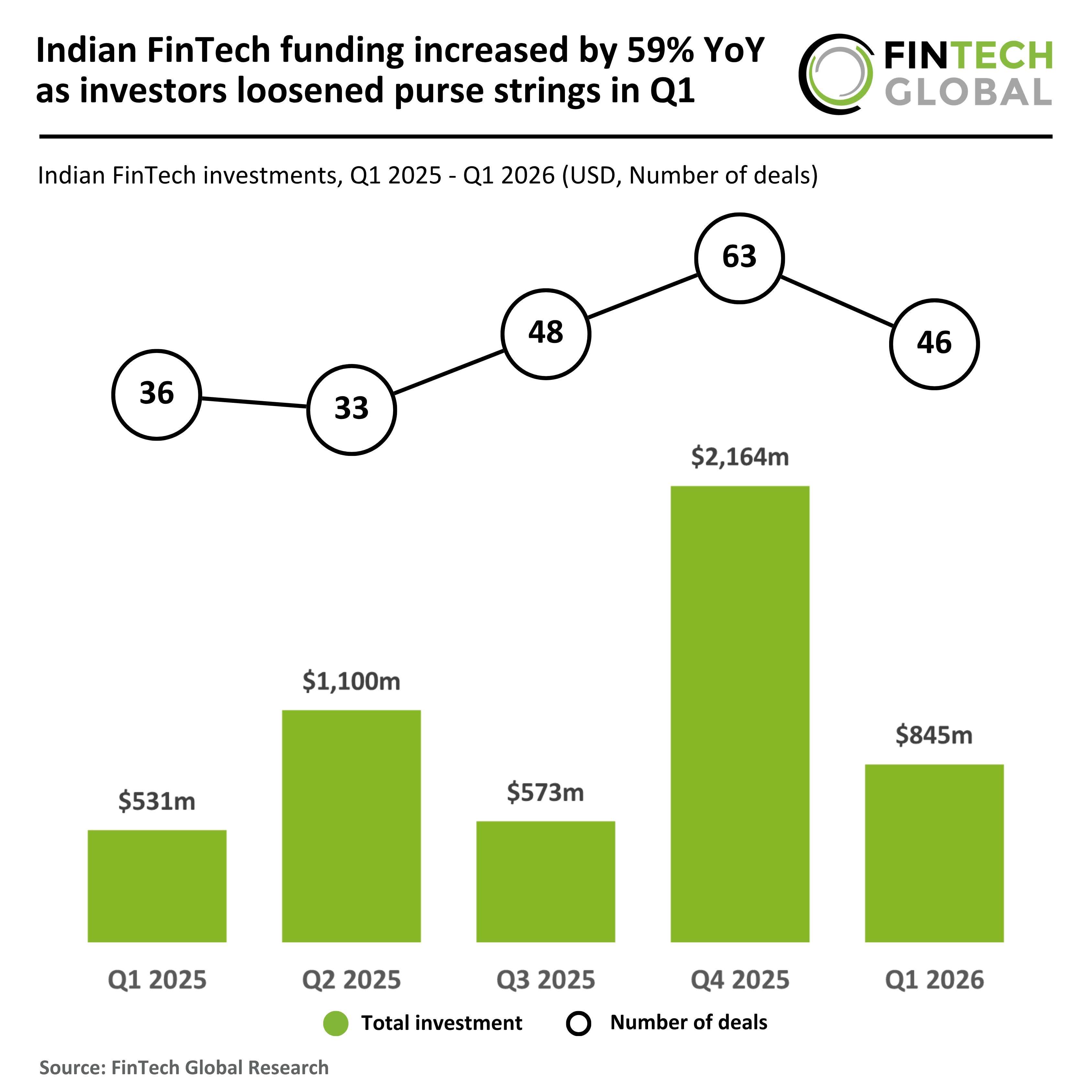
Key Indian FinTech investment stats in Q1 2026:
- Indian FinTech funding increased by 59% YoY in Q1 2026
- Average deal value increased by 24% to $18.4m as investors loosened purse strings
- Neo Group, a WealthTech firm serving high-net-worth individuals, ultra-high-net-worth clients and family offices, raised $53m in a funding round that values the business at $1.1bn, making it one of the biggest Indian FinTech deals of the quarter
Indian FinTech funding increased by 59% YoY in Q1 2026
Indian FinTech raised $844.5m across 46 deals in Q1 2026, a result that represents a 59% increase on the $531m recorded across 36 transactions in Q1 2025.
When set against Q4 2025, however, the comparison is more sobering: that quarter stands as the strongest period for capital deployment across the dataset by a considerable margin, with $2.2bn raised across 63 deals, meaning Q1 2026 funding came in 61% below that peak despite deal volumes falling by a somewhat smaller 27%.
The pullback from that peak is sharp, though the Q1 2026 figures still represent a meaningful step forward on a year-on-year basis, suggesting that underlying investor interest in the Indian FinTech market remains intact even as the exceptional conditions of Q4 2025 have not carried over into the new year.
Average deal value increased by 24% to $18.4m as investors loosened purse strings
The average deal value in Q1 2026 came in at $18.4m per transaction, a figure that sits 46% below the $34.4m average recorded in Q4 2025, when a concentration of larger deals drove the period’s outsized funding total.
Compared with Q1 2025, however, the average has risen from $14.8m, an increase of 24% year-on-year, pointing to a gradual upward shift in the scale of individual investments coming into the market.
The Q4 2025 average remains the clear high-water mark across the period, and the moderation seen in Q1 2026 likely reflects a return to more typical deal sizing rather than any deterioration in sentiment, with the Indian FinTech sector continuing to attract capital at values comfortably above where they stood a year ago.
Neo Group, a WealthTech firm serving high-net-worth individuals, ultra-high-net-worth clients and family offices, raised $53m in a funding round that values the business at $1.1bn, making it one of the biggest Indian FinTech deals of the quarter
The round was led by TVS Capital and its affiliates, marking the private equity firm’s first investment in the wealth management sector.
Founded in 2021 by Nitin Jain, a former Edelweiss Wealth Management executive, Neo Group provides advisory and yield-based investment products and manages close to $106.6bn in client assets.
The latest raise builds on a busy period of fundraising, with the company having secured $20m in February 2025, followed by a $19m round in August and a further $25m investment in November, the last of which was led by Crystal Investment Advisors.
Neo’s asset management arm has also been scaling, completing the first close of a $213.2m private equity secondaries fund at $79.9m, with plans to back 12 to 15 companies across financial services, healthcare and technology.
The fresh capital will be directed towards accelerating expansion and strengthening the firm’s knowledge-driven client offering, as Neo looks to build out its position in what TVS Capital has described as a structurally shifting wealth management landscape in India.
Keep up with all the latest FinTech research here
Copyright © 2026 FinTech Global







![Arete Wealth debuts direct-to-consumer digital wealth platform Smarsh, a pioneer in regulatory technology (RegTech), emerged from the visionary mind of Stephen Marsh in 2001. Grounded in his experience within the financial services sector, Marsh foresaw the imminent need for regulated organisations to effectively manage their digital communications. With traditional regulatory retention and oversight rules extending to new communication technologies, he identified a gap and founded Smarsh to bridge it. Tom Padgett, General Manager of Smarsh Enterprise, explained the company's founding months, "Steve had been working in the financial services industry and saw that the companies lacked a streamlined solution to be able to capture and archive their communications data and meet their compliance requirements." From these humble beginnings in Brooklyn, New York, Smarsh has evolved into the global industry leader that it is today, serving a substantial portion of the world's largest banking and insurance companies. Padgett examined their growth, attributing it to a steadfast commitment to innovation, "Ultimately, it has been a constant commitment to innovation that has enabled Smarsh to become and remain the industry leader in communications compliance – even as the digital messaging landscape has revolutionised over the last two decades." Keeping up with the times Over this more than two-decade journey, the US firm underwent significant transformation, aligning its offerings with the changing dynamics of digital communication. This constant evolution aligned firmly with Marsh's early vision, to spot the trends across the digital communications sector that no one else was spotting. Upon its inception, the firm initially focused on email, an antecedent to the modernised, futuristic digital landscape, as Padgett explained, "Back in 2001, e-mail was the dominant forms of digital communication, but Steve saw that with the rapid advancements in digital infrastructure, communication was also evolving fast." Indeed, it was Marsh's vision that continued to drive his eponymous company forward through the 21st century, with the firm leveraging up-and-coming technologies to find success in an industry where every change is scrutinised, thanks to ever-increasing regulatory restrictions, as Padgett revealed. "He knew that regulated organisations would need a solution that is able to keep up [with the digital transformation of communications]. Over the past 22 years, we have witnessed the needs of customers change dramatically as the number and complexity of communications platforms have surged. Over this time, Smarsh has evolved, expanding into platforms like Microsoft Teams and Zoom, and leveraging new technologies like AI to be able to further help meet these challenges head on. Throughout all these changes, our core purpose has remained the same – using technology to transform mandatory oversight into valuable foresight for our customers," he continued. The jewel in the crown While Smarsh has acted as the regulatory sector's chameleon for much of its two-decade run, shapeshifting into whatever caters to the needs of the modern client, as we head into 2024, it has established an offering as the centrepiece of its portfolio - the jewel in the crown. This flagship product is known as the Smarsh Enterprise Platform, and it stands as an integrated, cloud-based solution crafted to safeguard and prepare enterprise communication data strategies for the future. It facilitates the acquisition of fresh perspectives by leveraging top-notch technologies such as elastic compute, natural language processing, machine learning, and artificial intelligence. According to research from the TMF Group, in 31% of regions surveyed, there's an indication that clients might be unaware of the upcoming complexity of regulatory changes in regard to compliance, highlighting their lack of preparedness for what lies ahead. With this in mind, large financial institutions are finding it more difficult than ever to meet compliance regulations - which is where the Smarsh Enterprise Platform steps in. Padgett explained what their flagship product provides, stating, "The Smarsh Enterprise Platform is our cloud-native communications retention and oversight solution for enterprises. It enables large, highly-regulated organisations to meet the complex needs of global compliance. "Alongside capturing and retaining the myriad of communication channels that organisations use today, the platform leverages Smarsh-developed AI to surface business-critical insights from organisations’ stored communications data. We serve over 6,500 customers including 90% of the world’s leading financial services organisations," he continued. Smarsh's services don't stop there however, the firm also has its own simple, yet comprehensive risk management solution, targeted at small and mid-sized companies. The Professional Archive aims to ensure easy-to-use and effective digital communications compliance, and covers a wide range of needs, from capturing over 100 channels and website data to archiving, supervising, discovering, and securing information. On top of this, it also has its own third party and cyber risk management solutions, which can enhance your organisation's cybersecurity stance and effortlessly oversee the security and compliance of devices, networks, users, and vendors through a unified interface. Tailored to align with the National Institute of Standards and Technology (NIST) Cybersecurity Framework, Smarsh Cyber Compliance encompasses compliance and reporting functionalities. Challenges across the landscape The landscape of compliance technology isn't devoid of challenges. Padgett acknowledged the impact of incoming regulations, citing the Biden Administration's Executive Order on Artificial Intelligence which has captured the attention of many in the industry. However, while others may see this as a concern, he sees this as a validation of Smarsh's foresight in developing 'regulatory-grade AI' solutions, aligning with the imminent regulatory standards for AI implementation. Padgett said, "Smarsh has been developing AI solutions for a decade and has long been predicting that there are three pillars to AI: data, tech and regulation. This Executive Order removes all doubt that regulations are a third pillar. We see the regulation of AI as less of a challenge, more so validation that the time-consuming and labour-intensive work we prioritised to develop ‘regulatory-grade AI’ solutions, including model explainability, exhaustive testing to ensure protections against bias and discrimination and continual evaluation – was ahead of the curve." On top of this, the rapid development of new messaging platforms presents a vast challenge for compliance solution providers. Padgett emphasised the sector's struggle to monitor and capture diverse communication types while addressing the complexities arising from a growing array of messaging platforms. Specifically, monitoring "change-of-venue" conversations poses a significant associated challenge. In terms of addressing this proliferation of new communication platforms, Padgett once again turned to Smarsh's highly vaunted adaptability, claiming that the ability to be agile, dexterous, and quick of foot, was the path to keeping up with the evolving technological landscape. What does the future hold? Looking forward, Padgett envisions AI as an indispensable element rather than a luxury in compliance offerings. In line with Smarsh's long-term strategy, the firm has been an "early-mover" in the AI space, as the company looks to avoid resting on their laurels, and instead be a part of the next wave of change, as it has over its 22-year run. As the company steers toward 2024, Smarsh is aiming to focus on its market differentiators according to Padgett. He said, "We continue to develop and release AI-powered ‘Scenarios’, purpose-built models to help organisations accurately identify and address specific behaviours at scale. We are frequently adding to our library of Scenarios, which span market conduct, financial crime, workplace conduct and more. In addition, we have forged strong strategic relationships with key technology partners like AWS and collaborate closely with the modern communications platforms our customers depend on including Slack, Zoom, and Box. " Smarsh's trajectory exemplifies its unwavering commitment to innovation, regulatory excellence, and adaptive solutions, cementing its position as a stalwart in the ever-evolving landscape of compliance technology. Starting with Marsh's vision at the turn of the century all those years ago, the firm has never failed to fulfil its modus operandi sitting on the tenets of innovation, and future-planning, meaning that just as it was back in 2001, Smarsh is looking ahead to the future, aiming for ambitious targets, that its competition can't even see yet.](https://fintech.global/wp-content/uploads/2023/12/austin-distel-EMPZ7yRZoGw-unsplash-100x70.jpg)