


As we enter the final stretch of the year, FinTech funding was showing no signs of slowing down as a substantial funding package of over $2.6bn was raised across all 19 deals reported on by FinTech Global.
Despite it being Halloween this weekend, there was clearly no spooking of the FinTech market this week, with big-hitters like Kalshi and AI security firm Upwind Security bringing home massive funding hauls of $1bn and $400m respectively.
The funding raise was also up massively on last week, where a grand total of $541m was brought in across all sixteen deals, reflecting growing funding amounts permeating the sector.
The WealthTech sector dominated this week, bringing in ten of the nineteen deals in total. Trailing behind in joint second was InsurTech, CyberTech, RegTech and PayTech with two, whilst financial infrastructure-related firms brought in one.
Geographically, the US recorded twelve deals, the UK two, and Canada, Israel, Hong Kong and Belgium recorded one.
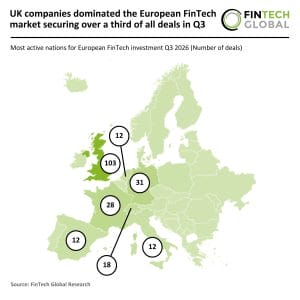
Research from FinTech Global this week showcased a strong Q3 for the European FinTech market. The market recorded 269 deals in Q3 2026, up 5% from 256 transactions in Q3 2025 and broadly flat against the 268 completed in Q2 2026, a rise of less than 1%.
Funding came in at $2.4bn, up 20% from $2bn in Q3 2025 but down 55% from $5.4bn in Q2 2026.
Here are this week’s deals.
Kalshi hits $40bn valuation with $1bn funding round
Kalshi, the New York-based regulated exchange for event contracts, has reportedly secured $1bn in fresh capital at a $40bn valuation as it looks to move past its prediction market origins and take on established trading venues.
Sequoia and Wellington jointly led the investment, according to a report from Reuters who cites a person with knowledge of the deal. Tiger Global Management and Dragoneer Investment Group also joined the round.
The company plans to use its growth to become a platform covering multiple asset classes, moving beyond the sports and election contracts that first brought it to prominence.
The new round arrives a little over five months after Kalshi closed a separate $1bn raise, led by Coatue Management, which priced the business at $22bn.
The funding news follows legal action earlier in the week. Utah’s attorney general filed criminal charges against Kalshi and two of its senior executives, alleging that the firm unlawfully promoted online gambling.
Kalshi was established in 2018 and describes itself as a next-generation financial exchange. Its prediction markets aim to give users live, reliable signals on how likely future events are to happen. As the first regulated exchange dedicated to events, the company is recognised for bringing prediction markets into the legal mainstream and turning them into a distinct financial asset class. Millions of individuals and a rising number of institutions across the US use the platform, which positions itself as the leading safe and regulated venue of its kind.
Upwind’s $400m Series C raises the stakes in AI security
Upwind, a cloud and AI security platform, has closed a $400m Series C round, arriving less than nine months after the business secured $250m in its Series B.
Bessemer Venture Partners led the investment. Every existing backer returned for the round, including Greylock Partners, Cyberstarts, Craft, Salesforce Ventures, Alta Park, Picture Capital, Swish Ventures, Cerca Partners, TCV, Penny Jar and Leaders Fund. Canapi Ventures joins the shareholder register as a new investor.
Upwind intends to channel the capital into expanding its product and engineering teams as it develops a platform for protecting cloud and AI infrastructure.
The latest raise lifts Upwind’s cumulative funding beyond $800m. The company said this places it among the best-capitalised businesses worldwide tackling cloud and AI security, and described itself as the fastest-growing firm in that market.
Upwind plans to use the money to help security teams counter the rapidly expanding risks that accompany AI adoption. It also credited its customers and partners for the round, noting that it competes against some of the largest companies in the world.
Upwind argues that because AI now reaches deep into enterprise environments, security must stretch from endpoints through to code and the cloud. To that end, it is developing AI sensors for endpoints, scanners for agents and skills, and a redesigned inventory graph.
The company has also introduced three AI agents. Its Blue Agent examines every log source and data point to assemble one coherent attack narrative and handles exploitation attempts at runtime. The Red Agent safely checks whether exposures and vulnerabilities can actually be exploited, allowing teams to concentrate on genuine threats. The Green Agent identifies leverage points capable of resolving thousands of security findings and resources at once.
The firm has additionally set up an AI Labs for Cybersecurity, designed to give talented researchers the infrastructure and latitude to pursue problems that will shape the industry’s future.
The lab concentrates on four areas: AI Security; Agentic Security; Frontier Models, Systems, and Benchmarks; and Advanced AI Systems. Looking ahead, Upwind intends to accelerate, simplify its product further and push into identity, data and AI.
Lovey secures £250m Pollen Street facility for SME lending
Birmingham-based FinTech Lovey has secured a senior secured credit facility of up to £250m from alternative asset manager Pollen Street Capital, marking the largest funding line in the SME lender’s history.
The facility comprises £50m in committed capital and a £200m accordion, giving Lovey additional capacity to expand lending from its own balance sheet while continuing to grow its brokerage operations.
The funding will support the company’s efforts to increase its lending capacity and provide more UK small and medium-sized enterprises (SMEs) with access to credit. Lovey said the deal reflects institutional investor confidence in its lending model, technology and long-term growth plans.
Founded by Jack Smith in 2016, Lovey has grown from a one-person operation into a business employing 120 people. The company has provided more than £600m in loans to over 11,000 SMEs across the UK, targeting businesses seeking faster and more flexible access to finance.
Lovey entered direct lending in 2022, building on its experience as a broker to address gaps in the SME finance market. It now operates both models, allowing businesses to borrow directly from Lovey or access funding through its network of lending partners. The company says businesses can submit an enquiry in 60 seconds and may receive funds within four hours.
The new facility follows funding arrangements announced last year, including a £35m revolving credit facility from Paragon Bank and a £10m junior medium-term note programme from LGB Capital Markets.
Ashurst Perkins Coie advised Lovey on the transaction, while Simmons & Simmons represented Pollen Street. Founded in 2013, Pollen Street manages more than €9bn across private equity and credit strategies and employs over 100 professionals.
Lovey founder and CEO Jack Smith said, “This new facility is an important milestone for us and will enable us to put more capital behind UK small businesses, scale our own-book lending and give more SMEs access to finance when they need it. Pollen Street shares our belief that finances for small businesses should be simpler, faster and more flexible, and we’re really pleased to have them backing Lovey for this next stage of growth.”
Lovey chief operating officer Kai Hunter added, “The funding announced today is the result of close and collaborative work with Pollen Street and I am grateful to their team, and to our own, for the diligence they brought to it. This funding deepens our lending capacity and allows us to offer larger loans, so that we can back more of the UK’s small and medium-sized businesses, from those that have found finance hardest to secure to the well-established, with greater speed and certainty.”
Pollen Street investment director Ethan Saggu also commented, “Lovey has spent almost a decade seeing the UK SME lending market from a broker’s perspective, giving the team an expert view of where demand for credit is going unmet. We have financed a number of specialist SME lenders and recognise what it takes to grow from brokerage into balance-sheet lending. Lovey has done so with a well-defined product and a focused approach, and we look forward to supporting the team as it scales.”
Neo Financial closes $185m credit union-backed facility
Neo Financial, the Canadian FinTech behind a range of credit cards, chequing, savings and mortgage products, has finalised a $185m syndicated warehouse facility led by ATB Financial, with a group of Canadian credit unions joining the lending syndicate.
ATB Financial took on the roles of administrative agent, lead arranger and sole bookrunner for the deal. As well as closing the facility at $185m, Neo has expanded the accordion feature, giving it room to scale the facility up to $250m. The arrangement increases the committed funding available to Neo for its credit card receivables.
Several Canadian credit unions are among the lenders in the syndicate, namely Vancouver City Savings Credit Union (Vancity), Beem Credit Union, Alterna Savings and Credit Union Limited and Innovation Federal Credit Union. Their involvement points to the rising role credit unions are playing in Neo’s funding platform, as well as the benefits both sides see in working together.
ATB Financial designed and led the syndicate with the aim of creating a warehouse facility that can expand in step with Neo’s growth. The structure is intended to give the company additional capacity as it keeps originating and financing credit card receivables.
Neo Financial is a technology firm focused on helping Canadians make progress with their finances. Its offering spans a suite of credit cards designed to help users build credit, everyday chequing accounts, the Neo Savings flexible high-interest savings account and Neo Mortgage, which the company says offers one of the lowest mortgage rates in Canada. The business serves more than one million customers, while its Neo for Partners arm supplies financial solutions to thousands of partners nationwide.
Since its launch in 2019, Neo has secured over $650m in funding and is supported by leading investors across North America. The company has been named Canada’s top-growing company by The Globe and Mail and Deloitte, and has ranked first on the Deloitte Technology Fast 50 for three consecutive years. It operates headquarters in Calgary, Winnipeg and Toronto.
Neo Financial CFO Allemander Neto said, “Credit unions are important partners in the financial system we want to help build. We’ve invested in a credit card platform that other institutions can participate in. Our ambition is to build lasting funding relationships with credit unions that see an opportunity to grow alongside us.”
Collective secures $100m to power solopreneur finances
Collective, a financial platform built for self-employed business owners, has secured $100m in new funding to develop what it describes as a financial operating system for the coming wave of one-person businesses.
The company intends to put the capital towards three main areas. It plans to broaden its offering so that it can support a wider range of businesses, including firms that employ staff. It also aims to apply AI more extensively to automate tasks across accounting, tax, payroll and customer support. In addition, Collective will introduce further services as it works towards building a comprehensive financial platform.
Collective argues that AI is changing the shape of entrepreneurship, allowing individuals to build operations that previously needed a full company behind them. According to the firm, the US is now home to 32 million solo businesses, which together produce close to $2tn in revenue each year. The number of these businesses rose by more than 5% in 2024, a growth rate over double that of the year before.
The company’s goal is to give independent workers the kind of financial support usually reserved for large corporations, at a much lower cost and with far less complexity. Its platform combines AI-powered bookkeeping, tax services, payroll and round-the-clock CFO support. Rather than simply supplying tools, Collective says its system is designed to carry out financial tasks on the user’s behalf, freeing business owners to concentrate on their core work.
Since its launch, Collective estimates that it has helped its members save around $350m in taxes, along with an average of 80 hours each year. The firm framed these savings as giving users more capital to reinvest, more time with their families and greater independence.
Nevis raises $70m Series B to scale AI for wealth firms
Nevis, a WealthTech developing an AI operating system for wealth management, has closed a $70m Series B round, taking its total capital raised to $110m within two years of launch.
EQT Ventures led the investment. Charles Schwab, Sequoia Capital, ICONIQ, QuantumLight and Ribbit Capital also took part.
As part of the deal, EQT Ventures partner and head Carolina Brochado will join the Nevis board of directors, and Kaushik Subramanian will become a board observer.
Charles Schwab came in as a strategic backer, and the two firms plan to deepen their partnership so Nevis agents can work across Schwab’s custodial infrastructure, opening up new automation options for advisers.
The company plans to use the new capital to speed up work on its AI agents and to extend its platform across the whole wealth management technology stack.
Nevis has scaled quickly over the past twelve months. Assets on the platform have risen from $50bn to more than $700bn, with about $75bn being added each month. Revenue has increased more than 25-fold, its AI agents have handled over 100,000 operational tasks, and dozens of new products have been released. The business employs 70 people.
The company combines CRM, meeting intelligence, financial planning and custodial workflows in a single platform, with AI agents that carry out operational work from start to finish.
Its goal is to free up financial advisers so they can spend more time with clients, provide better advice and grow their practices. Clients include Focus Financial Partners, IEQ Capital and United Capital. According to the firm, advisers on Nevis save up to 10 hours a week, take 30% more prospect meetings, produce financial plans and proposals in minutes and open client accounts in days rather than weeks.
EQT Ventures partner and head Carolina Brochado said, “Mark, Philipp and Ivan have built an exceptional AI platform at a time when wealth management faces a growing capacity gap, with advisors retiring as demand for advice rises. Nevis is helping firms serve more clients and scale efficiently. We’re excited to bring EQT’s network across wealth management and financial services to support their growth and ambition to become the foundational AI platform for the industry.”
Schwab Advisor Services head Jon Beatty said, “We’ve built an AI ecosystem that gives advisors greater choice and access to capabilities that can help them run and grow their firms. Our investment in and partnership with Nevis expands that ecosystem, helping advisors harness AI to operate more efficiently, increase their capacity and ultimately serve more investors.”
Phase lands $45m founder backing for AI agent blockchain
Phase, a company developing the operational backbone for an economy driven by AI agents, has switched on its Layer 1 blockchain mainnet with $45m of financial support supplied by its founder, Kirill Eves.
Eves is also the founder of Unlimit, a worldwide financial infrastructure business active in over 180 countries that handles upwards of $40bn in payments each year. Phase intends its blockchain to serve as the base for a full set of tools that allow AI agents to operate on their own, covering unrestricted web access, coordination of top AI models, distributed computing for AI workloads and payments.
The system is underpinned by a decentralised web of ordinary consumer devices, which protect the blockchain while also contributing bandwidth and processing capacity to its AI offerings.
Many blockchain networks depend on specialised servers and staked tokens, but Phase lets participants help secure its network through devices they already own, without buying extra equipment or committing money upfront. Smartphones are the first devices to be supported, and users can join by installing the Phase app via the Apple App Store or Google Play. To keep the network fair, Phase relies on a reputation-based consensus model that rewards dependable contributors and picks validators at random. It also checks that devices and node software are genuine, aiming to stop a small group of large operators from gaining dominance.
Alongside the mainnet, Phase has rolled out Phase Proxy, a tool designed to widen the parts of the internet AI agents can reach. The service sends agent traffic through mobile and residential connections on the network, helping agents reach sites that might otherwise refuse or limit them. Pricing begins at 0.5 USDT for 1,000 requests plus 1 GB of traffic. Citing Proxyway’s 2026 industry research, Phase said mobile proxy providers typically charge more than $5 per GB at entry level.
Two further products are due in November 2026. Phase Router will act as a single gateway to leading AI models, directing each request to the best option based on quality, speed and cost. Phase Compute will draw on the processing capacity of devices across the network to run open-weight models, delivering decentralised AI inference to agents. The company also aims to release a proprietary AI model that will serve as the platform’s core intelligence, capable of sophisticated reasoning, independent completion of complex tasks and management of other models.
AI agents on Phase can make on-chain payments using stablecoins or PHASE, the network’s own token. Services are billed on a pay-as-you-go model and support both the x402 payment standard and EVM-compatible smart contracts. Device owners will receive PHASE for validating blocks, and can earn more by supplying connectivity, inference and compute, with rewards tied to uptime, participation levels and customer demand. Phase plans to put part of its service revenue towards buying PHASE on the open market and passing those tokens to node operators in line with what they contribute.
Phase founder Kirill Eves said, “Soon, almost everyone will have AI agents acting on their behalf. Whoever controls the infrastructure behind AI agents will control what people can achieve. That power shouldn’t belong to any single company. We’re building Phase as a decentralized network of devices people already own, so millions can help run the infrastructure of the AI economy and share in the value it creates.”
Hyphenate raises $45m Series A for autonomous finance
Hyphenate, an autonomous finance platform built for the office of the CFO, has secured $45m in a Series A round after its revenue grew 86x over the past year.
Nexus Venture Partners led the investment, with B Capital also joining. Existing backers Foundation Capital, BoldCap and Gaia Ventures returned for the round, which takes the company’s total funding to $54m. Hyphenate plans to use the capital to extend its agents further across the finance function and into strategic finance.
The raise comes less than a month after the business changed its name from Maximor to Hyphenate. A year ago it closed a $9m seed round to reduce repetitive work for finance teams. Since then it has passed multi-million-dollar annual recurring revenue, and its customer base has grown 11x in 12 months to include six public companies.
Its agents now handle work across hundreds of entities, thousands of bank accounts and millions of daily transactions. Customers report 90% less repetitive finance work and 75% fewer audit exceptions. About 40% expand their use within the first year, some by two to three times, and the average customer uses six modules.
Several clients illustrate this growth. Consumer goods firm Mini Melts USA runs Hyphenate agents alongside its SAP environment for orders, invoicing and refunds, and recovered 16,640 hours of finance work a year within three months of launch.
North American online auction platform HiBid has processed more than $2.5bn in GMV through fully automated order-to-cash on the platform, reducing its month-end close from three weeks to one day.
Groupon is swapping legacy and in-house tools for Hyphenate across treasury, order-to-cash and over a dozen subledger processes.
Hyphenate operates as a layer over a company’s existing ERP, banking and other systems, joining them into a shared finance context without replacing systems of record. Its agents cover order-to-cash, treasury, GL accounting, procure-to-pay, and reporting and insights.
Rather than relying on engineers to build bespoke agents for each client, the platform learns from historical spreadsheets, emails and system logs, replaying previous months to capture edge cases. Resolved exceptions become precedent for later closes, and each action is accompanied by evidence so outputs are audit-ready.
Hyphenate co-founder and CEO Ramnandan Krishnamurthy said, “Every finance team carries a long list of work it does because somebody has to. Our customers are watching that list shrink in production. Once a team sees the system handle one workflow to an auditor’s standard, they hand it the next one. That is the pattern this company is built around, and this round lets us run it across the whole function.”
PhotonPay lands $40m to fuse stablecoins and fiat rails
PhotonPay, a payments infrastructure firm building a stablecoin-centric Financial Operating System for businesses, has closed a $40m Series C round as it pushes to merge on-chain liquidity with traditional banking rails and prepare its platform for AI-driven payments.
Blockchain Capital led the round, which drew SBI Group as a new backer. Existing investors IDG Capital, GL Ventures and Lightspeed Faction also returned. Blacksheep Technology served as the company’s exclusive financial adviser on the deal.
PhotonPay will direct the capital towards upgrading its multi-asset wallets, widening its global card issuing operation, reinforcing local clearing in priority markets and building an execution layer that AI agents can use. The firm also plans to bolster compliance infrastructure in current markets and enter new jurisdictions.
By August 2026, the company was processing $65bn in annualised transaction volume. It holds 34 payment and financial licences and regulatory authorisations across the Americas, Europe and Asia, and counts more than 200,000 business clients in over 200 countries and territories.
The platform combines multi-asset wallets, cross-border transfers, foreign exchange, local clearing and card issuing within a single API-first system. Stablecoins form its foundation, with wallets linking digital asset liquidity to fiat balances so firms can convert holdings into spending power for local payments.
Customers can open collection accounts in 17 markets, accept funds in more than 60 currencies and pay out through over 100 routes, including 74 major local e-wallets. Around 97% of payouts land the same day or within hours, and 68% settle in real time. PhotonPay issued 4.4 million cards in the past year, a 275% annual rise, and supports more than 100 enterprise and platform partners via embedded finance.
In May 2026, the firm ran a live agentic payment test with Mastercard using a tokenised PhotonPay card. It now plans Model Context Protocol support, a policy-driven framework to govern agent spending, and AI-assisted risk reviews that flag complex cases for human checks. Its network relies on ties with J.P. Morgan, Standard Chartered and DBS, as well as domestic systems including Brazil’s Pix and Mexico’s SPEI.
PhotonPay founder and CEO Lewison Chen said, “Moving money across borders in seconds means little if it still takes days to put that capital to work. Stablecoins are accelerating global money movement, while local clearing and global card issuing connect that liquidity to local settlement and everyday business spending. Our Financial OS brings these capabilities together, making the underlying infrastructure far less visible to businesses, even as it becomes more essential than ever.”
He added, “At the same time, business software is becoming increasingly autonomous. AI is shifting financial workflows from people manually operating fragmented tools toward systems that understand business intent and coordinate execution across assets, accounts and financial rails. That creates the foundation for agentic commerce. Stablecoins change how money moves. AI changes how it gets put to work. But commerce is still what money is for.”
Chen also said, “Connecting financial networks is only the beginning. The real breakthrough is abstracting that complexity behind a unified, programmable financial layer, so businesses and AI agents can move from intent to execution within clearly defined boundaries.”
PhotonPay chief compliance officer JP Pi said, “AI can simplify how businesses interact with financial services, but it cannot replace the infrastructure required to deliver them. Establishing local financial capabilities takes years of investment, institutional partnerships, and regulatory engagement. Software or AI models alone cannot replicate that depth. The simplicity businesses experience is the result of that heavy lifting, not a substitute for it.”
Coast raises $35m to power finance for trades businesses
Coast, a FinTech offering fuel cards, corporate cards and spend management to field-based businesses, has secured $35m in fresh capital to grow its offering into a wider financial operating system for the sector.
Thomvest Ventures led the round, with Intuit Ventures, Small World Capital and Alpha Square Group joining as new backers. Existing investors including ICONIQ Growth, Accel, Insight Partners, Better Tomorrow Ventures, Avid Ventures, Vintage Investment Partners, Colle Capital, Synchrony, RXR and The Fintech Fund also took part.
Thomvest first backed Coast in 2024, and the company said Intuit Ventures’ involvement brings it closer to an integration partner already central to the operations of many of its clients.
The investment comes as the rapid build-out of AI data centres drives heightened activity across construction, HVAC, electrical, utility and transportation work. Demand for HVAC engineers has climbed by close to 78% since 2022, while vacancies for electricians, welders and construction specialists have risen by 30%. According to Coast, as these firms scale and their operations become more complicated, many still rely on a patchwork of general-purpose cards, banking services and fleet products that were never built with their needs in mind.
The new funds will support three main areas. The first is AI-driven savings and automated expense management for field services, steering drivers towards the most cost-effective fuel and purchases while handling approvals and reconciliation without manual effort.
The second is a broader payments and finance offering, including Bill Pay and accounts payable products, allowing supplier invoices to sit alongside card spending in a single view.
The third is embedded partnerships with telematics, fleet management and field service providers. Clients can already manage Coast card controls within platforms such as Samsara and Fleetio, drawing on data such as vehicle location, driver identity and odometer readings to detect off-route fuel purchases, flag possible misuse or deactivate cards directly.
Coast serves sectors ranging from construction, plumbing and landscaping to pest control, solar, energy, oil and gas, and utilities. Having begun with a fuel card, the business has since added corporate cards, expense management and bill payment.
Its industry-specific features include visibility at vehicle and driver level, telematics-linked controls, detailed fuel grade and gallon data, job costing, and accounting integrations that automate reconciliation and coding. The company claims its platform saves clients tens of thousands of dollars and weeks of administrative work.
Mave’s $34m bet to end the SOC integration bottleneck
Mave, a developer of agentic security operations technology, has emerged from stealth with $34m in total funding, as it looks to reshape how large enterprises coordinate their defences against cyber threats.
The capital comprises a $28m Series A, led by Red Dot Capital Partners with backing from Lumir Growth Partners, alongside an earlier $6m seed round headed by Dell Technologies Capital and Emerge Ventures.
The business plans to put the money towards deeper AI research, a broader enterprise platform and international expansion, and expects to more than double its headcount, with recruitment concentrated on AI research and go-to-market roles.
Mave is already deployed in over 200 security operations centres (SOCs). Its customers include Fortune 200 firms and global managed security service providers, and the platform runs in regulated financial and healthcare settings.
During live attacks, it has supported containment by isolating affected systems, disabling compromised identities and stopping malicious activity.
The firm converts the security tools an organisation already owns into a single agentic defence system covering threat intelligence, hunting, investigations, detection engineering and response. Rather than requiring telemetry to be migrated into a central database, its agents query each connected system in its native language, pull live context and adjust as new evidence appears.
When a fresh attack campaign surfaces, Mave can gauge its relevance to a company’s technologies, assets and identities, search for related activity, investigate findings and help convert validated results into detections or approved responses. Security teams can also pose questions in plain language.
Transparency sits at the core of the design. Mave logs the queries, evidence, reasoning and actions behind each finding, while customers decide which actions run automatically and which need human sign-off.
Mave was founded by Raziel Oren and Guy Eshel, who first met during their time in Israel’s 8200 unit and have spent more than ten years working across offensive and defensive cybersecurity.
The company pointed to the 2026 SANS SOC Survey, in which 24% of security leaders named a lack of enterprise-wide visibility as their largest obstacle to effective operations. According to the firm, “In most organizations, the tools are there, but the integration that makes them useful together is not.”
Mave co-founder and CEO Raziel Oren added, “Mave is built to reduce risk by giving security teams AI that can keep pace with attackers, show its work, and know when human judgment is required.”
Avante targets rising insurance costs with $30m funding
Seattle-based Avante has raised $30m in Series A funding to expand its AI-powered employee benefits platform internationally, as employers look for ways to manage rising health care costs and reduce administrative workloads.
The round was led by Frist Cressey Ventures, with participation from new investors Sorenson Capital, Hearst Ventures and Morgan Stanley Next Level Fund, alongside existing backer FUSE. The latest investment brings Avante’s total funding to $40m.
The company plans to use the proceeds to expand into international markets and develop its network of AI agents, which help benefits teams evaluate programmes, assess vendors and automate routine processes. Avante also intends to improve the personalised guidance available to employees, helping them identify and access relevant benefits.
The funding comes as employers face mounting pressure to control health care expenditure. Large employers anticipate a median 9.2% increase in health care costs in 2027, placing additional strain on HR and benefits teams tasked with managing spending while maintaining employee support.
Many organisations still rely on manual processes and outdated information to oversee benefits programmes, despite managing multiple providers, insurance plans and regulatory requirements across different markets.
Avante’s platform uses AI agents to carry out benefits-related tasks, including reviewing vendor performance, preparing for contract renewals and identifying gaps in existing programmes. The technology can compare contracts with claims data, flag inconsistencies in plan documents and track important deadlines.
Last week, Avante introduced Ava Agents in beta, enabling teams to delegate recurring tasks to AI agents that return completed work for review. Employees can also use the platform to ask questions about their coverage and available support, receiving personalised guidance around the clock without having to wait for assistance from HR.
Since launching 18 months ago, Avante has secured more than 70 customer accounts. Bookings have increased almost fivefold year on year, while every customer eligible for renewal has renewed. The platform now supports more than 385,000 employees and their families.
Among its customers, Samsung Semiconductor has reported a 66% increase in employees and dependants discovering and using existing mental health support. News Corp has used the platform’s workforce data to accelerate decision-making. Other customers include Real Chemistry and Zscaler.
Avante has also established partnerships with benefits advisers Gallagher, OneDigital, Segal Benz, Howden and USI Insurance Services to extend its reach across the market.
Rohan D’Souza, CEO and co-founder of Avante, said, “Benefits teams are responsible for one of the largest and most consequential investments their companies make, yet they’re still operating with outdated information, archaic spreadsheets, and technology built for another era. We’re combining purpose-built technology with real-time automation and years of benefits expertise across the AI stack, resulting in 100x leverage for the people whose decisions shape the health, financial security, and well-being of millions. Few areas of work touch people’s lives more directly, and benefits teams deserve technology built for the importance of what they do.”
Senator Bill Frist, M.D., co-founder and managing partner of Frist Cressey Ventures, added, “As a physician, I saw again and again how hard it is for patients and their families to find their way through our health care system. Avante is harnessing AI to make that system easier to navigate, so employees get better care and employers get relief from costs that keep climbing. Its team brings rare depth in technology, health care and benefits, and has already earned the trust of leading employers. We’re proud to partner with Avante to reach more companies and make a lasting difference for the families who count on them.”
Numeracle lands $28m to scale verified business identity
Numeracle, a company that verifies business identities to protect trusted communications, has closed a $28m growth round to push its Entity Identity Management platform into fresh sectors and geographies.
Edison Partners led the investment. The capital will go towards enlarging Numeracle’s go-to-market, sales, product and research and development functions, alongside building out its presence outside the US.
The raise comes as efforts to tackle telecoms fraud increasingly catch out genuine organisations. Call blocking and labelling systems run by carriers frequently flag or stop calls placed by hospitals, schools, airlines and other legitimate firms. Research carried out by Numeracle found that 69% of US consumers have let a call go unanswered, ignored it or rejected it because they did not trust the caller ID. At the same time, AI has lowered the barrier for criminals to set up sham companies, obtain phone numbers and pose as established brands.
Where many number reputation tools focus solely on the phone number itself, tracking spam labels and lodging appeals via free carrier channels, Numeracle starts earlier in the process. It first confirms that a business genuinely exists and is actively trading, and it uses that confirmed identity to head off incorrect labelling and to push carriers to remove it. Verified firms can then layer on branded calling, so their name appears on outgoing calls.
Numeracle has been providing identity infrastructure for communications since 2018. Its platform lets organisations check, establish and keep watch over the corporate identity of the businesses they deal with, then carry that verified status across voice, branded calling, Number Reputation Management and other channels.
Momentum behind the business has been strong, with its annualised revenue run rate climbing 70% over the last 16 months. It now safeguards the identities of upwards of 4,000 enterprise brands in areas such as financial services, retail, healthcare and home services, serving everyone from small independent operators to Fortune 500 companies.
Looking ahead, Numeracle plans to take the verification model it has established in voice into messaging, rich communications and newer digital channels. Its latest product, Know Your Customer as a Service (KYCaaS), offers managed business identity checks across the customer lifecycle, allowing platforms to confirm an organisation is legitimate before onboarding it. With the Federal Communications Commission (FCC) progressing several rulemakings aimed at stricter identity and vetting rules for carriers, KYCaaS is designed to help telecoms firms comply affordably without having to build their own compliance systems.
Founder Rebekah Johnson saw this problem coming roughly ten years ago. Following a role in regulatory compliance at telecoms provider West, she joined the FCC Robocall Strike Force, where she cautioned carriers that heavy-handed blocking and labelling would hit genuine calls as well as fraudulent ones. When that warning went largely unheeded, she launched Numeracle to help reputable businesses get through to their customers.
Numeracle founder and CEO Rebekah Johnson said, “We built Entity Identity Management because fraud and impersonation are not fundamentally communications problems, they are identity problems.
“Edison Partners recognized that this was never just a telecom story. It’s a trust story, and trust scales far beyond any single phone call. With their partnership, we’re ready to build the identity layer for every business interaction.”
Edison Partners general partner Lenard Marcus said, “With Rebekah’s extensive experience in telecommunications and compliance, Numeracle has become a trusted partner to both the enterprises making calls and the carriers delivering them, and its customers see the results in higher contact rates and greater customer confidence. The combination of a proven business, a visionary founder, and rapidly growing demand makes this a compelling investment for us.”
Ravical raises $17m as AI reshapes accounting firm growth
Ravical, an AI platform that accounting and tax firms use to run their operations, has closed a $17m seed round aimed at helping practices expand without adding staff at the same rate.
MMC Ventures led the investment. Existing backers Lakestar and Pitchdrive also took part, and Shapers joined as a new investor. Ravical plans to use the capital to deepen its presence in the UK, Belgium, the Netherlands and Germany, extend its European roll-out, and launch in the US.
The raise comes as the traditional economics of accounting come under strain. Firms have historically expanded by recruiting more professionals and charging for their expertise. Client demand for accounting and advisory services continues to climb, but the pipeline of new graduates is shrinking and seasoned practitioners are increasingly scarce.
Meanwhile, AI can now handle many tasks that once required human input, and specialist knowledge has become easy for clients and rivals to access. According to Ravical’s own research, 70% of UK SMEs now follow AI-generated advice without checking with their accountant first.
Ravical argues that a firm’s real differentiator is the judgement, advisory skill and delivery approach of its strongest people. In most practices, however, that know-how stays with individual employees and benefits only the clients they personally handle.
Ravical’s platform captures the working methods of a firm’s top performers and turns them into a shared approach that AI applies across the entire client base. More than 100 accounting firms across Europe already build on the platform. The company was founded by CEO Joris Van Der Gucht, CTO Ken Bastiaensen and CPO Benjamin Vandermarliere. Van Der Gucht previously co-founded Silverfin, a cloud platform now used by over 1,000 accounting firms in 18 countries.
Ravical CEO Joris Van Der Gucht said, “AI is changing what clients expect from their accountants, and firms are becoming more proactive and strategic than ever before. Our role is to help them get there.
“Every firm will use AI, so the real question is who controls it. When every employee uses their own assistant in their own way, the individual gets better, but the firm doesn’t. We turn how a firm’s best people work into a shared way of working that AI carries out across every client. Firm leadership sees every opportunity and risk across the client base, so the firm wins more work from the clients it already has.”
Overwatch Data raises $15m to fight AI-scale cyber attacks
Overwatch Data, an AI-native threat intelligence and risk operations firm, has closed a $15m Series A to help cyber, fraud and risk teams respond to the growing volume of AI-driven attacks.
Mouro Capital led the investment. Visa Ventures and Capital One Ventures joined as strategic backers, and PruVen Capital and New Era Capital Partners returned with follow-on investments.
The company will put the capital towards expanding its AI agents into more stages of the risk lifecycle. That includes ongoing monitoring, investigations into criminal underground activity, merchant onboarding and due diligence. Overwatch Data is also adding staff in engineering, investigations and sales. Last year it hired Jeff Needham, previously CRO at
Flashpoint and Intel 471, to run its go-to-market efforts.
The firm argues that AI has lowered the cost of attacks and made them quicker and more frequent, while many risk teams still operate manually and in silos. Under that model, cyber, fraud and onboarding functions each see only part of the activity of the same attacker. FBI figures cited by the company put US cybercrime losses in 2025 at $20.9bn, a 26% rise on the year before.
Overwatch Data’s platform uses agents to gather adversarial signals from wherever they appear, filter out irrelevant data, and link patterns across different sources. The agents then take an investigation through to a suggested decision, together with the evidence an analyst needs to check it. Each validated investigation is added to a shared knowledge base, so the system improves as more customers use it. The company says this helps risk teams move from reactive triage to proactive operations that can scale.
According to the firm, one regional bank client found six times as many critical threats, more quickly, and saved each analyst over 20 hours a week of manual triage. Visa is also a current customer.
CoverGo raises $6m Series B1 to scale AI insurance platform
CoverGo, an AI-native InsurTech platform serving health, life and P&C insurers, has secured $6m in the first close of its Series B1 round to speed up worldwide uptake of its technology.
Betatron Venture Group (BVG) led the investment, which also drew backing from a mix of returning and new investors.
BVG focuses on B2B technology businesses that are reshaping long-established sectors such as insurance, and now sits alongside a group of international venture capital firms and strategic backers supporting the company. The latest round takes CoverGo’s total funding to more than $30m.
CoverGo plans to channel the capital into building out its AI-native insurance functionality and scaling its go-to-market efforts. The company aims to help insurers overhaul and eventually retire legacy core systems, while introducing AI agent-driven automation throughout their businesses.
Since closing its Series A in 2022, CoverGo has grown revenue tenfold and has also achieved EBITDA breakeven. It currently works with 25 institutional clients spread over 15 countries across the Americas, Asia, Europe, the Middle East and Africa. Among its customers are major insurance names including AXA, Bupa, Generali, Sun Life, Prudential, Blue Cross, MSIG and Marsh.
The company positions itself as one of the leading global AI insurance platforms, giving insurers a flexible, scalable and cost-efficient route to digital transformation. Its AI agents operate across the insurance value chain, and a rising number of insurers worldwide use the platform to digitise and automate work spanning omnichannel distribution, policy servicing and claims handling.
CoverGo CEO and founder Tomas Holub said, “Insurance companies realize more than ever that they need to modernize their core systems. CoverGo is uniquely positioned to accelerate their digital transformation and drive efficiencies across the insurance value chain.
“This funding will help us bring our AI-native platform to more insurance businesses globally and accelerate our vision of becoming the operating system powering the world’s most efficient insurers.”
Betatron Venture Group managing partner and CEO Matthias Knobloch said, “CoverGo combines deep insurance expertise with a next-generation platform that addresses the complexity of insurance transformation.
“Its client adoption, international reach, and progress toward profitable growth provide a strong foundation for its next stage of development. We are excited to support Tomas and the team as they scale the business and help insurers embed AI into their everyday operations.”
Mochatrade raises $6m to open US stocks to Indian traders
Mochatrade, a New York-based platform offering tokenised US equities to traders in India, has reportedly closed a $6m seed round as it looks to give Indian retail investors leveraged, round-the-clock exposure to American stocks using rupees.
CoinFund led the investment, with Coinbase Ventures, Pioneer Fund, Y Combinator and Nicky Montana also taking part, according to a report from Dealroom.
Users of the platform can take long or short positions of up to 50x leverage on contracts tied to US stock tokens, with all margin held in Indian rupees. Before a trade is confirmed, the platform displays both the margin required and the square-off level.
Unlike conventional exchanges, the tokens can be bought and sold at any hour, every day of the year. This addresses a timing problem for Indian investors, since regular US market sessions take place during the Indian evening.
Funding an account relies on India’s UPI payment system. Deposits reach a user’s balance within seconds, and withdrawals are processed on the same day, with money moving in rupees in both directions.
Mochatrade operates as a trading venue for US stock tokens aimed specifically at the Indian market. It holds registration with FIU-IND as a Virtual Digital Asset Service Provider, under registration number VA00049752.
Traders also get access to TradingView charting, company fundamentals and analyst consensus data, with orders processed on low-latency infrastructure.
Marrow raises $2m to bring AI agents into insurance sales
Marrow, a London-based InsurTech startup, has raised $2m in pre-seed financing to establish a common framework for AI assistants to access and transact insurance products, giving insurers greater oversight of how automated sales are conducted.
Insurtech Gateway led the funding round, joined by Seed X, Leo Capital, Portfolio Ventures and angel investors. The investment will support team expansion, the addition of more insurance providers to Marrow’s platform and further development of its AMI Standards for AI-led insurance transactions.
The raise comes as AI tools begin to influence how consumers research and select insurance products. Research from Consumer Intelligence found that 18.7% of UK home insurance shoppers had used AI tools, compared with 14.5% who had used a broker. While this does not establish how many consumers complete purchases through AI agents, it highlights the emerging role of AI in insurance distribution.
For insurers, the shift presents challenges around customer access, compliance and control. Blocking AI agents could limit access to customers using these tools, while allowing them to navigate existing websites provides less control over the information presented and the records created during a transaction. Building separate integrations for each AI platform could also increase complexity as new channels emerge.
Marrow aims to address these issues by providing a single access point through which insurers can make products available to AI agents under defined rules. Insurers connect their existing pricing and policy infrastructure to the platform, allowing agents from different AI assistants to access products through one protocol without requiring changes to core systems.
The platform also governs the transaction process, including the questions agents can ask, acceptable responses, disclosures customers must see before receiving a quote and the records retained from each interaction. Marrow does not generate demand or recommend one insurance product over another.
The company has been live with Aviva since March 2026, following the insurer’s procurement, information security, legal and data protection reviews. Other insurers, brokers and managing general agents (MGAs) have also signed up.
In September, Marrow released its AMI Standards, an open, machine-readable framework designed to define how AI agents request, compare, disclose and bind regulated insurance policies. Insurers and brokers are assessing the framework across five product lines, with feedback open until 13 November.
Marrow argues that existing agentic commerce infrastructure developed for payments and retail does not fully address the requirements of regulated insurance sales.
The company was founded by Tim Graham, formerly head of product at Ki, where he worked on small business insurance products, and Adam Mesout, a qualified actuary and founding engineer at Ki.
The new funding will support further hiring in London, expansion of onboarding across retail insurance lines and into commercial insurance, and continued work with the industry group developing the AMI Standards.
Marrow co-founder and CEO Tim Graham said, “We think that’s great, and that can allow a really consumer-centric interaction, whilst creating a massive opportunity for insurers. However, these are still regulated insurance sales: there’s a high bar to clear to be sure that the consumer is safe and these interactions are robust.”
Insurtech Gateway’s Dom Nolan added, “We’re excited to be supporting Marrow leading their fundraise. As the shift to agentic commerce creates a new infrastructure layer for regulated products, insurance is one of the clearest places where that layer is needed. Marrow has a rare combination of founder-market fit, production proof with a Tier-1 insurer, and a regulatory and protocol head-start that is difficult to replicate through software alone.”
Noewe Accounting raises €500,000 for AI-driven SME service
Noewe Accounting, the accounting business set up by integrated business services group Noewe, has secured €500,000 from private investor Philip Van Goethem, in a deal that values the company at €2.5m.
The capital will go towards building an accounting offering underpinned by automation and artificial intelligence, giving small and medium-sized enterprises (SMEs) on-demand access to structured financial data, insights comparable to those of a CFO, and tax recommendations.
The funds will be spent on developing technology and refining the service model, setting the stage for further growth in Lithuania and across other EU markets.
The firm is targeting a common frustration for business owners: financial figures that arrive too late to be useful. At conventional accounting practices, much of the work, including handling invoices and transactions, recording ledger entries and producing financial statements, is still done by hand and can stretch over several weeks. As a result, the numbers managers rely on may not be ready until a month or more after the fact.
By pairing automated data capture and processing with AI tools, Noewe Accounting expects to sharply cut the gap between when a transaction occurs and when it shows up in the books and in management reporting. Customers will no longer face lengthy waits while high volumes of paperwork are worked through.
Noewe Accounting will choose and roll out the technology itself. Alongside each customer, it will map how information moves through the business, pinpoint duplicated effort and identify tasks suitable for automation, with the aim of improving the whole data pipeline that determines how quickly and accurately information is delivered.
Because less time will be consumed by data entry and routine work, the company’s specialists will be free to dig into what shapes a customer’s profitability, where expenses are climbing, how cash flow is shifting and which steps management might take. The firm says this will bring SMEs the kind of in-depth analysis and guidance usually reserved for larger organisations with dedicated CFOs and finance teams, supplemented by performance assessments, forecasts and tailored management recommendations.
Tax monitoring and advice will also form an ongoing part of the offering. The model taps into the accounting, tax, legal and strategic management capabilities found throughout the Noewe Group. Automated analysis and tax reviews are intended to flag risks and opportunities early and to gauge how potential decisions could affect profitability, cash flow and tax obligations. Where customers need to claim relief, act on recommendations or pursue legal steps, the group’s tax and legal specialists will assist, covering everything from initial insight through to implementation.
Lithuania-based investor Philip Van Goethem said, “I believe in the accounting model being developed by Noewe Accounting, where technology and professional expertise enable businesses to quickly obtain the financial and tax insights they need to make decisions. I see significant potential for this model in Lithuania and other European Union markets.
“I am committed to contributing to the project’s success not only through investment but also by actively participating in the development of technological solutions and commercial expansion. Together with the team, we aim to create a service that companies will regard as an essential tool for day-to-day business management.”
Noewe managing partner Gediminas Laucius said, “Business leaders need to know what is happening in their businesses now. Information received a month later may explain past performance, but by then it is often too late to take action. That is why we are building Noewe Accounting to ensure clients receive structured financial data and the financial and tax insights derived from it in a timely manner, helping them make concrete business decisions.”


