US firms capture lion’s share of FinTech funding in $1.9bn week
US firms dominated FinTech funding this week, accounting for nearly half of all deals and attracting more than four-fifths of the capital raised, as global investment reached approximately $1.9bn across 17 transactions.
American companies secured seven of the 16 deals completed during the week, representing 44% of all activity. More strikingly, those firms attracted roughly $1.3bn in funding, around 85% of the week’s total capital deployed.
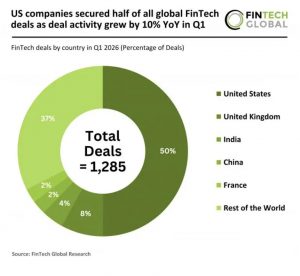
The firm’s Q1 2026 data showed US FinTech companies completed 642 deals, accounting for 50% of all global transactions, up from 458 deals and a 39% share a year earlier.
This week’s figures point in the same direction, with US firms responsible for seven of the 16 deals completed and attracting the vast majority of capital raised, reinforcing the country’s growing dominance of the global FinTech landscape.
The largest round of the week came from US financial operations platform Ramp, which secured a landmark $750m Series F financing and reached a valuation of $44bn.
Ramp was followed by AI-powered market intelligence platform AlphaSense, which raised $350m at a $7.5bn valuation, while travel and spend management company Perk completed a $300m private credit facility to support international expansion and product development.
Together, those three transactions accounted for more than three-quarters of all capital raised during the week.
Despite US dominance, funding activity remained geographically diverse. Israel delivered three transactions spanning observability infrastructure, AI governance and identity security, while the UK contributed deals focused on regulatory technology and AI-powered banking operations.
Elsewhere, Germany, the Netherlands, Ireland and Spain each recorded funding activity, highlighting continued investor appetite for specialised financial infrastructure and compliance technologies across Europe.
The week’s deal flow was heavily influenced by artificial intelligence, with AI featuring prominently across sectors ranging from insurance and banking operations to cybersecurity, compliance and enterprise software.
Infrastructure and enterprise software emerged as the most active category, accounting for five deals. Companies including Coralogix, Saris, Offroad, Gray Swan and Perk attracted investment by positioning themselves as foundational technology providers helping enterprises manage increasingly complex AI-driven environments.
Insurance technology was another notable theme, generating three transactions. Pace raised $46m to automate insurance workflows through AI agents, while Honeycomb Insurance secured $40m to expand its underwriting platform. Gradient Labs also attracted fresh capital to develop specialist AI agents for regulated banking and financial services environments.
RegTech remained a significant area of activity, with Bayshore, Cense and Aveni collectively highlighting growing investor interest in compliance automation and AI governance. As regulators increasingly focus on how firms deploy artificial intelligence, businesses offering auditability, oversight and regulatory controls continue to attract attention.
Payments and financial infrastructure also featured prominently. Ramp, Forage and Paypercut all raised capital to enhance payment operations, merchant infrastructure and benefits-related financial services, demonstrating continued demand for technologies that simplify money movement and financial workflows.
Cybersecurity activity was comparatively selective but strategically important. Willow and Offroad both secured funding to address governance, identity and access risks associated with the rapid deployment of AI agents across enterprise environments.
Notably absent from the week’s activity was ESG-focused FinTech, with investor attention instead concentrated on AI infrastructure, operational efficiency and enterprise productivity. The shift reflects a broader market preference for technologies capable of delivering measurable cost savings and automation benefits in the near term.
Here are this week’s FinTech funding rounds:
Ramp hits $44bn valuation with landmark Series F
Ramp, a financial operations platform focused on helping businesses save time and money, has closed a $750m Series F primary financing round that values the company at $44bn.
The raise was led by ICONIQ, GIC and Ontario Teachers’ Pension Plan. New investors joining the cap table include Goldman Sachs Alternatives, D.E. Shaw & Co., Morgan Stanley Investment Management, Generation Investment Management, Insight Partners and BroadLight Capital.
A large group of returning backers also participated, including Founders Fund, Lightspeed Venture Partners, D1 Capital Partners, T. Rowe Price, General Catalyst, Alpha Wave Global, 137 Ventures, Thrive Capital, Coatue, Sands Capital, Khosla Ventures, 1789 Capital, Avenir Growth, BoxGroup, 8VC, Pinegrove Venture Partners, Definition Capital and Stripes. The latest raise brings Ramp’s total equity financing to over $3bn.
The funding arrives as Ramp records its strongest growth momentum in three years. Total payment volume grew approximately 170% year-on-year in March 2026, despite the business now being around 20 times larger than it was when it last achieved comparable rates. That growth is being driven in part by emerging AI-related categories such as token spend management, as well as the company’s entry into the accounting firm market through Stack, a segment it is addressing for the first time.
AlphaSense raises $350m at $7.5bn valuation
AlphaSense, an AI-powered market intelligence platform serving the business and financial sectors, has closed a $350m funding round that values the company at $7.5bn, nearly double its previous $4bn valuation, bringing its cumulative funding to over $1bn.
The round was led by Vitruvian Partners, Accenture Ventures, and J.P. Morgan Asset Management, with new participants D. E. Shaw Ventures and Pinegrove Opportunity Partners also contributing. Returning backers CapitalG, Goldman Sachs Alternatives, and Viking Global Investors also took part.
As part of its involvement, Accenture becomes AlphaSense’s inaugural strategic channel partner, with plans to embed AI market intelligence and workflow automation into agentic systems at client organisations.
The financing comes on the back of robust commercial momentum. AlphaSense surpassed $600m in annual recurring revenue (ARR) during the first quarter of 2026, up from $500m reported in October 2025. The company now counts more than 7,000 global enterprises among its clients, including Adobe, Amazon, American Express, Cisco, J.P. Morgan Chase & Co., Microsoft, Nvidia, Pfizer, and Salesforce, among others. AlphaSense also serves the majority of Fortune 500 companies and nearly all of the world’s largest financial institutions.
The fresh capital will be directed towards further development of AlphaSense’s AI platform and its proprietary content library, which now encompasses more than 500 million business documents. Funds will additionally support international expansion and the continued build-out of global customer support infrastructure. The company has more than doubled its headcount across EMEA and APAC, and recently established its global headquarters at Hudson Yards in New York City.
Perk lands $300m credit facility to fuel AI expansion
Perk, formerly TravelPerk and now rebranded as an AI-native travel and spend management platform, has closed a $300m private credit facility as it moves to accelerate global growth and prepare for the imminent launch of its integrated spend platform in the United States.
The facility was led by Neuberger Specialty Finance, with participation from Blue Owl Capital, Hercules Capital and Liquidity. It supersedes the company’s 2024 credit facility on considerably more favourable terms, and is described as one of the few private credit transactions of this size to be completed by a technology company in the current market. Capital raised is intended to fund further investment in product development, technology and artificial intelligence, as well as support Perk’s broader international growth ambitions.
Perk crossed $300m in annualised revenue during 2025, recording 48% revenue growth over the year. The company describes itself as the fastest growing platform in the global travel and spend management space, citing gross margins — which it says have climbed from 40% to the mid-70s over the past three years — as evidence of a near-term route to profitability. In November 2025, Perk launched an integrated platform combining travel, spend and events management within a single AI-native product.
Perk provides businesses with a unified platform for managing corporate travel, employee spending and event planning. The company — which rebranded from TravelPerk — positions itself around the application of artificial intelligence across its product suite, with AI cited as a central driver of its margin improvement and operational scalability.
Coralogix raises $200m in Series F funding
Coralogix, a data and AI platform specialising in observability, has closed a $200m Series F funding round, bringing the company’s total capital raised to $550m.
The round was co-led by Advent, CPPIB, and Greenfield, with additional participation from Brighton Park Capital.
The investment arrives as conventional observability tools face growing pressure from AI-driven workloads. Modern AI-powered applications produce telemetry data at volumes, speeds and complexity levels that legacy monitoring platforms were never designed to accommodate.
Simultaneously, AI agents are taking on an increasingly active role in enterprise operations — handling incident investigations, surfacing anomalies and, in some cases, directly managing production systems. This has exposed significant shortcomings in older observability architectures, which were designed for static and sampled environments and often struggle with runaway ingestion costs and critical blind spots as data volumes accelerate.
Coralogix says its architecture was developed with this transition in mind. The platform is built around full-fidelity ingestion, real-time streaming analytics, open data formats and storage infrastructure owned by the customer. The company argues this positions it well for the shift from human-led observability workflows towards increasingly autonomous, AI-driven operations. Its Olly AI agent, alongside MCP and CLI interfaces, all run on the same underlying data layer, enabling engineering teams to adopt agentic capabilities without migrating to a new platform.
Pace lands $46m funding round to automate insurance workflows
Pace, an AI operations company focused on insurance workflows, has raised $46m in Series B funding as it accelerates the rollout of its agentic automation platform across global insurance markets.
The round was co-led by Thrive Capital and Sequoia Capital, with participation from Emergence Capital and Pruven Capital, as investors back the company’s ambition to scale AI-driven operational automation across the insurance value chain, according to InsurTech Insights.
Founded last year, Pace builds AI agents designed to automate insurance workflows spanning submissions, renewals, policy servicing and claims processing, positioning itself as an infrastructure layer for what it describes as an “agentic workforce” in insurance operations.
The company said its platform has already autonomously completed more than 250,000 insurance workflows, with clients including Prudential, Palomar, Convex and WTW using the technology across different parts of their operations.
Pace said the new capital will be used to expand its deployment across the US, Europe and additional international markets, with a focus on scaling to tens of millions of insurance operational tasks in 2026.
At Prudential, the platform is being used to automate thousands of hours of customer acquisition and policy servicing work. At Palomar, Pace said its AI agents resolve around 90% of policy servicing tasks without increasing customer service headcount, while Convex is using the system to speed up data ingestion for new business and renewals.
Honeycomb Insurance raises $40m in Zeev Ventures-led round
Digital insurer Honeycomb Insurance has raised an additional $40m in funding as it looks to expand its geographical footprint, enhance its underwriting technology and broaden its product offering.
The round was led by Zeev Ventures, with participation from existing investor Ibex Investors and new investors Peakline, Alpha Partners, Meitar Partners, Practical VC and former San Francisco 49ers player Harris Barton.
The latest investment brings Honeycomb’s total funding to $95 million.
Founded to serve apartment buildings and condominium associations, Honeycomb has positioned itself as an AI-driven insurer focused on commercial real estate risks. The company said the new capital will be used to accelerate expansion into additional states, improve agent-facing tools and further develop its proprietary underwriting platform.
The funding follows a year of growth for the business. Honeycomb said it exited 2025 with Gross Written Premium (GWP) of $275 million, while also expanding its geographic reach, product portfolio and total insured value across its platform.
Gray Swan raises $40m to secure AI at the frontier
Gray Swan, an AI security company founded out of Carnegie Mellon University’s AI safety research programme, has raised $40m in a Series A funding round as it moves to bring frontier-grade security to enterprise AI deployments.
The round was co-led by Wing Venture Capital and Madrona, with additional backing from Obvious Ventures, Snowflake Ventures, Hudson River Trading, Samsung Next, and existing investor Magarac Venture Partners. The capital will be used to accelerate Gray Swan’s go-to-market operations, deepen its relationships with leading AI labs, and grow the team supporting organisations seeking to deploy AI rapidly without undermining security.
Gray Swan has positioned itself as the go-to security evaluator for the world’s most advanced AI models, having been cited in 11 recent frontier model system cards, including those published by Anthropic, OpenAI, and Meta. Its benchmarks are embedded into safety evaluation processes for these models before they are released publicly — a level of access and trust the company says no other AI security provider holds across multiple leading frontier labs simultaneously.
The business was built on the premise that every AI deployment represents an open attack surface until proven otherwise. As AI agents have moved from experimental tools into production environments — accessing enterprise data, executing workflows, and making decisions autonomously — threats such as prompt injection, jailbreaks, and data exfiltration have become operational concerns rather than theoretical ones. Tightening global regulation has further raised the cost of deploying AI without appropriate security measures in place.
Forage targets one million families with $40m funding round
Forage, a US-based financial infrastructure platform focused on government benefits payments, has closed a $40m Series B funding round to scale its consumer app and expand its payments technology.
The round was led by Mouro Capital, with contributions from Nyca Partners, PayPal Ventures, Long Journey Ventures, Intuit Ventures, NextLadder Ventures, Pivotal Ventures, and FJ Labs. Alongside the raise, the company has launched a free consumer app designed to help low-income families check their electronic benefits transfer (EBT) balances and earn rewards on everyday spending.
The new capital will be deployed to grow the app’s user base, with Forage targeting one million low-income families through the platform by the end of 2026. Since launching in late 2025, the app has already been downloaded more than 100,000 times. Beyond balance checking and rewards, the tool enables users to locate nearby and online stores accepting SNAP, identify which items qualify for benefits by state, and access broader financial health resources.
Saris raises $28.8m to automate bank back offices
Saris, an agentic workflow platform built for banks and credit unions, has closed a $28.8m Series A funding round.
The raise was led by 8VC, with Audacious Ventures, Homebrew, Btech Consortium, and Service Ventures also participating. Proceeds will go towards expanding the platform across a wider range of financial institutions, strengthening integrations with Fiserv, Encompass, and MeridianLink, and growing the team responsible for training and deploying Saris agents.
Financial institutions continue to face mounting pressure to modernise operations while managing rising customer expectations and constrained resources. Back-office functions in areas such as lending, compliance, and operations have largely failed to keep up, with staff still dedicating significant time to manual document review, data entry, and repetitive tasks that do not require human decision-making.
Saris positions its platform as the first of its kind within the financial industry. Its agentic workflows are designed to compress tasks that previously took hours down to minutes, with the company claiming automation of up to 70% of consumer, mortgage, and commercial lending tasks and cost reductions of as much as 35%. Banks and credit unions using the platform have reportedly more than doubled output without increasing headcount.
Gradient Labs raises $26m to build AI agents for banks
Gradient Labs, a vertical AI company building specialist autonomous agents for financial services, has expanded its Series A funding round to $26m.
The round was led by new investors Octopus Ventures and CommerzVentures, with follow-on participation from existing backers Redpoint Ventures and Exceptional Capital. The company said the capital will be used to develop the foundations of what it describes as autonomous banking, with the goal of dramatically improving conditions for both bank operators and their customers.
Gradient Labs offers a suite of specialist AI agents, each designed to handle a distinct regulated function within financial services. Its Lending Agent automates the full borrower lifecycle, from missed payments through to collections calls and repayment agreements. A Disputes Agent manages the process from intake and investigation through to chargeback, while a KYB Agent carries out identity and document verification.
The agents are built to operate across all customer-facing channels, including voice, which the company describes as the most challenging environment for automating regulated work. Each agent is embedded with compliance guardrails and domain-specific test scenarios, covering frameworks such as FCA Consumer Duty and the EU AI Act.
Lloyds and Nationwide-backed Aveni raises £12m
AI FinTech Aveni has raised £12m in a funding round led by PXN Ventures, with participation from existing investors Puma Growth Partners, Lloyds Banking Group, Nationwide and Scottish Enterprise.
The funding will be used to expand its artificial intelligence assurance platform and support the launch of new products designed to help financial services firms oversee AI systems that interact with customers.
Founded in 2018, Aveni develops AI tools for banks, wealth managers and financial advisers. Its existing products include Aveni Assist, which supports advisers and operations teams, and Aveni Detect, a compliance monitoring platform. Both are built on FinLLM, the company’s proprietary language models trained using UK financial services data.
The latest investment will support development of Aveni’s Unified Assurance Platform, which is intended to help firms monitor both human and AI-led customer interactions. As part of that strategy, the company is launching Agent Assure and Agent Approve, products focused on assessing and managing the conduct risks associated with AI agents.
The move comes as financial institutions explore wider use of agentic AI systems while regulators scrutinise how firms maintain oversight of customer outcomes.
Bayshore raises $8m to automate compliance with AI agents
Munich-based RegTech Bayshore has raised $8m in seed funding led by Earlybird Venture Capital to help organisations transform legal and compliance requirements into AI-powered operational workflows.
Lucid Capital, Booom, Heliad and a group of strategic angel investors also participated in the round, according to tech.eu.
Bayshore’s platform is designed to address one of the biggest challenges facing regulated organisations: translating complex regulations, internal policies and legal requirements into practical business processes. The company converts those rules into machine-readable code that can be applied by AI agents, creating automated compliance workflows with built-in auditability and governance.
As regulatory obligations continue to expand across industries, compliance teams are increasingly under pressure to review large volumes of activity manually, creating operational bottlenecks and slowing decision-making.
Bayshore’s approach allows AI agents to assess requests against predefined legal and compliance rules, automatically approving lower-risk cases while escalating more complex matters to human specialists.
Hetz Ventures backs Willow’s $7m AI agent security play
Willow, an Israeli agentic access platform that enables enterprises to safely govern and control AI agents, has emerged from stealth with $7m in seed funding to accelerate product development and its go-to-market strategy.
The round was led by Hetz Ventures, with early angel backing from Wix co-founder and CEO Avishai Abrahami and Wix president Nir Zohar, both of whom invested at the company’s earliest stage. Proceeds will be directed towards expanding Willow’s commercial operations and advancing its product roadmap.
The funding arrives at a moment of significant tension between rapid AI agent adoption and insufficient governance infrastructure. With 79% of companies now deploying AI agents internally and 73% operating multi-agent systems, these tools have quickly become embedded in enterprise operations. Yet a 2026 survey found that 65% of companies have experienced agent-related security incidents in the past year, underscoring how little oversight has accompanied the rollout.
Willow’s platform addresses this gap by providing organisations with a governance and access layer that determines how AI agents connect to internal systems, which actions they are permitted to carry out, and which agents employees are already using without authorisation.
Identity security rethought as Offroad exits stealth with $7m
Offroad, an agentic identity security startup, has emerged from stealth with $7m in seed funding to help enterprises move beyond manual investigation of access risks across human, machine, and AI identities.
The round was led by Ibex Investors and Skywell Capital Partners. Rather than delivering alerts or dashboards, Offroad’s AI agents autonomously gather context from fragmented enterprise systems, surface both real-time threats and underlying posture risks, and resolve them — either by taking direct action where it is safe to do so, or by routing the issue to the relevant person with the context needed to act.
To illustrate the scale of the identity risk problem, Offroad audited 2,890 public OAuth applications listed across the Google Workspace Marketplace and GitHub Marketplace as of May 2026.
The company found that roughly one in three apps, collectively accounting for more than 1.85 billion installs, displayed serious structural security concerns that a thorough security analyst would likely reject during manual review.
OAuth applications are among the hardest categories of identity risk to govern: they can receive broad, persistent access to systems such as Google Workspace or GitHub — including email, files, code, and calendar data — yet security teams often cannot determine who owns that access, whether it remains justified, or what risk it creates. Alongside its audit findings, Offroad is launching ohauth.ai, a free OAuth security catalogue designed to help teams assess app permissions, governance risks, and security concerns.
Cense raises €6.5m seed round for digital asset compliance
Cense, a provider of a digital asset compliance and evidence platform for financial institutions, has raised €6.5m in a seed funding round co-led by G+D Ventures and Rabo Investments, with significant participation from several angel investors.
The round will be used to accelerate Cense’s expansion across Europe, grow its sales team, and broaden its market position among private and retail banks.
The funding addresses a growing challenge facing banks as digital assets become more widely adopted. Financial institutions are increasingly struggling to trace the movement of funds between wallets, digital asset exchanges, and the traditional financial system, particularly when digital assets are converted and transferred into bank accounts.
Without sufficient visibility into the origin of those funds or the risks attached, including money laundering, sanctions violations, or terrorist financing, banks risk declining transactions, damaging customer relationships, and forgoing business opportunities.
Cense’s platform operates at the junction of digital assets and traditional banking, automating compliance due diligence and generating standardised, auditable documentation. It collects and analyses wallet, exchange, and transaction data to produce consistent reporting that gives institutions a reliable basis for decision-making. The company says it fills a gap left by both conventional anti-money laundering systems, which were not designed with digital assets in mind, and pure digital asset analytics tools, which do not adequately reflect banking regulatory requirements or internal decision-making processes.
Paypercut’s €5m bet on fixing cross-border CEE payments
Paypercut, a European FinTech payments platform that enables online merchants to accept payments across Central and Eastern Europe (CEE) via a single integration, has closed a €5m seed round.
The round was co-led by Concentric, Passion Capital, and Araya Ventures. Additional participation came from SMOK Ventures, Portfolio Ventures, BrightCap Ventures, BlackWood, SABAH.fund, MFG Invest, Main Set, and payments entrepreneur Matt Doka.
The proceeds will support Paypercut’s expansion into further CEE markets, deepen its footprint in markets already served, fund the next stage of product and infrastructure development, and cover the capital requirements associated with its Irish Electronic Money Institution (EMI) licence application.
The company submitted its EMI application to the Central Bank of Ireland and expects authorisation in Q4 2026 — a development that would allow it to hold customer balances directly and broaden its product capabilities. In the interim, Paypercut operates through licensed and regulated partners across the European Economic Area to maintain compliance in every market it serves.
The seed raise follows a €2m pre-seed in July 2025, since which the company has evolved from a buy now, pay later (BNPL) aggregator into a full payments platform, counting more than 200 active merchants across eight markets. Among the forthcoming product developments is Express Checkout, due to launch this quarter.
Zazume raises €2.5m to consolidate Spanish rental market
Zazume, the Barcelona-based proptech that digitises the full residential rental lifecycle, has closed a €2.5m funding round aimed at expanding its footprint across Spain through the acquisition of property management portfolios.
The round was led by London-based venture capital firm Nordstar and Spanish family office GTV Capital, which is making its first entry into Zazume’s shareholding. The raise also incorporates the conversion of capital previously provided by Sabadell Venture Capital and other family offices, bringing the company’s total fundraising to €7.8m since its founding in 2021.
Over half of the new capital, more than 50%, will be directed towards acquiring residential property management portfolios in provincial capitals, with the remainder allocated to marketing and sales.
Zazume currently manages 3,500 properties and is targeting more than 5,000 by the end of the year, while also aiming to double its billing. Looking further ahead, the company is setting its sights on surpassing 10,000 managed properties by 2027.
Investors
The following investor(s) were tagged in this article.