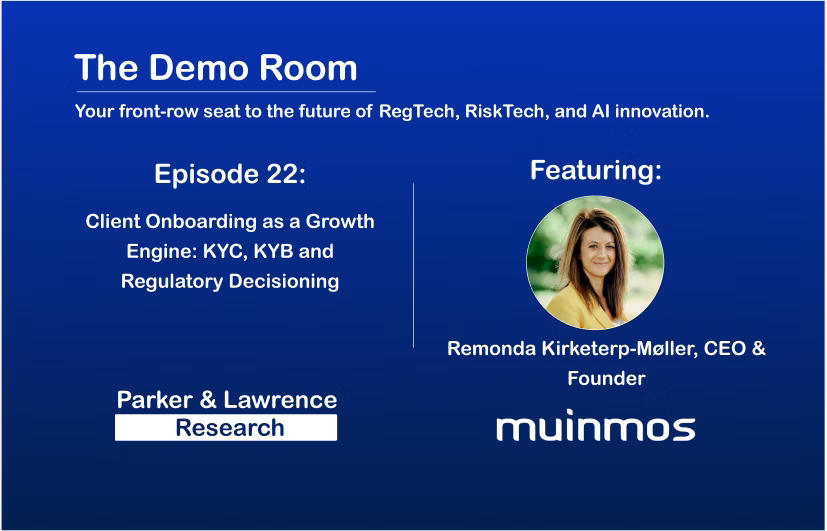
Client onboarding has long been viewed as a regulatory necessity, but leading firms are increasingly treating it as a competitive advantage. By combining KYC, KYB and intelligent regulatory decisioning into a single, risk-based process, organisations can reduce friction, accelerate customer acquisition and strengthen compliance from the very first interaction. The Global State of RegTech 2026 report – authored by RegTech Analyst and Parker & Lawrence Research – took the time to discuss the importance of moving beyond documented compliance.
As part of the research for the report, Parker & Lawrence Research interviewed market leaders in the space to discuss the evolution of client onboarding.
On this occasion, the firm spoke with Remonda Kirketerp-Møller, CEO and Founder of Muinmos, an end-to-end client onboarding and lifecycle management platform for KYC, KYB, investor protection and regulatory decisioning.
This interview was part of the wider Global State of RegTech report conducted by RegTech Analyst and Parker Lawrence Research. To download the full report, click here.
Client onboarding has long been treated as a compliance obligation to be endured rather than a capability to be optimised. That view is changing rapidly, and for regulated financial institutions, the costs of clinging to fragmented, manual processes are starting to register not just in compliance budgets but in revenue, market expansion and customer experience.
The question at the centre of every onboarding decision is deceptively complex: can this client be onboarded for this product, in this jurisdiction, under the firm’s risk appetite and applicable regulation? It reaches well beyond identity verification or sanctions screening to encompass entity data, ownership structures, politically exposed persons (PEPs), adverse media, jurisdictional risk, regulatory classification, suitability, appropriateness, product permissions and ongoing monitoring. Getting this right, consistently and at scale, requires something most institutions have not yet built: a single, law-grounded decision engine that connects all of these layers.
Research into financial crime compliance is beginning to identify law-mapped, explainable decision engines as an emerging and critical capability. In onboarding specifically, firms need decisions that are both fast and traceable, ones that can be followed back to the regulation, policy and data that produced them.
This is the problem that Muinmos was designed to solve. The platform’s founding logic is rooted in regulation rather than process, a distinction its chief executive is direct about.
Muinmos CEO & Founder Remonda Kirketerp-Møller said, “Everything Muinmos was built on as a SaaS platform started with one key source, and that is the law.”
The fragmentation problem
Across many institutions, onboarding remains a patchwork exercise. Separate vendors handle identity verification, corporate data, sanctions screening, adverse media and product suitability, while compliance teams are left to manually reconcile the outputs into a final decision. The result is duplication, delay and diffuse accountability.
The challenge intensifies across borders. Investor protection obligations differ by product type and client category. Regulatory requirements evolve. A process that satisfies the rules in one jurisdiction may fall short in another. Clients are asked to submit documentation multiple times. Sales teams are left uncertain about whether they can proceed, while compliance functions are drawn into reviews that technology should be handling.
The stakes extend beyond operational efficiency. For regulated firms, a faster onboarding process only has value if the decision it produces is defensible. Speed without accountability creates its own category of risk.
Muinmos’ law-mapped approach
Muinmos addresses the fragmentation problem by orchestrating KYC, KYB, screening, regulatory classification, suitability and appropriateness, and ongoing monitoring within a single, configurable platform grounded in legislation and regulatory guidance.
The platform’s law-mapped decision engine translates regulatory requirements into structured logic, producing go or no-go onboarding determinations based on the applicable rules, the client’s profile, enriched data, the intended product and the relevant jurisdiction. Institutional policy can be layered on top, but the architecture begins with the legal framework, supporting consistency, explainability and auditability.
For individual onboarding, the platform supports identity document validation, liveness checks, eIDV and document verification across more than 2,050 document types in more than 200 jurisdictions, drawing on connections to more than 260 registries across 73 jurisdictions. For corporate onboarding, Muinmos provides access to data on more than 650 million companies and 290 million directors, sourced from more than 9,100 registries and data sources, enabling detailed assessment of ownership structures, business activity and related parties.
Screening capabilities cover more than 2,200 watchlists encompassing over four million entities and individuals across more than 200 jurisdictions and 230 sanction regimes, with full PEP, sanctions and adverse media coverage. Critically, screening feeds into ongoing monitoring, treating onboarding as a client lifecycle process rather than a one-off event.
Where Muinmos differentiates most clearly is in investor protection. The platform determines the regulatory client category, including under frameworks such as MiFID and MiCA, and assesses whether a specific client can access specific products based on their knowledge, experience, financial profile and objectives. Many onboarding tools focus on establishing who the client is. Muinmos extends that to what the client can lawfully be offered and under which regulatory constraints.
Why this matters for the market
Analysis from Parker & Lawrence highlights the commercial impact achievable through this approach. A global multi-asset brokerage reduced onboarding time by 96% after deploying Muinmos, freeing compliance experts to focus on genuinely complex cases rather than routine processing. Improvements of that magnitude help explain why onboarding automation is increasingly framed as a growth enabler rather than a cost-reduction exercise.
The broader market dynamics reinforce the direction of travel. Boards are more willing to treat compliance transformation as a strategic priority when it demonstrably affects revenue and customer outcomes. Regulators are intensifying their focus on investor protection, suitability and ongoing monitoring obligations. Firms are under simultaneous pressure to reduce friction and strengthen the evidential trail behind their decisions.
Muinmos’ primary challenge is one common to any platform that seeks to reshape an operating model: firms must be prepared to re-examine how sales, compliance, legal and operations work together, rather than simply plugging in new technology around existing structures. That is a change management question as much as a technology one.
The underlying direction, however, is clear. End-to-end onboarding decisions, anchored in law and delivered in real time, are where regulated financial services is heading. Institutions that treat onboarding as a strategic capability, rather than a friction point to be managed, will be better placed for expansion and better protected when regulators come knocking.
Read the original post from Parker & Lawrence Research here.
Copyright © 2026 FinTech Global