
Several major FinTech deals help to bring this week’s total funding to over $2bn, as a total of 22 companies closed investment rounds.
A total of $2.3bn was rasied by companies across the FinTech sector this week, more than doubling the amount raised the previous week. Last week, a total of $1bn was raised through 17 deals, with a $260m being the biggest round.
The largest deal of the week was a colossal $900m Series H round secured by India-based CRED. The company, which offers services across payments, lending and wealth management, secured the funds through a mix of primary and secondary share purchases. Tech giant Meta led the Series H round, which will be used to support CRED’s growth, institutional capabilities and deepen its competitive position. The company’s pre-money valuation is $4.5bn.
There were a total of four FinTechs that secured rounds in excess of $100m this week. The second largest deal of the week was raised by InsurTech giant Alan. It secured €480m ($550m) for its Series G round, which was led by Prosus, with participation from existing shareholders Teachers’ Venture Growth (TVG) and Index Ventures, as well as new investor Dara Holdings. The deal brings its valuation to €5.5bn ($6.3bn.
Airwallex also closed a sizable round this week. The PayTech giant secured $320m for its Series H, which brings its valuation to $11bn. The decacorn was valued at $8bn just six months ago. The fresh capital will be directed towards accelerating product development in autonomous finance and agentic commerce, broadening the company’s regulatory and infrastructure reach into new markets, and scaling the teams behind its next-generation AI-native financial software.
The final deal to exceed $100m was raised by Taktile, an AI transformation platform for financial institutions. It raised $110m for its Series C funding round.
In terms of countries, the US dominated the market again with a total of 12. This included Taktile, Fomo, Arca, Warp, Niural, Allium, Andera, Lama AI, Caplight Technologies, Trovy, CentSight and Matic.
India was the second biggest market with three deals (Cred, Mitigata and LUMIQ), with Canada and Singapore close behind with two deals apiece. The Canadian companies were Float Financial and SELLIT9, while the Singaporean FinTechs were Airwallex and Libeara. It is worth noting that Airwallex is dual headquartered in Singapore and the US.
Other countries represented this week were France (Alan), Belgium (Warren) and the UK (Equipal).
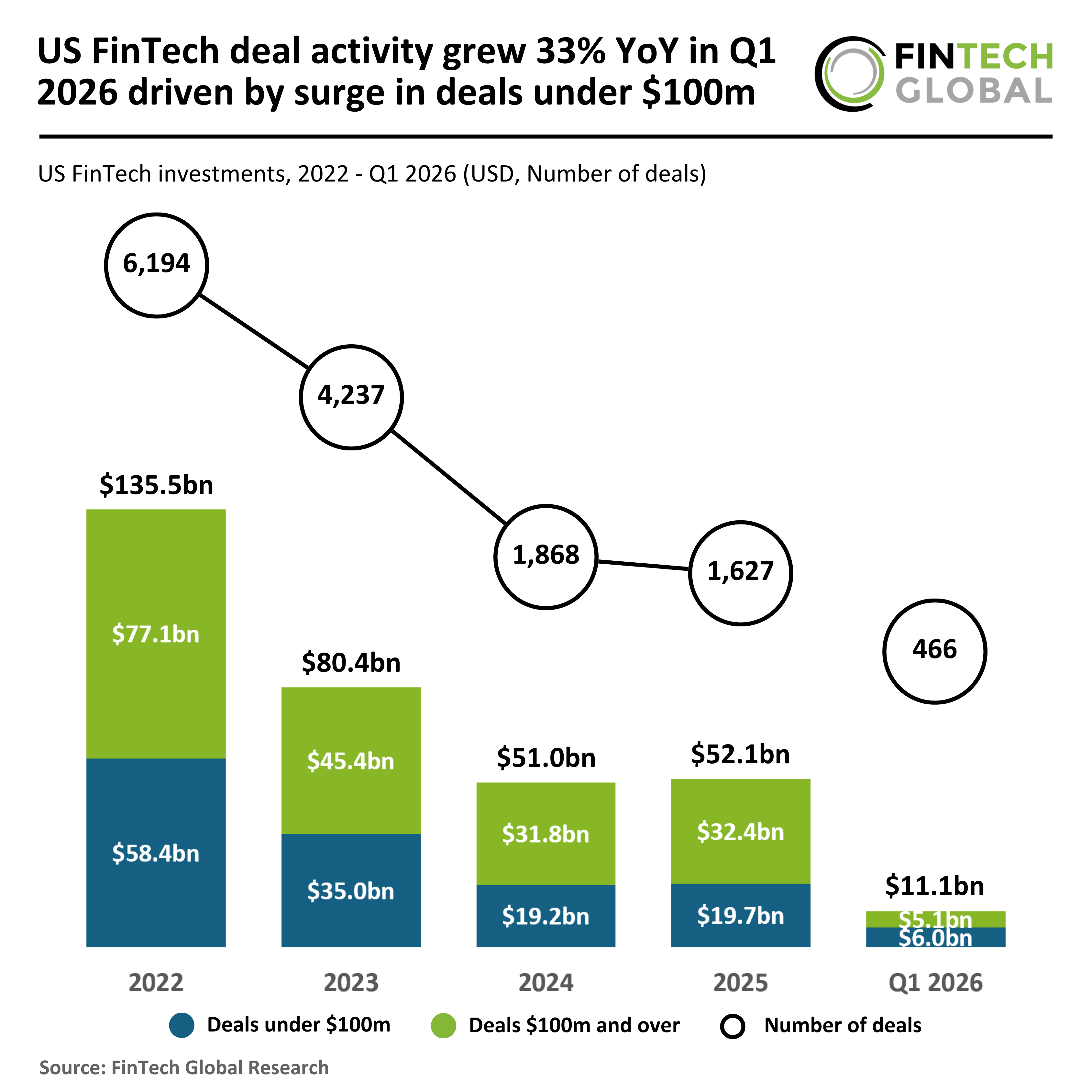
The US’ FinTeh sector has seen its deal activity rise 33% YoY, according to research from FinTech Global. US FinTech companies raised $11.1bn across 466 deals in Q1 2026, a 16% increase in funding and a 33% rise in deal count compared to the $9.6bn and 350 transactions recorded in Q1 2025.
It was a mixed week, in terms of sectors. Four sectors each recorded four deals apiece. These were WealthTech (Fomo, Arca, Libeara and Warren), infrastructure & enterprise software (Taktile, Warp, Niural and Andera), marketplace lending (Float Financial, Lama AI, Equipal and Trovy) and data & analytics (Allium, Caplight Technologies, CentSight and LUMIQ).
Behind them were PayTech with three (Cred, Airwallex and SELLIT9), InsurTech with two (Alan and Matic) and CyberTech with one (Mitigata).
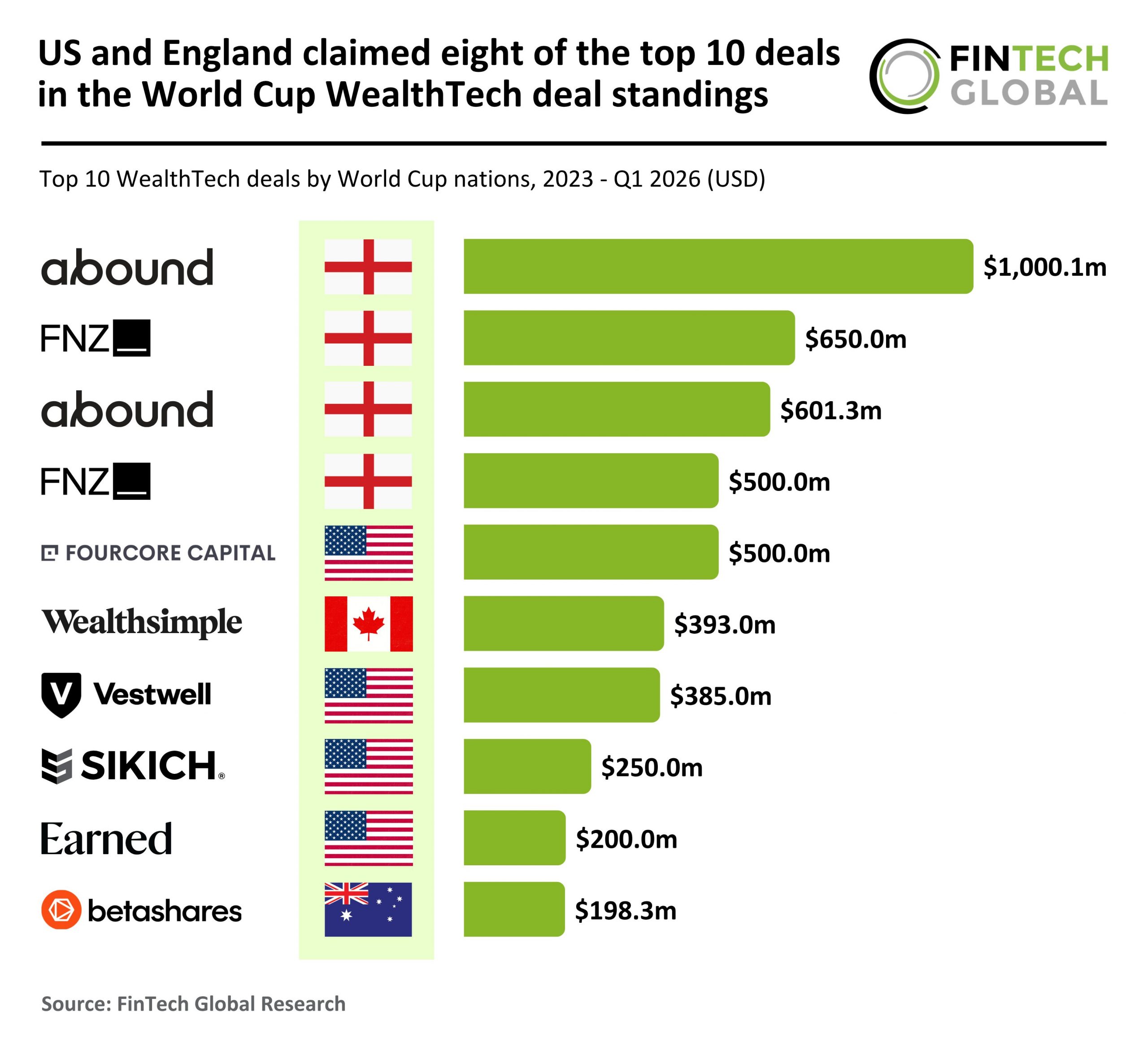
In a World Cup inspired research piece, FinTech Global found that global WealthTech deal activity among World Cup qualifying nations grew 21% as it reached $42.5bn. Global WealthTech activity among World Cup qualifying nations reached $42.5bn across 3,632 deals from 2023 through to Q1 2026. Among the 10 largest WealthTech deals recorded across World Cup qualifying nations since 2023, England and US each accounted for four, together representing 80% of the top 10.
Here are the 22 FinTech deals covered on FinTech Global this week:
Meta backs CRED in $900m Series H at $4.5bn value
CRED, the Indian FinTech platform serving creditworthy consumers across payments, lending, and wealth management, has secured INR 8,550 crore (~$900m) in a Series H funding round led by social media giant Meta.
The round, structured through a mix of primary and secondary share purchases, values CRED at a post-money valuation of INR 43,239 crore (~$4.5bn), up from a pre-money valuation of INR 38,819 crore (~$4.03bn). Meta will join CRED’s cap table as a minority investor and will not gain access to any CRED customer data under the terms of the deal.
The capital injection is intended to accelerate CRED’s growth trajectory, strengthen its institutional capabilities, and deepen its competitive position across its core product categories. Alongside the funding announcement, founder Kunal Shah will transition out of his role as CEO, while retaining his personal shareholding in the business. He will move to a position within Meta’s global leadership team. Miten Sampat, who has led strategy and finance at CRED since 2020, has assumed the role of interim CEO with immediate effect. The company’s board and senior leadership are now working to establish a formal leadership structure in preparation for an eventual IPO.
CRED was founded in 2018 and has since grown into a prominent consumer FinTech platform in India, processing more than 40% of all credit card bill payments in the country, a category it is credited with pioneering eight years ago. The platform now serves 1.7 crore (17 million) members on a monthly basis and offers products spanning payments, lending, insurance, wealth, and lifestyle. Its lending arm has scaled to INR 24,000 crore (~$2.5bn+) in managed assets under management, working with some of India’s leading financial institutions.
Alan raises €480m to expand prevention insurance globally
Alan, a prevention InsurTech valued at €5.5bn ($6.3bn), has secured a €480m ($550m) Series G financing round led by Prosus, with participation from existing shareholders Teachers’ Venture Growth (TVG) and Index Ventures, as well as new investor Dara Holdings.
The raise values Alan at €5.5bn and marks one of the largest InsurTech funding rounds in Europe this year. The closing of the financing remains subject to regulatory approvals, including sign-off from the relevant French financial authorities.
Alan has used the past decade to move beyond its origins as a conventional health insurer, pioneering what it describes as a new category, prevention insurance.
The company integrates health coverage, care navigation, wellbeing services and AI-powered health assistance into a single platform, enabling members to address health concerns before they escalate. It currently serves more than 1.1 million members and more than 37,000 businesses, as well as self-employed professionals and retirees, across France, Belgium, Spain and Canada.
The fresh capital will be deployed across several strategic priorities: expanding into new international markets, deepening the company’s foothold in its existing four countries, pursuing acquisitions, and continuing to invest in artificial intelligence, healthcare services and product development.
Airwallex raises $320m Series H at $11bn valuation
Airwallex, a global payments and financial platform, has closed a $320m Series H funding round, pushing its valuation to $11bn from $8bn just six months ago.
The round was led by returning investor Addition, with contributions from Baillie Gifford, Hummingbird, QED Investors, T. Rowe Price, Hedosophia, Haun Ventures, Washington University in St. Louis and Amex Ventures.
The fresh capital will be directed towards accelerating product development in autonomous finance and agentic commerce, broadening the company’s regulatory and infrastructure reach into new markets, and scaling the teams behind its next-generation AI-native financial software.
Alongside the funding announcement, Airwallex revealed two new product initiatives. The first, T:0, is an AI-native platform designed to handle the complete finance function of a business from the outset, covering bookkeeping, forecasting, taxes, compliance and reporting without any migration required. It is currently in private beta, with a wider rollout expected in the coming weeks.
The second, Airi, is an agentic consumer wallet that at launch will feature one-click checkout functionality, which has already demonstrated up to a 14% uplift in successful checkout conversions for digital merchants during early testing. Airi is set to expand in the months ahead to include delegated agent payments, spend controls, permission management and multi-currency balances. When paired with Airwallex’s Agentic Commerce Suite, the product is intended to deliver a fully regulated end-to-end commerce flow for both merchants and consumers.
Taktile raises $110m to put AI at heart of finance
Taktile, an AI transformation platform for financial institutions, has closed a $110m Series C funding round led by Growth Equity at Goldman Sachs Alternatives.
Joining Goldman Sachs in the round were existing and new backers including Balderton Capital, Index Ventures, Tiger Global, Y Combinator, and Dig Ventures. The capital will be channelled into enhancing Taktile’s AI capabilities for complex banking and insurance applications, as well as broadening its presence across the US, EMEA, and LATAM.
Taktile helps banks and insurers transition into AI-native organisations, enabling them to build, oversee, and operate autonomous agent-driven decisions within a framework that business leaders across credit, fraud, and underwriting functions can understand and manage. Unlike general-purpose AI tooling aimed at engineering teams, Taktile is purpose-built for regulated financial services environments, where errors in automated decisions can have significant financial and regulatory consequences.
The new funding builds on the company’s track record of deploying AI agents within complex, heavily regulated enterprises. Taktile Labs, founded as the firm’s applied research arm, continues to monitor capability thresholds and translate advances in frontier AI into production-ready solutions for the financial sector.
Fomo raises $75m Series B to scale on-chain trading
Fomo, a social-first trading platform that simplifies access to on-chain markets, has raised $75m in a Series B round led by Index Ventures, with participation from Union Square Ventures and existing backer Benchmark.
The capital injection comes as major legacy exchanges, including the NYSE and NASDAQ, pursue blockchain-based asset issuance, signalling a broader shift in global financial market infrastructure. Despite this momentum, on-chain participation remains out of reach for most consumers, who must contend with non-custodial wallet management, fragmented blockchains, volatile gas fees, and complicated token bridges, barriers that have historically benefitted digital asset-native users over mainstream investors.
Fomo intends to deploy the fresh funding to broaden its asset offering, adding equities, perpetuals and prediction markets, while continuing to develop its trading and social platform.
Fomo’s platform addresses the complexity of on-chain trading by consolidating liquidity, automating transaction routing, and offering straightforward onboarding through methods such as Apple Pay.
Beyond execution, fomo positions its social layer as central to the platform’s value proposition. Users can browse trending assets, follow high-performing traders, monitor open positions, and view real-time profit-and-loss data through public leaderboards, replacing the unverifiable screenshots common on traditional social media. The platform’s creator ecosystem has grown considerably, with several prominent fomo content creators accumulating more than 100,000 followers within a year of launch.
Arca exits stealth with $64m to reshape wealth management
Arca, an AI-native WealthTech company focused on personalised, advisor-led financial services, has emerged from stealth and announced it has raised a total of $64m across a seed round and a Series A.
The $48.5m Series A was led by General Catalyst, with participation from Index Ventures and Venrock. Venrock had previously led the company’s $15.5m seed round.
Arca currently oversees more than $1bn in client assets and employs 28 people across wealth management operations, product and engineering. The company intends to use the capital to expand its client base and advisory team, while continuing to build out its platform and brand.
Despite trillions of dollars sitting in the hands of more than a third of US households, those clients still lack access to the kind of proactive and personalised wealth management the industry is capable of delivering. With upwards of 15,000 SEC-registered registered investment advisers (RIAs) across the United States, service quality remains inconsistent. Research also indicates that advisors currently spend less than a fifth of their working time with clients, as the remainder is consumed by back-office tasks, fragmented tooling and manual processes.
Arca combines high-touch advisory services with AI-powered automation designed to absorb the manual and repetitive elements of wealth management. The aim is to free up advisors to spend more time with clients and deliver a higher calibre of personalised financial guidance, ultimately improving outcomes. The company’s infrastructure is built to strip away the operational complexity that typically crowds out the most valuable parts of an advisor’s role.
Warp raises $60m Series B to rebuild HR software with AI
Warp, an AI-native human capital management (HCM) platform, has closed a $60m Series B funding round led by Battery Ventures, with participation from Peak XV, Sound Ventures, and Y Combinator, bringing its total funding to $85m in under a year.
The round came together in just six days, ahead of the company’s original plan to fundraise in the autumn. Notable angel investors joining the round include Shopify CEO Tobi Lütke, former Stripe COO Claire Hughes Johnson, Dropbox co-founders Drew Houston and Arash Ferdowsi, former Coinbase CTO Balaji Srinivasan, former Eventbrite founder and CEO Kevin Hartz, former Cruise founder and CEO Kyle Vogt, and Replit founder Amjad Masad.
Warp positions itself as a challenger to legacy HCM systems such as Workday, arguing that the employee management category remains one of the last major areas of enterprise software yet to be rebuilt around artificial intelligence.
The platform covers payroll, HR, compliance, benefits, onboarding, offboarding, and IT operations across a single system, serving companies with between five and 5,000 employees. Rather than surfacing tasks for administrators to complete, Warp is designed to execute those tasks autonomously, registering accounts in new states, filing tax returns, and reconciling benefits elections directly into payroll without manual intervention.
Proceeds from the round will be directed towards developing deeper AI agents, expanding its tax and compliance infrastructure, broadening its product suite, and scaling customer support.
Float Financial raises CAD $85m ($59.9m) Series C
Float Financial, a Canadian business finance platform offering corporate cards, bill pay, and working capital credit, has closed a CAD $85m all-equity Series C round, lifting its valuation by 70%.
The round was led by Inovia Capital, with continued support from Goldman Sachs Alternatives, which led the company’s Series B in December 2024, and Garage Capital. New investors BDC Capital and Northleaf also joined the round. The raise brings Float’s total capital secured since inception to CAD $300m, spanning both debt and equity, with all existing investors maintaining their positions.
The fresh capital will be directed towards three areas: building out Float Intelligence, the company’s AI-driven layer that automates day-to-day finance workflows; geographic expansion across Western Canada and Quebec; and recruitment across product, research and development, sales, and marketing.
Float’s platform gives Canadian businesses a single, integrated environment to manage spending, payments, and cash. Its products include corporate cards in CAD and USD, high-yield business accounts, bill pay automation, working capital credit, and cross-border payments, all built within Canada’s regulatory and bilingual framework. The platform serves customers including Cohere, Knix, Neo, Jane, and Rebel. As part of the transaction, Inovia Capital partner Dennis Kavelman will join Float’s board of directors. CEO and co-founder Rob Khazzam recently joined the board of Fintechs Canada as part of Float’s efforts to shape national policy around the future of finance.
Niural grows Series A to $52m with AI Labs launch
Niural, an AI-native platform for global payroll and benefits, has launched Niural AI Labs, a dedicated research arm focused on developing long-horizon AI agents for high-stakes operational domains, alongside $21m in new strategic capital that brings its Series A to $52m.
The fresh funding came from customers and partners already using Niural in production, including FOG Ventures and NewView Capital, with continued participation from existing investors.
Niural AI Labs is designed to extend capabilities the company developed through running regulated payroll and benefits infrastructure into other domains where accuracy, compliance and deadlines are critical. The Lab’s foundational stack includes workflow orchestration, agent decomposition, verifiable data infrastructure, evaluation systems, and post-training loops built around correctness.
For existing Niural customers, the Lab functions as the engine behind the product roadmap, with each development intended to feed back into the core platform as more autonomous workflows, reduced manual handoffs and broader agent coverage.
The company operates in more than 150 countries, moving billions of dollars in global transaction volume annually for clients including Rillet, Sevaro, ConductorOne and Polygon. It runs proprietary tax engines and regulated money movement capabilities, and in April 2026 launched a master medical partnership with Aetna, adding to existing institutional partnerships with Guardian and Kaiser. Since that partnership went live, Niural has crossed $200m in annualised gross revenue on its PEO product alone.
Why Allium’s $40m raise could reshape onchain finance
Allium, a blockchain data platform serving enterprises and financial institutions, has closed a $40m Series B funding round as global finance accelerates its shift onto blockchain infrastructure.
The round was led by Amplify Partners, with Kleiner Perkins and Theory Ventures returning as existing investors. Amplify’s David Beyer will also join Allium’s board as part of the deal.
The raise arrives at a moment of significant momentum for blockchain-based finance. Stablecoin circulation has reached $302bn, onchain payments volume hit $394bn in 2025, and tokenised financial instruments now account for $27.6bn. Despite this growth, institutions have lacked a reliable and standardised way to operate within these systems.
Since its Series A, Allium has grown revenue more than tenfold and now counts more than 150 enterprise clients spanning financial institutions, FinTech companies, and government agencies. Among its notable partnerships, Visa worked with Allium’s data to build its Onchain Analytics Dashboard, giving partners live visibility into onchain payment flows and wider ecosystem activity. BCG also relies on the platform to underpin stablecoin payments research and digital asset advisory services for institutional clients.
Its product suite includes Terminal, which delivers analytics through dashboards, APIs, and data warehouse integrations, enabling trading, compliance, and product workflows. Rather than limiting data to visualisation, the platform allows users to track where growth is occurring, monitor how stablecoins and tokenised assets are being deployed, and feed insights directly into broader organisational workflows.
Andera raises $37m to automate internal audit
Andera, an AI-native platform built to automate the internal audit function, has secured $37m in a Series A funding round led by Lightspeed Venture Partners.
The investment marks Lightspeed’s conviction that the audit sector has reached a pivotal moment for AI-driven transformation. The venture firm spent several months building its thesis before committing capital, consulting with finance and audit leaders across Fortune 500 companies spanning technology, financial services, healthcare, and consumer sectors, alongside Big Four partners and former Public Company Accounting Oversight Board (PCAOB) officials.
Lightspeed concluded that a genuine opportunity had opened for a new entrant, driven by two converging forces: the arrival of large language model reasoning capable of handling complex audit workflows, and mounting pressure from CFOs demanding efficiency gains of 200-300% from back-office functions.
Andera’s platform automates the end-to-end testing of every control type, from user access provisioning through to complex bad debt reserve and management review controls, spanning SOX, operational, and compliance categories. The system processes hundreds of millions of tokens of financial evidence per control across sources including Excel workbooks, PDFs, system screenshots, and journal entries.
At its core is a proprietary agentic retrieval engine that draws relevant evidence across billions of tokens without the recall failures associated with conventional vector-retrieval approaches. The architecture also includes probabilistic beam search to concentrate compute on uncertain areas of the data graph, and bespoke agents that interact with financial workpapers with precision. The company’s longer-term vision extends to documenting, assessing, and testing any category of control regardless of industry, complexity, or the underlying system.
EJF Ventures backs Lama AI’s $20m lending push
Lama AI, an AI-native loan origination platform purpose-built for community and regional banks, has closed a Series A funding round that brings its total capital raised to over $20m, as the company reports 3x year-on-year revenue growth.
The round was led by EJF Ventures, the FinTech arm of EJF Capital. New investors Fin Capital and 1st & Main joined alongside a number of banking industry veterans, with existing backers Viola Ventures, Hetz Ventures and SixThirty all returning. The proceeds will be used to expand Lama AI’s go-to-market and customer success functions, scaling to meet rising demand from banks across the United States, while the company continues to build out AI capabilities tailored to regulated financial institutions.
The platform is already live at dozens of community and regional banks, including SouthState Bank, Colony Bank, Capital Community Bank, First Bank, Gate City Bank and Luminate Bank, and has processed billions of dollars in loan volume since its launch.
Lama AI’s platform is designed to handle the full lending lifecycle, from initial borrower intake and document collection through to spreading, underwriting, decisioning, approval, closing and ongoing portfolio monitoring. Crucially, it operates within each institution’s own policies, credit standards and compliance requirements, rather than displacing them.
Equipal secures £16.25m ($21.4m) from Altum Capital Management
Equipal, a UK-based tech-enabled business equipment funder, has secured £16.25m in combined equity investment and forward flow funding from Altum Capital Management, an institutional credit fund, to accelerate its growth in the UK asset finance market.
The deal comprises a £1.25m equity injection alongside a £15m forward flow facility, the latter consisting of initial full lease funding and contingent junior funding. Altum Capital provided both components of the transaction.
The funding comes at a difficult period for platform lending and the broader private credit market, where many smaller platforms have been constrained by investors pulling back. Altum Capital structured the transaction conservatively, with strong credit enhancement and robust legal and corporate protections, while backing equipal’s credit capability, business model and growth plans.
Equipal runs a proprietary platform embedded at the point-of-sale with more than 75 equipment vendors across the UK, enabling businesses and vendors to arrange fast, fully digital asset finance for equipment purchases of up to £250,000. The company serves sectors including manufacturing and transport, financing hard assets ranging from CNC machines to coaches across terms of up to five years.
Caplight raises $16m Series A from BlackRock and Fin Capital
Caplight Technologies, a San Francisco-based venture capital data and transaction infrastructure platform, has closed a $16m Series A funding round co-led by BlackRock and Fin Capital, with strategic participation from UBS Investment Bank.
The round also drew involvement from new investor LEAP Global Partners as a co-lead, while existing backers DB1 Ventures, the corporate venture arm of Deutsche Börse Group, Better Tomorrow Ventures, Clocktower Ventures, and Dash Fund each increased their positions.
The proceeds are set to extend Caplight’s lead in venture secondary data whilst driving expansion across private market data offerings and agentic workflows for both research and transactions.
Caplight’s own data points to the scale of the opportunity it is addressing. Venture capital has grown threefold over three years to become a $12tn-plus asset class, yet the supporting infrastructure has not kept pace. The platform currently brings together 100,000 company and investor profiles, $4tn in funding round data, more than $300bn in proprietary secondary data, and over $5bn in daily live transaction flow. Clients, who collectively manage more than $52tn in assets, can access the platform via a direct interface, API, or MCP server.
Mitigata raises $15m Series B for AI cyber resilience
Mitigata, India’s first AI-native cyber resilience platform, has closed a $15m Series B funding round to accelerate its ambition of building the country’s largest sovereign, indigenous AI security infrastructure.
The round was led by Bessemer Venture Partners, with existing investors Nexus Venture Partners, Titan Capital and WEH Ventures also participating.
Mitigata intends to use the capital to expand its Security Operations Centre into India’s largest, grow its team across AI, research and development, product, engineering and customer success, with plans to double headcount, and accelerate international expansion.
Founded in 2023 by Mohit Anand, Sarthak Dubey, Mayank Morya and Akshit Kaushik, Mitigata operates on the principle of Insure. Detect. Defend. Recover., guiding organisations through every stage of their cyber resilience journey. Its offering spans cyber insurance for risk assessment and transfer, AI-powered security operations and cyber risk intelligence for threat identification, compliance automation for strengthening defences, and digital forensics, incident response and breach recovery services.
Home equity credit card startup Trovy closes $25m raise
Trovy, a US consumer FinTech replacing high-cost consumer debt with home equity-backed financing, has announced it has closed a $15m Series A, bringing its total capital raised to $25m.
The Series A was led by Left Lane Capital, with existing seed investors Kleiner Perkins, DCM Ventures, and Camber Creek all returning to participate in the round. The proceeds are earmarked to drive Trovy’s nationwide expansion, deepen its product capabilities, and scale the team behind what the company describes as the definitive financial home base for America’s 85 million homeowners.
The funding arrives against a backdrop of record household debt in the United States, where non-mortgage consumer debt has climbed past $5tn, costing Americans an estimated $550bn in interest payments each year, with many borrowers carrying balances at annual percentage rates exceeding 20%. Trovy’s argument is that homeowners sitting atop trillions of dollars in untapped equity are paying far more to borrow than they need to, and that a smarter financing route is already within reach.
Trovy operates as a licensed consumer lender, which gives it direct ownership of its product, underwriting processes, and overall borrower experience rather than relying on bank partnership arrangements common to many FinTech platforms.
Its flagship offering is a home equity-backed credit card that grants homeowners flexible, on-demand access to low-cost capital usable anywhere, positioning it as a direct alternative to high-rate credit cards, personal loans, and fragmented specialty financing products. The card itself is issued by Cross River Bank under a Mastercard licence. The company is also preparing to launch its second product this summer: the 1Loan, a home equity line of credit designed specifically for home purchases and refinancing, providing borrowers with ongoing flexible access to equity for a range of subsequent needs including improvements and debt consolidation.
Libeara raises $14m to scale tokenisation infrastructure
Libeara, a provider of tokenisation infrastructure for regulated digital assets, has closed a $14m strategic funding round led by GSR, a global market maker.
The round also brought in Openspace Capital, Kyobo Life Insurance Group, AlloyX, Monk’s Hill Ventures, Kaia Investment Partners and Simsan Ventures as regional distribution and ecosystem partners.
Proceeds from the raise will be used to accelerate Libeara’s international growth as it works to become a primary provider of tokenisation infrastructure, with the aim of enabling financial institutions and asset managers to seamlessly issue and distribute digital assets.
Openspace Capital, a Southeast Asian venture capital firm whose portfolio spans early-stage to growth technology companies across Web3 and enterprise software, joins the round with the view that tokenised assets will form a central part of next-generation financial markets. Kyobo Life Insurance Group, meanwhile, has been deepening its focus on the tokenisation of Real World Assets (RWA) and the use of digital assets across several of its affiliate businesses in South Korea.
Warren’s €10m ($11.3m) bet on fixing Belgium’s broken pensions
Warren, a Ghent-based WealthTech platform operating its own regulated pension fund and offering AI-powered financial coaching to employees, has closed a €10m seed round to accelerate its Belgian growth and lay the groundwork for a wider European push.
The round was led by the venture arm of transatlantic investment fund Motive Partners, with F Capital joining as a new backer alongside returning investors Entourage, Syndicate One and 100IN.
Warren obtained an IBP licence in June 2025 and has since operated Warren Pension Fund OFP, a regulated fund supervised by the FSMA that invests through a diversified portfolio of equity and bond exchange-traded funds. There are no entry or exit fees, no percentage-based charge on assets under management, and no additional cost for companies that switch provider.
Employers pay a fixed subscription, and the full investment return goes to the employee. Within its first year of operations, around a hundred Belgian companies, including Lighthouse, Yuki, Wintercircus and Poppy Mobility, have moved their pension arrangements to the platform, with thousands of employees now accessing it on a daily basis. The new capital will be used to expand Warren’s team by around thirty people and fund the groundwork for entry into one or two larger European markets after consolidating in Belgium, with the company targeting 100,000 employees on the platform by 2028.
SELLIT9 raises $4.1m to expand recommerce platform
SELLIT9, a Toronto-based recommerce platform enabling consumers to unlock liquidity from unused household items, has raised $4.1m CAD ($3m USD) in a new funding round to drive expansion across Canada and the United States.
The round was led by the Business Development Bank of Canada’s (BDC) Seed Venture Fund, with participation from MaRS Investment Accelerator Fund (IAF), AQC Capital and Anges Québec.
The capital will be used to scale SELLIT9’s platform, bring on additional retail partners, and prepare for broader entry into the US market. The company also plans to expand its engineering team in Toronto and extend its real-time pricing capabilities.
SELLIT9 operates a trade-in platform that begins with electronics, before broadening into other household goods. Consumers can quickly exchange unused items for liquidity, while retail partners benefit from improved customer retention, increased sales driven by trade-in incentives, and support for their sustainability commitments, all without needing to manage the traded stock themselves.
Since launching, the platform has processed more than 6,000 trades worth over $2.4m, supported by a network of more than 100 refurbishers and 25 merchants. The company states the model has already kept a significant volume of electronic waste out of landfills.
CentSight launches with $1.5m pre-seed backing
CentSight, an AI-native financial intelligence platform designed for small and mid-sized businesses, has officially launched publicly, offering business owners access to CFO-grade financial insight without the associated hiring costs.
The company has secured a $1.5m pre-seed investment from Mudita Venture Partners to support the launch. CentSight was also built alongside Mudita Studios, Mudita’s company creation arm, which provided product, engineering, finance, and go-to-market support throughout the platform’s development.
CentSight integrates directly with tools that businesses already rely on, including QuickBooks Online and bank accounts via Plaid, enabling owners to query their finances in plain English across areas such as cash flow, expenses, revenue, profitability, runway, and margins, without the need to work through spreadsheets or wait for month-end reports.
A key feature of the platform is Signals, a proactive alert system that continuously monitors connected financial data and flags potential issues before owners are aware they need to ask. Rather than generating generic dashboard notifications, Signals converts financial movements into specific business prompts, for example flagging a cash gap forming in the coming weeks, a customer falling behind on payment, or a vendor category experiencing an unexpected rise.
LUMIQ secures funding to automate financial decisions at scale
Read the daily FinTech news
Copyright © 2026 FinTech Global