There was a total of $1.36bn raised in 12 FinTech deals this week, representing a strong first week of September following the end of the summer holiday season.
The dominant round this week came from WealthTech giant FNZ, who were able to snatch up $450m in new equity funding. There was a number of nine-figure raises, including firms such as AJIAB of Indonesia and Felix of Mexico.
This week saw WealthTech firms make up most of the deals, pulling in four funding raises. Financial infrastructure companies, PayTech firms and CyberTechs made up two of the deals. RegTech and InsurTechs pulled in one each.
US firms made up seven of the deals this week, whilst Indonesia, India, Brazil, Israel and Mexico made up the rest with one deal each.
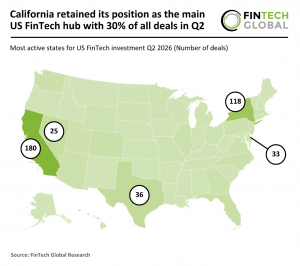
The strong performance by US firms is no surprise, considering how well the country is performing in the FinTech sector. Research from FinTech Global this week found that US FinTech firms raised $16.3bn across 610 deals in Q2 2026.
Funding climbed 9% from $14.9bn in Q2 2025 and had a sharp increase of 47% from the $11.1bn raised in Q1 2026. Deal volume fell 5% from 642 transactions in Q1 2026 but rose 12% from 546 deals in Q2 2025.
Here are this week’s deals.
Investors back FNZ’s $450m WealthTech transformation
FNZ has secured $450m in new equity funding from a group of existing long-term institutional shareholders.
The capital was provided by some of the firm’s most established backers, including La Caisse, Canada Pension Plan Investment Board (CPP Investments), Generation Investment Management and Motive Partners.
The funding is intended to support FNZ’s ongoing transformation programme, with proceeds directed towards its technology platform, its people and its product range, as the Group looks to capture what it describes as a significant market opportunity ahead.
Over the past twelve months, FNZ has worked to consolidate its position and narrow its focus onto its core wealth management technology business, which serves large financial institutions.
The Group has renewed and expanded several major client relationships across its key markets during that period, and it has also introduced FNZ Select, a premium tier of service offering clients heightened support, more sophisticated capabilities and additional platform resources.
Alongside this, FNZ has carried out a series of notable divestments intended to sharpen its strategic focus. These include the disposal of FNZ Bank in Germany, its fund platform based in Luxembourg known as IFSAM, and its core banking software business in Switzerland. According to the company, these sales are freeing up resources so that FNZ can concentrate on its strategic priorities and improve how it executes its plans.
FNZ operates a wealth-management platform used by large financial institutions to deliver investment and wealth services to their end clients. Its business spans technology, product and operational support designed to help institutional partners run their wealth offerings.
The new funding round and the accompanying disposals form part of a broader effort by FNZ to become a more focused organisation with tighter operational discipline, positioning it to keep executing its long-term business plan as it works to build profitability.
FNZ group chief executive officer Blythe Masters said, “We continue to make strategic progress, creating a more focused business, driving greater operational discipline and delivering more consistently for our clients. This capital provides the financial strength to continue executing our plan as we harness technology to transform wealth management in partnership with our clients.”
SBI invests $270m in Indonesia’s Ajaib in record round
Ajaib, the Jakarta-based investment platform, has reportedly closed a $270m equity round backed by Tokyo-listed financial services group SBI Holdings, in what it describes as the largest amount raised by an Indonesian technology company in more than four years.
The Series C financing was significantly oversubscribed and was priced at a premium to the valuation Ajaib achieved when it reached unicorn status in 2021, according to a report from e27.
The fresh capital takes Ajaib’s total funding raised to more than $500m.
Founded in 2019, Ajaib runs a fast-growing investment platform in Indonesia, offering services that span stock trading, mutual funds and digital assets.
The company positions itself as Indonesia’s first fully online stock brokerage, operating without physical branches or offline brokers, and says it built its mobile-first platform around low fees and ease of use to make investing accessible to younger customers.
It reports a customer base of more than three million and describes itself as the fastest-growing investment start-up in South-East Asia. Alongside DST Global, its backers include Horizons Ventures and Alpha JWC Ventures, and the company says it was Indonesia’s first fintech unicorn in the investment space.
Ajaib said the new capital will go towards expanding its business and increasing headcount in Indonesia and across the wider region.
Félix lands $200m to rewire US Latino banking
Félix, a FinTech that connects people in the United States with family across Latin America through a conversational financial platform built on WhatsApp, has announced it has closed $200m in new funding led by Andreessen Horowitz and General Catalyst.
The raise comprises an $87m equity investment led by Andreessen Horowitz, with participation from QED Investors, Castle Island Ventures, Switch Ventures, Contour Venture Partners and Endeavor Catalyst. It also includes a separate $113m commitment from General Catalyst’s Customer Value Fund, which will support the company’s growth.
The fresh capital will be used to push Félix further into becoming a multi-product financial provider, built around what it calls its Cognitive Financial Companion, a conversational tool designed to interpret what a customer needs in their own words and match them with a suitable financial service.
Plans include building out lending and savings offerings through third-party partners, growing established services such as remittances and mobile top-ups, and putting more resources behind the artificial intelligence, engineering and financial infrastructure that underpins the platform.
Rather than sending customers between separate apps, menus and forms for each financial task, Félix folds these services into a single conversational interface on WhatsApp. The company starts with the outcome a customer wants to achieve and works backwards to the appropriate financial product, an approach it says is intended to help users make progress on more of their financial goals.
Félix has processed more than $8bn in transactions since launch and has grown revenue by more than 2.5 times over the past year. It currently links customers in the United States with relatives across eleven Latin American markets, namely Mexico, Guatemala, Honduras, El Salvador, Nicaragua, Colombia, the Dominican Republic, Costa Rica, Brazil, Ecuador and Peru, having processed transactions for more than six million people across the Americas.
The business began by focusing on remittances before adding mobile top-ups after customers asked for ways to keep relatives’ phones connected, and it has built out its payments and distribution network through relationships with Stripe, Checkout, Circle, Zerohash, Bitso, Uniteller, Dlocal and Mastercard.
Its branchless model allows it to direct investment towards engineering, artificial intelligence, compliance and financial infrastructure instead.
The company cites recent reports estimating the US Latino population at approximately 68 million people generating around $4.4tn in annual economic output, alongside Nielsen data suggesting Hispanic consumers are 29% more likely than the general population to use AI platforms, and Latino Donor Collaborative figures indicating Latino-owned businesses adopt AI at twice the rate of their peers.
Proceeds will also go towards expansion across Latin America and additional hiring in engineering, artificial intelligence and product development.
Félix co-founder and CEO Manuel Godoy said, “I experienced this problem personally. When I came to the U.S., even getting a small loan was harder than it should have been. Traditional financial institutions often start with the product they want you to use. We want to start with the person. You tell Félix what you need, in your own words, and we help you figure out the rest.”
Godoy said, “We don’t have to guess what our customers need next. They tell us. That has always been the secret to Félix: we build as close to our customers as possible. Latinos in this country have spent decades adapting to financial products that were never designed for them. We are building the opposite. With this funding, we will cement Félix as the Cognitive Financial Companion for a community traditional banks never built for. They should never have had to wait this long.”
TabaPay raises $155m as it moves into banking
TabaPay has secured $155m in strategic growth financing from FTV Capital as it prepares to move into banking through the planned acquisition of Transact Bank.
The financing combines new primary capital with a secondary transaction and comes alongside TabaPay’s plans to acquire Transact Bank, an OCC-chartered and FDIC-insured bank headquartered in Denver, Colorado.
Following completion of the deal, Transact Bank will be rebranded TabaBank, N.A. and will sit alongside TabaPay under a newly formed holding company, TabaHoldings, Inc.
The move is intended to bring payments and banking capabilities under one roof, giving TabaPay’s customers access to a more integrated service while the company continues to work with its existing network of more than 20 partner banks across the US and Canada.
TabaPay operates a money movement platform serving fintechs, lenders and high-growth platforms across the US and Canada. Its single API supports payments across both card and bank rails, and the company says its infrastructure can reduce client costs by as much as 75% while improving reliability.
The company is on track to process more than $100bn in payment volume this year and is the fifth-largest card-not-present processor in the US by transaction count, according to TabaPay. It also says its services are used by around one-third of American households.
The planned banking operation is designed to address some of the growing complexity around sponsor banking as fintech platforms expand into new use cases and increasingly rely on multiple banking partners.
TabaBank will work alongside TabaPay’s existing bank network to provide additional capacity for use cases including digital banking and debt repayment. It will support major money movement rails including RTP, FedNow, ACH and wire transfers, as well as card sponsorship across Visa, Mastercard, Discover and regional networks.
The bank is also expected to act as an acquirer across industries and major card networks, strengthening TabaPay’s sponsorship offering for merchants, independent sales organisations and payment facilitators.
Alongside the banking expansion, the $155m raised will support further product development, including new merchant liquidity tools, as well as potential acquisitions.
TabaBank is expected to become one of a small number of payments-focused banks based in Silicon Valley, according to TabaPay, giving it closer proximity to fintech and technology companies with complex money movement requirements.
TabaPay co-founder and CEO Rodney Robinson said, “For nearly a decade, TabaPay has helped innovative fintech companies move money faster, more efficiently and more reliably. The planned launch of TabaBank will bring payments and banking capabilities under one roof, offering our clients a more integrated experience while continuing to work alongside our network of bank partners. Together, TabaBank and FTV’s investment will expand our capabilities and help keep TabaPay at the forefront of payment innovation.”
FTV Capital partner Robert Anderson said, “As payments infrastructure becomes increasingly complex and mission-critical, TabaPay stands out for its scale, reliability, and profitable growth. We’ve known Rodney and the team for several years and have been continually impressed by the differentiated platform they’ve built, as well as the trust they’ve earned from many of the industry’s most demanding financial services companies. We are excited to support TabaPay as it launches TabaBank and executes on its next phase of growth.”
Slice reportedly raises $100m as valuation hits $450m
India-based Slice has reportedly raised $100m in a funding round that puts its valuation at $450m.
Neo Wealth served as the lead investor, with contributions also coming from Kado Global and Moore Strategic Ventures, according to a report from MoneyControl.
The funding round includes a secondary share sale by existing investors. It was not disclosed how much this accounted for.
The report does state that between $20m – $25m of the total funding round was supplied by Neo Wealth.
Slice previously raised $50m in a financing round back in 2021, which had put its valuation between $1.5bn and $1.8bn.
The company offers digital banking capabilities, including savings accounts, UPI credit cards, UPI ATMs, fixed deposits, lending and more.
HiddenLayer bags $100m to guard enterprise AI agents
HiddenLayer, the AI security company that protects agentic, generative and predictive AI applications for enterprises, has closed a $100m Series B funding round.
The round was led by Delta-v Capital, with additional backing from Ten Eleven Ventures, Morgan Stanley, M12, Microsoft’s Venture Fund and Booz Allen Ventures.
HiddenLayer plans to put the capital towards expanding its enterprise platform, with a particular focus on its Agentic Runtime Security offering and a newly launched product called Agent Harness Security. The latter builds on the existing Runtime Security module, extending protection to AI coding agents while they operate, and is aimed at businesses bringing autonomous coding tools into their development environments.
The Series B follows a year of rapid expansion for the company. Annual recurring revenue climbed more than tenfold, and HiddenLayer added over 50 new platform customers spanning securities brokerage, banking, insurance, accounting, government, technology, IT services, pharmaceuticals, airlines, and the US defence and intelligence sectors.
Its international customer base grew too, taking in one of the world’s largest pharmaceutical firms alongside several premium automotive and food and beverage brands. Separately, the company also helps a major frontier model provider secure a platform used by more than 700 million people weekly.
Much of this momentum stems from HiddenLayer’s research division, which holds 39 granted patents and a further 65 pending, covering areas such as adversarial detection, model protection and AI threat analysis.
The team built the first Adversarial Prompt Engineering Taxonomy and continues to track emerging risks across generative, predictive and agentic AI, having identified numerous vulnerabilities throughout the AI stack, from foundation models through to supporting tools and infrastructure.
With the new funding, HiddenLayer is prioritising three areas of enterprise exposure: giving organisations real-time visibility into how their AI agents behave in production and the ability to flag or halt misuse; securing the agentic harnesses and autonomous coding agents that increasingly write and deploy code with limited human review; and reinforcing the view that trustworthy AI cannot rely on design-time safeguards alone but must be verified continuously at runtime.
HiddenLayer secures agentic, generative and predictive AI applications across the full AI lifecycle, covering everything from discovery and AI supply chain security to attack simulation and runtime protection.
Chris Sestito, CEO and Co-Founder of HiddenLayer, said, “We set out to pioneer trusted, secure use of AI for enterprises, long before most organizations saw the urgency we do today. This funding lets us keep growing the purpose-built team and platform required to meet that moment as agentic AI becomes core to how enterprises operate.”
Delta-v Capital Partner Dan Williams said, “Traditional security tools were built for code and infrastructure, not for models that can be poisoned, hijacked, or manipulated through their own inputs.
“HiddenLayer built a platform from the ground up to secure AI across its full lifecycle, from the model at its core to the agentic systems being layered on top and whatever architecture comes next. We’ve watched this team turn deep adversarial-AI research into a product CISOs actually rely on, and we’re proud to partner with them.”
Corgi raises $40.7m as AI insurer builds on $2.6bn valuation
San Francisco-based AI insurance platform Corgi has raised $40.7m through a securities offering, according to a regulatory filing with the US Securities and Exchange Commission (SEC), building on a previous $2.6bn valuation.
The company raised the full $40,678,902 from 11 investors through a combination of equity and rights to acquire additional securities.
The first sale under the offering was recorded on 9 July, with outside investors required to make a minimum investment of $10,000.
The offering was filed under Rule 506(b) of Regulation D. The filing states that none of the proceeds will be used to make payments to the company’s executive officers, directors or promoters, while no sales commissions or finder’s fees were reported in connection with the raise.
The latest capital injection adds to Corgi’s previous fundraising, which includes a $160m Series B and a subsequent $106m raise that valued the company at $2.6bn.
Corgi operates an AI-native insurance platform serving startups and other commercial businesses, with its technology supporting areas including underwriting and policy management. The company was incorporated in Delaware in 2024 and is led by co-founders Nico Laqua and Emily Yuan.
Alexander Wortmann and Oliver Jung are also listed as directors in the latest filing, while Yuan, who serves as chief operating officer, signed the filing on 21 August.
The latest funding comes as insurers increasingly explore AI across the insurance lifecycle, with technology being used to support underwriting, risk assessment and policy management. Corgi has positioned its platform around using AI to streamline these processes for commercial insurance customers, as InsurTechs continue to attract capital for technology-led approaches to insurance.
Guardio, a consumer-focused cybersecurity company that shields individuals from scams, phishing attempts and AI-generated fraud, has raised $40m and reached a valuation of $1.1bn.
The milestone follows a $40m funding round backed by Wiz co-founder and CEO Assaf Rappaport, alongside returning investors ION Crossover Partners, Union Tech Ventures, Vintage Investment Partners, Cerca Partners and Emerge Ventures. The fresh capital takes Guardio’s cumulative funding to date to $167m.
Guardio has posted revenue growth above 100% year-on-year for four consecutive years, a run that has taken the business past one million paying customers and $150m in annual recurring revenue. The company plans to put the new funding towards broadening and deepening its protection for the whole of a consumer’s digital presence.
Generative AI tools have lowered the barrier to entry for online criminals, putting attack methods once reserved for skilled hacking teams within reach of far less sophisticated operators. Mass personalised phishing campaigns, near-flawless brand impersonation and deepfake voice calls have become far easier to produce at volume, leaving ordinary consumers increasingly exposed.
Recent figures illustrate the scale of the problem. Close to three-quarters of American adults reported being targeted by a scam or attack over the past year, the FBI logged 22,000 complaints tied to AI-enabled schemes, and cybercrime losses across the US reached a record $20.9bn.
Rather than centring security on the device, Guardio builds its protection around the individual, monitoring messages, email, calls and browsing activity to intercept a scam before a victim can act on it. Its system also safeguards digital accounts and assets, applying targeted measures to strengthen overall digital hygiene and lower the likelihood of a successful attack. Guardio further identifies threats that span multiple devices and channels at once, such as a phone call that leads a victim to install malware on a computer, giving individual users a standard of protection comparable to that of a large corporate security team.
Guardio CEO and co-founder Amos Peled said, “Scammers stopped hacking computers years ago – they hack people, and with AI, it’s cheap and easy. Cybercrime is essentially democratized. Nobody is losing their savings to a virus.
“People are losing savings to a scam that AI wrote, voiced and dialed – while their antivirus reports that their laptop is perfectly clean. Consumer security has to be rebuilt around the person, not the device. That’s what one million people are already paying us for, and this round is a stepping stone to bring it to the tens of millions who are still protected by software built for a decade ago.”
Apate.AI raises $8.15m to fight fraud with AI agents
Apate.AI, the world’s first autonomous fraud counter-intelligence platform, developer of adversarial conversational AI agents that infiltrate and disrupt scam networks, has closed an over-subscribed US$8.15m seed funding round.
The raise was led by Lobby Capital, with backing from OIF Ventures, Investible, Concept Ventures and Baobab Ventures. Alongside the funding, Apate has reincorporated in the US as a Delaware corporation, a move that took effect on 25 August 2026 and is designed to support the firm’s continued global expansion.
Apate noted that global scam losses have now reached an estimated US$1.03trn, and despite billions of dollars being poured into detection and blocking tools by banks, telecoms providers and governments, losses continue to climb as fraud operations become industrialised and increasingly powered by AI.
Rather than waiting to catch fraud after the fact, Apate’s platform inserts itself directly into scam operations. Its voice and text-based agents are built to convincingly imitate real victims, holding conversations with fraudsters that can stretch up to two hours, tying up attackers’ time and resources while quietly harvesting intelligence that can be used to shut their operations down before a scam is completed.
Through these engagements, the platform pulls out actionable details that institutions would otherwise have no visibility into, including impersonation methods, phishing links, and mule accounts used across banking and digital asset rails. Each conversation adds to a growing intelligence library that Apate says continually sharpens its agents’ effectiveness against new scammers, forming what it describes as a unique dataset underpinning its investigation and disruption tools.
The technology is already deployed with major institutional clients, among them Commonwealth Bank of Australia, and Apate reports it has carried out more than 2.5 million autonomous conversations with threat actors, yielding upwards of 250,000 pieces of intelligence that have been fed directly into customers’ fraud disruption processes.
The company also points to a shifting regulatory backdrop as a driver of demand, citing Australia’s Scam Prevention Framework, the UK’s reimbursement rules and the EU’s PSD3 as measures that are turning scam prevention into a balance-sheet responsibility for institutions rather than simply a reputational concern.
With the fresh capital, Apate plans to deepen its product offering and grow its international footprint. A new London office is due to open next quarter to serve European clients, while its US operations will be scaled up to meet rising interest from telecoms companies, financial institutions and government bodies.
Co-founder and chief product officer Peter Eckermann is relocating to the US to head up that push across North America, while the company’s technology and research staff will continue to be based in Sydney.
Apate.AI founder and CEO Prof. Dali Kaafar said, ““For the first time, the people defending against fraud can get ahead of it. Our agents engage scammers directly, waste their time and money, and turn their tactics into intelligence that protects the people they target. This round takes that to institutions and their customers worldwide.”
Lobby Capital founding and general partner Buddy Arnheim said, “Scammers around the globe are increasingly sophisticated, and proliferating exponentially as they embrace AI. As a result, the number of victims and the related losses are accelerating. The proprietary and pioneering Apate solution is combatting this with a proactive approach that is showing unparalleled results, and they are just getting started. We are thrilled to back a team with such unique technical expertise and a compelling market leadership position. At Lobby Capital, we seek opportunities to back some of the most impactful businesses, and Apate perfectly aligns with our investment thesis: doing good while also doing well.”
Pluggy secures $3.5m to scale Brazil’s Open Finance
Pluggy, a Brazilian agnostic Open Finance B2B infrastructure platform, connecting more than 600 ERPs, accounting systems and financial management platforms to the banks and institutions its clients already rely on, has closed a fresh $3.5m funding round.
The raise was led by DGF and saw participation from Y Combinator and B Venture Capital (BVC).
Through its network, Pluggy gives access to a potential market of more than 10 million small and medium-sized enterprises (SMEs) in Brazil.
Pluggy provides a single connection point between applications and the financial data of their users, letting businesses of all sizes and across all segments build products based on Open Finance, while maintaining strong security standards and respecting the privacy of the underlying customers.
Swaystack secures backing to activate bank accounts
Swaystack, a unified account activation platform for community banks and credit unions, has secured a strategic investment from Btech Consortium Fund, a consortium of community banks.
The backing is designed to help Swaystack scale its platform, which is built to turn newly opened bank accounts into deposits that are actually funded and used, rather than left dormant. Industry data cited in the announcement shows that acquiring a new checking account can cost a bank more than $400, yet close to half of new accounts go inactive within a year, while more than 40% of new business accounts and over half of new retail accounts are never fully funded.
Rather than relying on the patchwork of tools many banks already use, such as separate deposit-switching software and engagement systems often added through acquisitions, Swaystack combines retail account switching, business account switching and ongoing engagement into one system. Customers can complete funding themselves or with staff assistance, cutting down on the disconnect between tools that banks currently juggle.
Swaystack has grown its client base to 26 financial institutions, up 189% over the last year, and connects directly into digital banking systems already used by banks, including Jack Henry/Banno, Q2, Alkami, Lumin and Candescent. Think Bank is among the institutions using the platform to address the long-standing challenge of accounts that open but never become active.
Swaystack was founded by chief executive Har Rai Khalsa and chief technology officer Simran Singh. Khalsa previously built MK Decision, an account-opening and loan-origination platform that Alkami acquired in 2021, giving him established ties across community and digital banking. Singh previously co-founded Zogo, bringing consumer FinTech product expertise to the venture.
Swaystack chief executive and co-founder Har Rai Khalsa said, “For years, banks have measured success by how many accounts they open, not how many actually become real relationships.
“We built Swaystack because getting an account fully funded takes more than another point solution. It takes one platform that can fund, switch, and engage a customer from day one. This investment from Btech Consortium lets us bring that platform to more of the community banks and credit unions that need it.”
Aquiline to invest in wealthtech platform Flourish
Aquiline, a global private investment firm focused on financial services and technology, has entered into a definitive agreement to invest in Flourish, an innovative WealthTech platform currently owned by MassMutual that gives registered investment advisors, or RIAs, private-bank-like solutions to serve their clients.
Following completion of the deal, which is expected to close in the fourth quarter of 2026 subject to customary closing conditions and regulatory approvals, Aquiline will hold a controlling interest in Flourish, while MassMutual will retain a significant stake in the business.
Industry veteran David Canter, who previously led Fidelity’s RIA and family office segments, will join Flourish’s board as incoming executive chairman.
New York-based Flourish acts as a growth engine for more than 1,300 RIAs. Its advisor-led cash-management solution has grown assets under custody from $1bn to $8bn over five years, and the company recently launched what it describes as the first home-lending solution built exclusively for the independent advisor channel.
Aquiline will work alongside Flourish to build on its record of meeting the changing needs of independent advisors through new functionality and capabilities, helping RIAs compete against larger broker-dealers and wirehouses. MassMutual pointed to Aquiline’s experience investing across wealth, retirement and investment technology, along with its history of scaling go-to-market strategies and backing consumer-friendly financial services innovation, as key reasons for selecting the firm as a partner.
Aquiline’s past investments in the wealth and retirement space include Ascensus, Assetmark, RIA-in-a-Box and Sageview.
Flourish CEO Max Lane said, “Flourish was built on a single insight: identify where clients’ financial lives spill outside the traditional advisory relationship and help advisors grow by bringing those assets into their orbit. As we enter this next chapter with Aquiline’s strategic backing, we are positioned to move even faster and better to serve the independent advisor market. This new structure preserves our deep, ongoing relationship with MassMutual while providing the agility to accelerate our roadmap and deliver the next generation of products that independent advisors need to succeed.”
Flourish incoming executive chairman David Canter said, “I am delighted to join Flourish as the firm continues to develop its proposition for independent advisors. Cash management and lending solutions are key foundational components of a comprehensive wealth management platform. In an increasingly competitive advisor landscape, Flourish’s solutions enable independent advisors to more effectively respond to clients’ needs by actively engaging in their clients’ most meaningful financial decisions while protecting and growing their practices.”
Copyright © 2026 FinTech Global