Key views on Impact of automation and AI across asset management functions:
- Acuity Analytics surveyed around 80 senior asset management representatives across the Americas, Europe and Asia-Pacific on how AI and automation are changing key functions
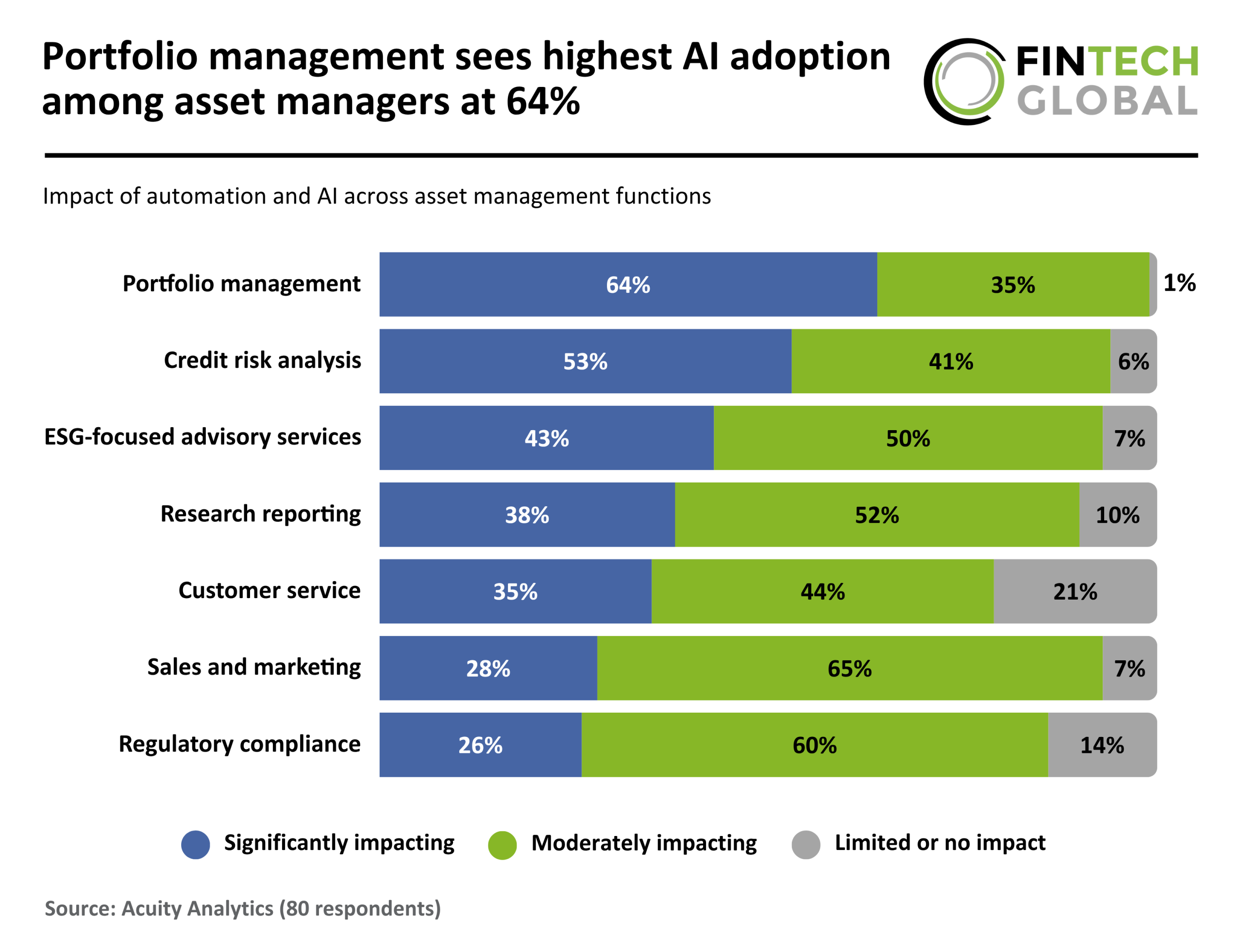
- Portfolio management leads significant AI impact at 64%, while regulatory compliance records the lowest at 26%
- AI is reshaping data-driven functions fastest, while human-intensive and regulatory areas are seeing a more gradual pace of change
Acuity Analytics surveyed around 80 senior asset management representatives across the Americas, Europe and Asia-Pacific on how AI and automation are changing key functions
The Annual Survey of Asset Managers 2026 was produced by Acuity Analytics, drawing on responses from around 80 representatives of leading global asset management firms contacted through email and LinkedIn.
The respondent base spans a senior cross-section of the industry, including chief executives and heads of asset management (26%), chief investment officers (24%), chief operating officers (19%), heads of research, portfolio managers and analysts (17%), chief compliance officers (10%) and chief marketing officers (4%).
By assets under management, 36% of respondents oversee between $10bn and $100bn, 34% manage less than $10bn, and 30% manage more than $100bn.
The survey is evenly split between the Americas and Europe at 45% each, with 10% from Asia-Pacific.
The chart addresses how automation and AI are changing key functions across the asset management sector.
Portfolio management leads significant AI impact at 64%, while regulatory compliance records the lowest at 26%
The results draw a clear line between functions where AI is driving fundamental change and those where its influence remains more measured.
Portfolio management stands out as the function most thoroughly reshaped, with 64% reporting significant impact and just 1% limited or no effect, a near-total absence of the latter that suggests AI has become effectively unavoidable here regardless of firm size or strategy.
Credit risk analysis follows at 53% significant impact, reinforcing the pattern that quantitative, data-intensive functions are where AI is landing hardest.
ESG-focused advisory services sit at 43% significant impact, though the larger 50% moderate figure hints at a function where AI is broadening its reach without yet reshaping it at its core.
At the other end of the spectrum, regulatory compliance records the lowest significant impact figure at 26%, with 14% reporting limited or no change, reflecting the caution that regulatory scrutiny and accountability requirements impose on AI deployment in this space.
AI is reshaping data-driven functions fastest, while human-intensive and regulatory areas are seeing a more gradual pace of change
The pattern that emerges is consistent with what one might expect from a technology that excels at processing large volumes of structured data and identifying patterns at speed.
Portfolio management and credit risk analysis, both heavily dependent on data analysis and quantitative modelling, are feeling AI’s impact most sharply.
The functions where human judgement, relationship management and contextual understanding matter most, customer service, sales and marketing, and regulatory compliance, are experiencing a more measured pace of change.
The high moderate impact figures across sales and marketing and regulatory compliance are worth noting.
They suggest that AI is making inroads in these areas, but in a supporting rather than transformative role, augmenting existing processes rather than replacing them.
For asset managers, the practical implication is that the efficiency gains available in portfolio management and credit risk are already within reach for those willing to invest.
The longer-term competitive question is whether firms can extend AI’s reach into the more complex, judgement-driven functions where the returns, though harder to realise, are likely to be just as significant.
Keep up with all the latest FinTech research here
Copyright © 2026 FinTech Global