

Tag: AI governance

Why unexplained bond prices are becoming a liability
Fixed income valuation has reached a turning point. According to LSEG Data & Analytics, it is no longer enough for firms to show that...

Napier AI warns opaque AI could cost firms their licence
As artificial intelligence spreads across financial services, a growing argument suggests that opacity is not only unavoidable but sometimes desirable, a way to protect...

Sumsub council tests whether AI agents can be trusted
Sumsub, a provider of AI-driven trust infrastructure built to support compliance operations at scale, has formed a new APAC forum aimed at shaping how...

Palma.ai raises $1.8m to govern enterprise AI agents
Palma.ai has raised $1.8m in pre-seed funding to help enterprises govern AI agents operating across their systems, with two of its investors already using...

Undeclared AI is insurance’s biggest blind spot
Does artificial intelligence need its own class of insurance, or is it quietly reshaping risks the market already underwrites? That question was at the...

AI fatigue is reshaping how banks choose RegTech providers
Financial institutions have poured significant sums into technology meant to simplify complex operations. Sometimes it delivers. Often, however, the real difficulties only surface once...

Manual AI disclaimers won’t survive EU AI Act scrutiny
The EU AI Act is no longer a distant regulatory milestone, it is an active compliance obligation. Prohibitions took effect from February 2025, transparency...

Private credit’s growth exposes a data trust gap
Scaling private credit requires more than capital. It requires trusted data, according to LSEG Data & Analytics, which argues that as allocations to the...
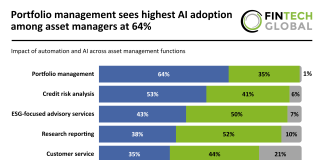
Portfolio management sees highest AI adoption among asset managers at 64%
Key views on Impact of automation and AI across asset management functions: Acuity Analytics surveyed around 80 senior asset management representatives across the Americas,...

Undeclared AI is becoming cyber insurance’s blind spot
Cyber insurance leaders are increasingly viewing AI as an extension of existing technology risk rather than a new category that requires its own insurance...
© Copyright 2026 FinTech Global. All Right Reserved
