Key views on AI productivity impact by function across FIs and FinTechs:
- The Cambridge Centre for Alternative Finance surveyed 203 FinTechs and 149 traditional FIs across 151 countries on AI productivity impact by business function
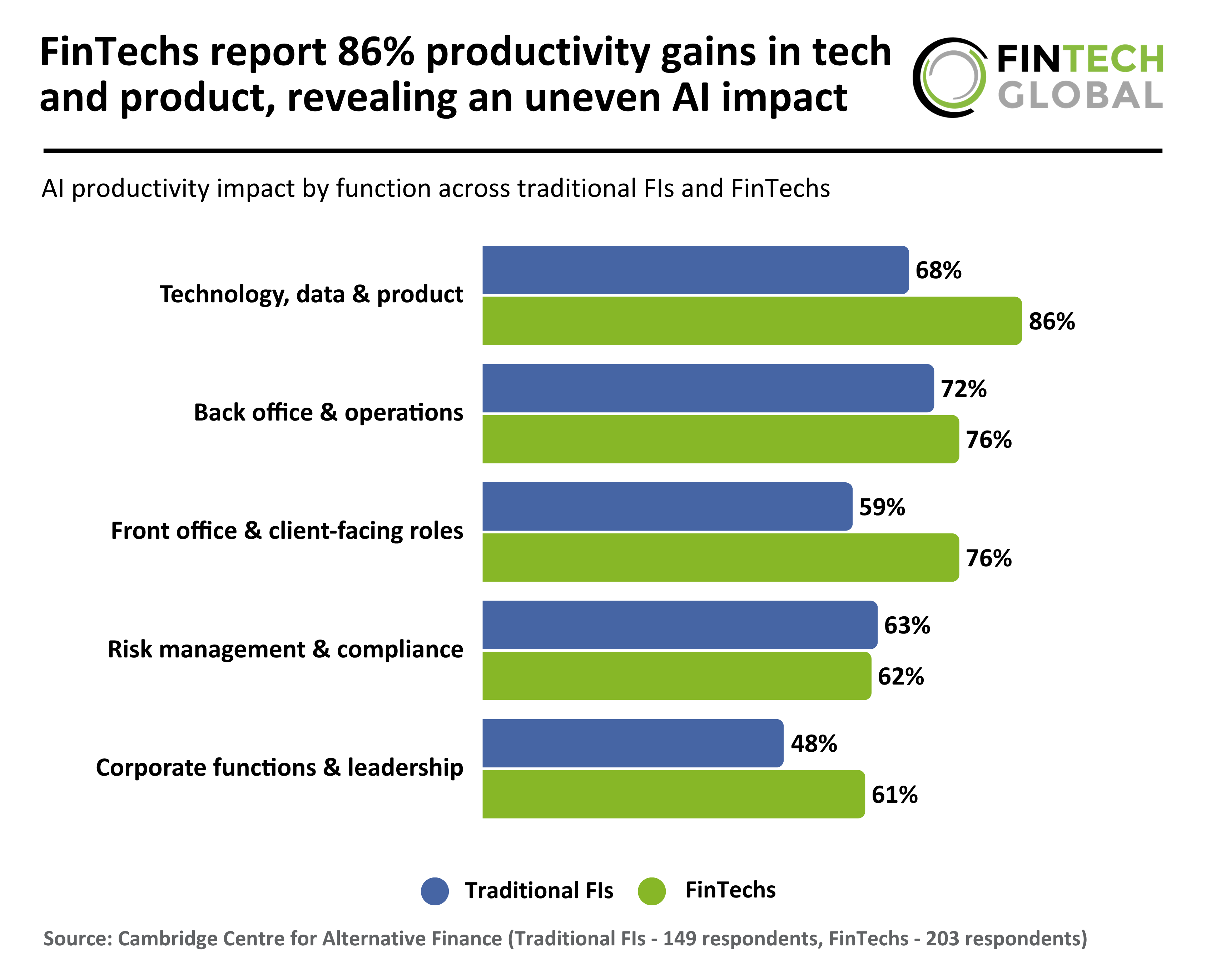
- FinTechs report the strongest gains in technology, data and product at 86%, an 18-point lead over traditional FIs at 68%
- AI is delivering broad but uneven gains, with FinTechs pulling ahead in revenue-facing functions while both groups lag in corporate and leadership roles
The Cambridge Centre for Alternative Finance surveyed 203 FinTechs and 149 traditional FIs across 151 countries on AI productivity impact by business function
The 2026 Global AI in Financial Services Report was produced by the Cambridge Centre for Alternative Finance at the University of Cambridge.
The study draws on 628 respondents across 151 countries, using three parallel survey instruments to capture perspectives from FinTechs, traditional financial institutions, AI vendors and regulators.
For the specific question this chart addresses, only FinTechs and traditional FIs were surveyed, representing 203 and 149 respondents respectively.
The regional spread is robust, with Asia-Pacific, Europe and Latin America and the Caribbean each accounting for between 29% and 36% of firm respondents, and Sub-Saharan Africa representing the smallest share at 14%.
The chart examines where AI is delivering positive productivity impact across five business functions, comparing results between FinTechs and traditional FIs.
FinTechs report the strongest gains in technology, data and product at 86%, an 18-point lead over traditional FIs at 68%
The results show that AI is delivering broad productivity gains across all functions for both groups, though FinTechs consistently report stronger outcomes.
Technology, data and product recorded the highest positive impact overall, with 86% of FinTechs reporting gains compared to 68% of traditional FIs, an 18-point gap that is the widest in the dataset.
Back office and operations follows closely, with near-identical results across the two groups at 76% and 72% respectively, suggesting that operational automation has delivered reliably regardless of firm type.
Front office and client-facing roles show a more pronounced divergence, at 76% for FinTechs against 59% for traditional FIs, a 17-point gap that mirrors the technology function in scale.
Risk management and compliance is the one area where traditional FIs edge ahead, recording 63% against 62% for FinTechs, effectively level across both groups.
Corporate functions and leadership recorded the lowest positive impact across the chart, at 61% for FinTechs and 48% for traditional FIs.
AI is delivering broad but uneven gains, with FinTechs pulling ahead in revenue-facing functions while both groups lag in corporate and leadership roles
The overall picture is one of genuine but uneven progress.
AI is delivering productivity gains across the board, yet the scale of those gains varies considerably depending on firm type and function.
The consistency between FinTechs and traditional FIs in back office and operations is encouraging, pointing to a set of automation benefits that appear accessible regardless of a firm’s size or heritage.
The gaps elsewhere tell a different story.
FinTechs are pulling ahead most sharply in the areas closest to revenue generation and product delivery, technology, data, product and front office roles, where their more agile operating models and appetite for experimentation appear to be translating into measurable advantage.
The near-parity on risk and compliance is notable and perhaps unsurprising: regulatory pressure applies equally to both firm types, creating a shared incentive to deploy AI in this area.
The weakest results across both groups in corporate functions and leadership suggest that AI adoption at the strategic and organisational level remains work in progress, and represents the area most likely to see focus shift towards in the next phase of deployment.
Keep up with all the latest FinTech research here
Copyright © 2026 FinTech Global