

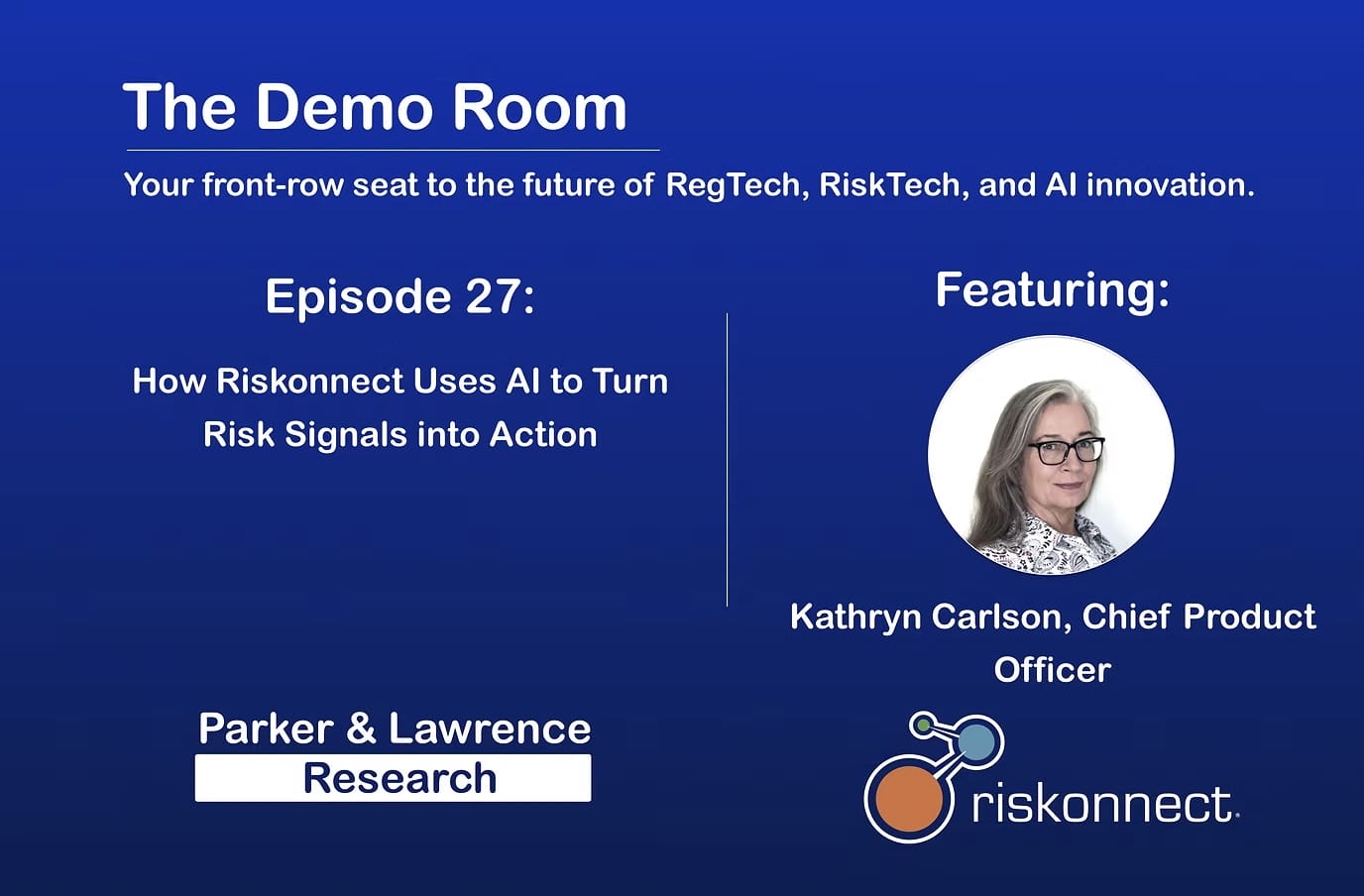
As organisations face growing technology risk from expanding AI systems, interconnected assets and changing regulatory requirements, identifying which changes require action is becoming an increasingly complex challenge. The 2026 research from Parker & Lawrence Research found that 60% of respondents rated AI-related technology risk as high or greater, highlighting the need for more connected and context-aware risk management.
As part of its research, Parker & Lawrence Research interviewed providers developing solutions to help organisations identify, assess and respond to emerging risks across their technology environments.
On this occasion, the firm spoke with Riskonnect, a provider of an Integrated Risk Platform that connects technology assets, controls, incidents, policies and regulatory requirements across the enterprise.
This forms part of The Demo Room series, which explores how technology providers are addressing significant risk and compliance challenges through their products and solutions, and this interview was part of the wider AI in Risk and Compliance 2026 report conducted by RegTech Analyst and Parker & Lawrence Research. To download the full report, click here.
Technology risk changes faster than many of the processes used to manage it. An organisation’s exposure can shift whenever a critical asset is modified, a dependency changes, a control fails, an incident occurs or a regulation is updated. Each development can affect the significance of other records across the business. Yet many risk assessments remain periodic exercises built around separate inventories, spreadsheets and manually maintained relationships.
The growing adoption of AI adds further complexity. Firms must map an expanding estate of models, data flows and third-party dependencies while accounting for risks that existing taxonomies may not adequately capture. At the same time, organisations are exploring how AI can support asset management, impact assessment, control mapping and remediation. Parker & Lawrence Research found that 60% of respondents rated AI-related risk within technology risk as high or greater, underlining the importance of strengthening oversight as adoption accelerates.
For many organisations, technology teams maintain asset and configuration data, risk teams manage risk and control records, and compliance teams interpret regulatory requirements. Resilience, cybersecurity, audit and third-party risk functions may each maintain separate views of critical services and dependencies. When these records are disconnected, assessing risk in context becomes difficult.
An incident could affect several controls, a regulatory change could alter the requirements applying to an asset class, or a supplier control failure could undermine the resilience of a critical business service. Without connected information, teams may struggle to understand the wider implications. Routine changes can trigger unnecessary work, while material risks remain hidden. Preparing assessments, impact statements, mitigation plans and control updates adds further manual effort after the initial review.
Standalone AI assistants cannot necessarily resolve these issues. Without reliable enterprise data and clear relationships between records, language models may generate plausible risk assessments based on incomplete information. Organisations therefore need structured records and dependable change signals before AI can provide meaningful analysis.
Riskonnect aims to address this challenge through a context-aware technology risk workflow that combines connected risk data, rules-based processes, retrieval-grounded language models and AI agents within existing risk management workflows.
The platform links technology assets, risks, controls, causes, consequences, incidents, policies, regulations and related records. These connections provide the context needed for analysis and reduce the manual reconciliation required during risk assessments. Rules-based processes detect changes and assemble relevant information before generative AI is introduced, helping ensure that repeatable steps remain predictable and auditable.
Riskonnect’s Risk Signal Agent evaluates changes against an organisation’s risk appetite, asset criticality and governance framework. It recommends whether a reassessment is necessary and explains the reasoning behind its recommendation. Human reviewers retain responsibility for accepting or declining consequential actions, keeping material decisions subject to oversight.
The platform also uses retrieval-grounded models to compare organisational policies with regulatory requirements, identify potential gaps and explain their significance. The resulting analysis can be translated into practical tasks for technology risk teams, while the underlying sources and connected enterprise records remain available for review.
Beyond identifying and assessing risks, Riskonnect can draft risk descriptions, risk appetite statements, business impact assessments, mitigation plans, playbooks and suggested controls in a consistent format. AI agents then coordinate assessments, remediation and policy updates through defined review stages.
According to Riskonnect, its approach can reduce the time spent understanding unfamiliar regulations by more than 80%. The company also cites lower labour costs and earlier identification and resolution of risks, although these outcomes will depend on the organisation’s data quality, implementation and existing workflows.
Parker & Lawrence Research highlights continuous materiality assessment as a distinctive element of Riskonnect’s approach. By evaluating changes against the organisation’s risk appetite, asset criticality and governance framework, the platform helps teams determine which developments warrant a reassessment, why they matter and what action should follow.
The architecture also supports traceability by separating predictable, rules-based processes from AI-driven interpretation and workflow coordination. Deterministic logic prepares the relevant context, retrieval-grounded models interpret information and draft outputs, and agents coordinate subsequent activities while people retain authority over material decisions. This division is particularly relevant in technology risk management, where recommendations must be explainable and aligned with established governance requirements.
However, adoption will depend heavily on data readiness. The quality of AI-generated recommendations rests on the completeness and reliability of the asset, dependency, risk and control relationships underpinning the platform. Organisations that leave existing information silos intact may limit the effectiveness of even sophisticated AI capabilities. Buyers will also need evidence that the system can distinguish material changes from routine activity without overwhelming reviewers, and that proposed remediation remains consistent with local policies and risk appetite.
As AI expands the technology estate organisations must oversee, connecting risk information and identifying material changes will become increasingly important. Riskonnect’s approach illustrates how combining structured enterprise data, AI-driven analysis and human oversight could help organisations move beyond periodic assessments towards more continuous, context-aware technology risk management.
Read the original post from Parker & Lawrence Research here.
Copyright © 2026 FinTech Global