
It was a slower week for the FinTech sector, compared to some in the past couple of months. A total of $623m was raised across 17 deals.
This week was a noticeable decline from last week, which saw $806m raised across 23 deals. Last week was bolstered by a couple of major deals, including digital bank Plata, which raised $405m in its Series C and brought its valuation to $5bn.
This week is the second consecutive week of reduced FinTech funding, following the heights of the week commencing 10th April, which saw $2.17bn raised over 23 deals.
Going back to the week at hand, there were two deals to exceed $100m. The biggest deal was raised by k1x, an AI-native platform for private markets tax data. The tech platform raised $175m in growth funding led by Sumeru Equity Partners, with participation from existing backer Edison Partners.
The second biggest deal of the week was a $100m financing round raised by Philippines-based Salmon. It is a technology-driven financial services holding company building a banking and lending platform across Southeast Asia. The funding was comprised of a $60m equity component and a $40m public bond issuance.
The Philippines was not the only country in south east Asia to see a FinTech company close a funding round. Malaysia-based Hata secured an $8m Series A investment round led by Bybit. Hata, which claims to be Malaysia’s only dual-licensed digital asset exchange, intends to deploy the capital across three areas: boosting liquidity on its platform, driving user growth through marketing and ecosystem initiatives, and co-developing digital asset products tailored to Malaysian users alongside Bybit.
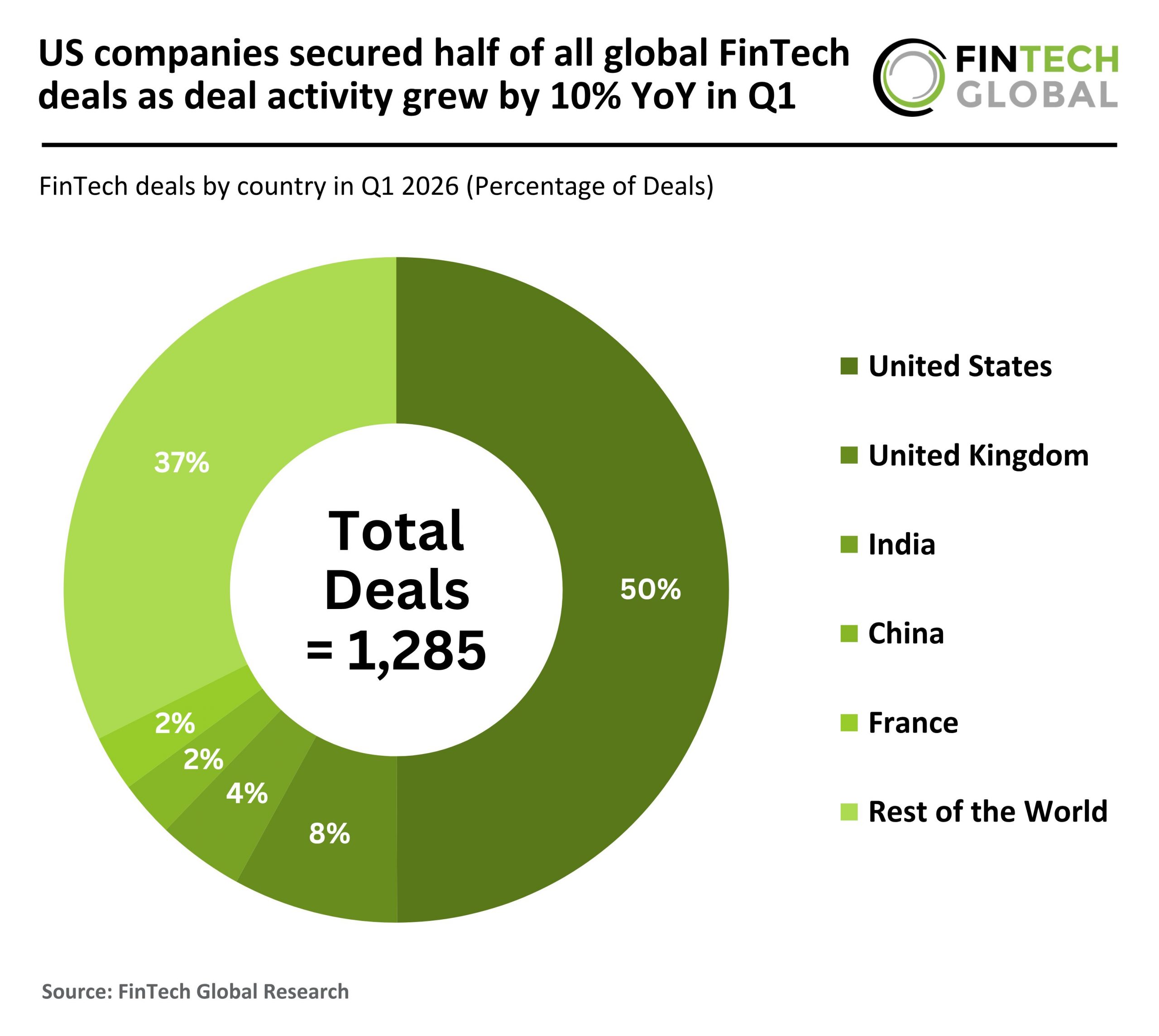
As for the leading position, the US accounted for the majority of deals this week, recording nine. These included K1x, Loop, Monk, Petual, Rilian, Zenskar, RIIG Technology, Astor and Openly. The only other location to record multiple deals this week was the UK with two. These were Belfast-based Cloudsmith and London-based Daintta. Other countries represented this week, with one deal each, were Switzerland (BLP), Ireland (Seapoint) and Israel (Copperhelm).
Research from FinTech Global last week claimed that global FinTech deal activity grew by 10% YoY, sitting at 1,285 deals in Q1 2026, up 10% from 1,165 deals in Q1 2025 and 7% from 1,200 deals in Q4 2025. Despite this increase, funding volume declined. A total of $19.8bn was raised during the quarter, down 8% from $21.6bn in Q1 2025 and 36% below the $31.1bn recorded in Q4 2025.
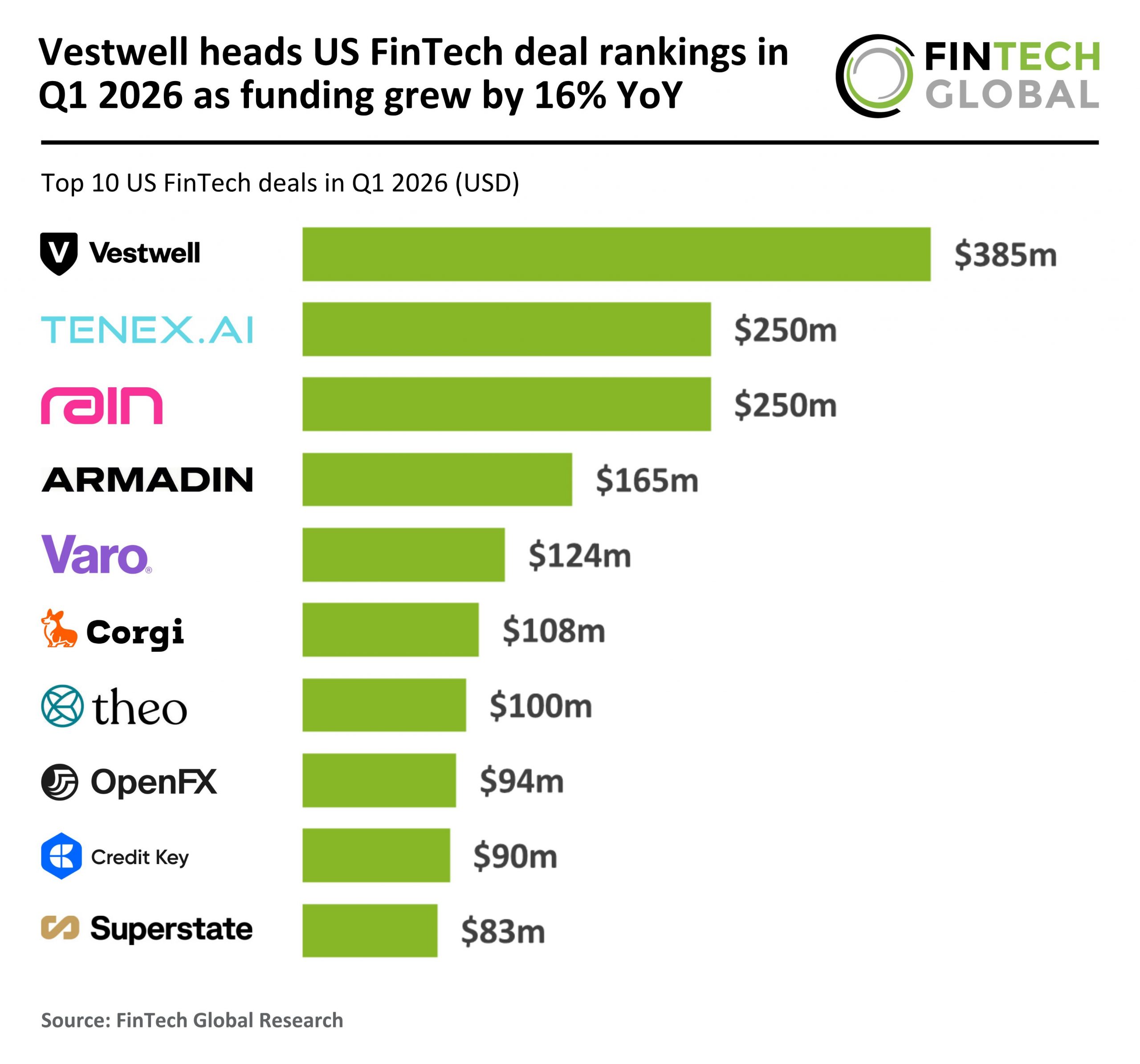
Focusing on the US specifically, research from FinTech Global found that US FinTech funding grew by 16% YoY in Q1 2026. The country saw $11.1bn raised across 466 deals, marking a 16% increase in funding compared to the $9.6bn raised across 350 deals in Q1 2025. Deal volume also rose sharply, up 33% YoY.
In terms of sector, it was a banner week for infrastructure and enterprise software companies with five deals. These companies were K1x, BLP, Monk, Zenskar and Seapoint. It was then followed by CyberTech (Spectrum Security, Rilian and Copperhelm) and RegTech (Cloudsmith, Petual and Daintta), with three deals apiece.
Elsewhere, there were two WealthTechs (Hata and Astor), two InsurTechs (RIIG Technology and Openly), one data and analytics company (Loop) and one marketplace lending company (Salmon).
Here are the 17 FinTech funding rounds covered on FinTech Global this week.
K1x secures $175m to digitise private market tax data
K1x, an AI-native platform for private markets tax data, has closed a $175m growth investment led by Sumeru Equity Partners, with participation from existing backer Edison Partners.
Sumeru will take a majority stake in the business as part of the transaction. Edison Partners, which has now invested in K1x three times since 2022, also contributed to the round.
The capital injection arrives as private markets continue to attract a broader investor base beyond traditional institutions, creating a surge in the volume and complexity of tax reporting obligations. The industry is estimated to bear an annual burden of $27bn in tax reporting costs. Growth in pass-through structures such as LLCs and S corporations has heightened demand for Schedule K-1 creation and reporting, revealing significant gaps in existing infrastructure.
K1x was founded to address this challenge. The company’s patented platform uses AI to automate the extraction, aggregation and standardisation of complex K-1 data, replacing manual processes with a unified, scalable approach to tax reporting across accounting firms, general partners, limited partners and technology platforms.
The company intends to deploy the proceeds across several areas, including deepening its core platform capabilities, accelerating product development, expanding its application of machine learning and generative AI, and strengthening customer experience and support infrastructure. K1x currently works with 44 of the 100 largest institutional investors and 20 of the top 25 accounting firms, and handles data across K-1s, 1099s, W-2s and 990s.
Salmon raises $100m to fuel Philippines expansion
Salmon Group, a technology-driven financial services holding company building a banking and lending platform across Southeast Asia, has closed a $100m financing round aimed at accelerating its growth in the Philippines.
The round comprised two tranches: a $60m equity component and a $40m public bond issuance. The equity raise was led by Spice Expeditions, with additional participation from Washington University Investment Management Company (WUIMC), Moore Strategic Ventures, FJ Labs, and a number of Salmon’s existing investors.
The transaction was significantly oversubscribed, reflecting strong investor confidence in the company’s model and its execution in one of the region’s most active consumer finance markets.
Proceeds from the equity tranche will be directed towards expanding Salmon’s product suite, broadening its distribution footprint across the Philippines, strengthening the capitalisation of Salmon Bank, and growing the group’s overall balance sheet capacity.
The $40m bond component, priced at an effective yield of 13.7% under Salmon’s existing $150m Nordic bond programme, was placed with leading global fixed income investors and will support the continued scaling of its lending portfolio. The dual-tranche structure is intended to diversify the group’s funding base and support sustained balance sheet growth.
Salmon Group operates through two regulated entities in the Philippines: a BSP-licensed bank and an SEC-licensed financing company.
Loop raises $95m Series C to power supply chain AI
Loop, a full-stack verticalized AI platform for logistics and supply chains, has raised $95m in a Series C funding round to expand its platform across a wider set of enterprise use cases and deepen its engineering capabilities.
The round was led by Valor Equity Partners and the Valor Atreides AI Fund, with additional backing from 8VC, Founders Fund, Index Ventures, J.P. Morgan Growth Equity Partners, and Tao Capital Partners.
Proceeds will also be directed towards attracting top AI talent as the company looks to deepen its product and engineering capabilities.
The raise arrives at a turbulent moment for global supply chains. Rising tariffs, the need to diversify supplier networks, and elevated energy costs are compounding the difficulties already posed by legacy systems, siloed data, and a lack of operational and financial visibility. The company argues that enterprises require a more dependable data foundation to sustain high operational performance, free up working capital, and take strategic decisions with confidence.
At the heart of Loop’s offering is DUX, a family of models and agents purpose-built for the demands of logistics and supply chains. DUX draws on document, data, and domain understanding to ingest, standardise, contextualise, and act on logistics data spanning a broad range of documents and systems, providing customers with a more unified view of their supply chain and a stronger basis for automation and decision-making.
The company helps organisations turn fragmented operational and financial data into better visibility, tighter cost control, and more effective decision-making across logistics, finance, and supply chain workflows. Its existing client base includes Outset Medical, Clemens Food Group, Olipop, Kendra Scott, and Dot Foods.
Cloudsmith lands $72m to govern AI-generated software
Cloudsmith, a cloud-native universal artifact management platform serving some of the world’s largest enterprises, has closed a $72m Series C funding round co-led by TCV and Insight Partners, alongside contributions from other existing investors.
The raise, which comes just one year after Cloudsmith’s Series B, will be directed towards accelerating product development and expanding the company’s go-to-market capabilities. TCV led the previous round and has returned to co-lead alongside Insight Partners for this latest raise, reflecting continued investor conviction in Cloudsmith’s leadership, product and market position.
The investment arrives as enterprises increasingly move away from legacy tools in favour of cloud-native infrastructure capable of keeping pace with AI-driven software development. Fortune 500 and Global 2000 companies are among the existing customers upgrading to Cloudsmith’s platform, while businesses adopting AI coding agents are turning to the company to provide governance and guardrails across their software supply chains.
The artifact management market has been fundamentally altered by the rise of agentic software development. As AI coding agents produce code at an accelerating pace, the resulting software artifacts and dependencies are creating an expanding attack surface that has risen to board-level concern. Enterprises must now manage increasingly large software supply chains spanning open-source libraries, internal packages and third-party dependencies, all while facing mounting regulatory pressure to demonstrate that AI-generated software is secure by design.
Cloudsmith’s platform addresses this challenge directly, giving engineering teams the scale and visibility required to govern every package at every stage of the development process. By offering a broad view across the open-source ecosystem, the platform is designed to help enterprises identify and mitigate the types of threats that AI-driven development introduces.
Goldman Sachs backs BLP Digital with $50m investment
BLP Digital, a Zurich-based provider of agentic AI-powered enterprise resource planning (ERP) automation, has received a $50m investment from Growth Equity at Goldman Sachs Alternatives.
The funding will support BLP Digital’s mission to eliminate manual processes in high-volume finance workflows. The company’s platform targets core finance functions such as Accounts Payable, delivering shorter closing times and measurable improvements to cash flow and working capital, all without requiring businesses to overhaul their existing ERP infrastructure.
Rather than bolting an additional AI layer onto an existing technology stack, BLP Digital replaces the conventional mix of optical character recognition, workflow tools, scripts, and customisation with a unified execution architecture.
Finance workflows are broken down end-to-end into discrete tasks, each handled by specialised agents and coordinated by a Digital Twin. This Digital Twin draws on data from ERP systems, email, and process records to determine when an agent can act independently, when human input is needed, and logs how that human input subsequently informs the AI, providing CFOs with full visibility, clearly assigned responsibilities, and a traceable audit trail.
The company’s entry point is deliberately the Accounts Payable function, which, despite its complexity, follows broadly consistent patterns across organisations. From there, agents are progressively extended into adjacent areas including procurement, logistics, and sales.
Monk raises $25m Series A to automate receivables
Monk, an AI-native accounts receivable platform, has closed a $25m Series A funding round, bringing its total capital raised to $29m.
The round was co-led by Footwork and Acrew Capital, with continued backing from existing investor BTV. The latest raise follows a $4m seed round led by BTV in spring 2025.
Monk intends to deploy the new capital towards research and development as it looks to build out further products within the accounts receivable space.
The company targets a widespread industry challenge: trillions of dollars are tied up in accounts receivable annually, with much of it managed via email by teams manually chasing payments, reconciling deposits and fielding queries.
Monk’s platform automates the entire contract-to-cash lifecycle, and the company reports that customers typically see a 40% reduction in days sales outstanding, more than 25 hours saved per month for accounts receivable teams, and a 24% improvement in collections response rates.
Petual raises $20m for AI-powered SOX compliance
Petual, an AI-powered audit and compliance platform, has secured $20m in funding to modernise Sarbanes-Oxley (SOX) compliance and internal audit functions at enterprise scale.
The round drew backing from Andreessen Horowitz, First Round Capital, Cowboy Ventures, and investor Elad Gil. The capital will go towards accelerating product development and expanding the company’s go-to-market operations.
Petual’s agentic AI platform automates the gathering of evidence and the generation of work papers for SOX testing and internal audit. The system is capable of processing both structured and unstructured inputs, including screenshots, PDFs, and Excel files, to produce complete, auditor-ready work papers in a matter of minutes rather than the double or triple-digit hours that most teams currently spend performing the same work manually.
Outputs are formatted to satisfy external auditor requirements, with reasoning traceable directly to source materials. A built-in approval workflow keeps human oversight at the centre of the process throughout.
Spectrum Security raises $19m in seed funding round
Spectrum Security, a cybersecurity firm specialising in automated threat detection, has emerged from stealth after securing $19m in seed funding.
The round was led by TechOperators, with additional backing from WhiteRabbit Ventures, Skinos Ventures, a new cybersecurity fund established by Shlomo Kramer and Yishay Yovel, and Alumni Ventures, as well as a number of prominent cybersecurity operators and investors.
Proceeds from the raise will be directed towards accelerating Spectrum’s engineering capabilities and go-to-market efforts to address growing enterprise demand.
The company was founded to tackle what it describes as a critical but long-overlooked gap in modern security operations: the inability of organisations to reliably detect threats targeting them in real time.
Spectrum’s platform addresses this by automating the process of building, testing, deploying, and maintaining detection logic. Rather than layering on top of existing alert systems, the company targets the underlying problem, identifying gaps in threat coverage, generating production-ready detection rules tailored to individual environments, and updating those rules as infrastructure evolves.
The platform is designed to integrate with a customer’s existing security stack, including SIEMs, data lakes, and EDRs, without requiring any replacement of current tooling.
Rilian bags $17.5m to scale AI-native cyber platform
Rilian, an AI-native cybersecurity and defence systems integration company, has closed a $17.5m seed and seed extension funding round to expand its agentic AI capabilities across government and critical infrastructure markets.
The round was led by 8VC, First In, and Tamarack Global, with 8090 Industries, Liquid 2 Ventures, Perot Jain, and Protego Ventures also contributing. Capital from the raise will be directed towards Rilian’s expansion across the United States, Gulf Cooperation Council (GCC) countries, and other Allied nations, covering go-to-market activity, engineering recruitment, and research and development in agentic AI-powered cyber and defence solutions for both commercial and nation-scale environments.
The company was established by cybersecurity and defence specialists Christian Schnedler, Nick Pompeo, and Dan Fischer. Its flagship product, Caspian, is an agentic security orchestration platform that consolidates cyber and defence technology capabilities into a single command layer, enabling autonomous delivery across an organisation’s existing tools and infrastructure.
The AI-native platform is designed for governments, private sector operators, and critical infrastructure providers, allowing them to deploy and automate security capabilities across private or sovereign cloud, on-premise, air-gapped, and compliance-sensitive environments. Pre-trained AI agents within the platform are built to boost analyst productivity through automation, anticipate adversarial behaviour, preserve institutional knowledge, and reduce onboarding friction for new capabilities and personnel.
In July 2025, Rilian entered a contract with the UAE Cybersecurity Council to protect the country’s critical infrastructure. As part of that agreement, the UAE’s National Security Operations Centre is deploying Caspian to integrate, operate, and automate cybersecurity solutions across operational technology environments, with dedicated AI agents trained to autonomously assess risks and respond to national-level threats.
The project also involves technology partners from the UAE, the US, and global allies. Rilian has additionally formed strategic partnerships with cyber and defence technology providers, hyperscalers, and foundational AI large language model developers, including SentinelOne, Censys, and SimSpace.
Zenskar raises $15m Series A for agentic B2B finance
Zenskar, an AI-native billing and revenue automation platform built to deliver zero-touch finance for complex B2B businesses, has closed a $15m Series A funding round.
The raise was led by Susquehanna Venture Capital, Bessemer Venture Partners, Shine Capital, and Rho, with additional backing from Rocketship, J-Ventures, Future Back Ventures by Bain & Company, and Converge.
The capital will be directed towards expanding Zenskar’s agentic capabilities, including the further development of its Agents Marketplace — a growing library of AI agents that finance teams can build, tailor, chain together, and deploy across the entire order-to-cash cycle without requiring any engineering resource.
The platform also features a Slack agent and model context protocol (MCP) that connects with leading AI tools, enabling teams to delegate tasks, review exceptions, and approve actions from within their existing workflows.
The company has recorded fivefold revenue growth over the past year, with momentum continuing to build across its customer base.
Seapoint raises €7.5m ($8.7m) seed to build founder finance hub
Seapoint, an AI-native financial operations platform designed for European startups, has closed a €7.5m seed round, bringing its total funding raised to €10m in little over a year.
The round was led by London-based FinTech venture capital firm 13books, with backing from more than 40 angel investors alongside additional venture capital participants. Notable backers include Claire Hughes Johnson, former COO of Stripe; Laurence Krieger, formerly UK CEO of Tide and COO of Revolut; Intercom co-founder Des Traynor; and Luke Mackey, CEO of Kota. Existing investors Frontline Ventures and Tapestry VC also participated.
As part of the deal, 13books’ Michael McFadgen will take a seat on Seapoint’s board.
Alongside the funding announcement, Seapoint has opened its platform to self-service sign-ups for founders across the UK and Ireland, removing the waitlist for the first time.
The platform targets venture-backed startups from pre-seed through to Series A stage. Once signed up, founders can connect their existing banks, accounting tools and email within ten minutes, with Seapoint’s AI automating reporting, bookkeeping, expense management and payroll from day one. The company also provides embedded financial products covering multi-currency accounts, payments, cards, treasury and foreign exchange, enabling startups to consolidate their financial operations in a single platform.
Hata raises $8m Series A led by Bybit
Hata, Malaysia’s only dual-licensed digital asset exchange, has closed an $8m (~RM31.6m) Series A funding round led by Bybit, the world’s second-largest digital asset exchange by trading volume, with additional participation from several prominent global family offices.
The round deepens an existing relationship between the two firms, with Bybit having previously participated in Hata’s $4.2m seed round. The latest raise extends that relationship into a wider strategic collaboration, with both companies committing to expanding Malaysia’s digital asset ecosystem. A number of global family offices focused on Southeast Asian technology and financial markets also contributed to the round.
Hata intends to deploy the capital across three areas: boosting liquidity on its platform, driving user growth through marketing and ecosystem initiatives, and co-developing digital asset products tailored to Malaysian users alongside Bybit.
Founded by Malaysians and operating under licences from the Securities Commission Malaysia and the Labuan Financial Services Authority, Hata provides a regulated platform for investors to buy, sell and custody digital assets.
Since launching in May 2023, the exchange has grown to more than 209,000 registered users and processed RM1.04bn in transaction volume during 2025. Its assets under custody have accumulated to RM86.3m since launch, reaching a peak of RM115m in September 2025 before broader market corrections took hold.
Copperhelm exits stealth with $7m seed round
Copperhelm has emerged from stealth with $7m in seed funding and the launch of what it describes as the sector’s first agentic cloud security platform.
The round was led by TLV Partners, with additional investment from toDay Ventures, ICON, and SaaS Ventures Israel. Angel investors participating in the raise include Kfir Tishbi, Or Hiltch, Guy Zipori, and Ephraim Yarmak. As part of the announcement, Shay Michel, managing partner at Merlin Ventures, will join Copperhelm’s board of directors.
The company’s platform deploys purpose-built AI agents designed to take over manual cloud security workflows. Rather than alerting security teams and leaving them to investigate, the agents autonomously monitor cloud environments, assess threats, and carry out remediation in real time — keeping human teams in control while handling the bulk of the operational workload.
The platform is aimed at CISOs and security teams at large enterprises, and the company says it already counts Fortune 500 businesses among its paying customers. In one case, a Fortune 500 client used the platform to reduce 6 million raw security findings down to a few hundred evidence-backed, validated risks that teams could realistically act on.
Central to Copperhelm’s approach is what it calls the Context Lake — a real-time decision layer that structures and connects data across cloud environments to give AI agents the contextual grounding they need to act with accuracy. The company argues that connecting a general-purpose AI model to hundreds of cloud accounts produces unreliable results due to the complexity and fragmentation of cloud infrastructure.
Its agents are purpose-built for this environment, capable of analysing infrastructure across hundreds of accounts, verifying genuine risk, and executing remediation with confidence. Specialised agents cover network analysis, system behaviour, adversarial simulation, and automated remediation. They connect to live workloads, inspect active processes and container images, map cloud network topology, and deploy protections such as WAF rules to neutralise threats without causing downtime.
Copperhelm was founded by Shimon Tolts, Eyar Zilberman, and Roman Labunsky, whose collective backgrounds span Unity, McAfee, and RSA. The trio brings experience in building cloud infrastructure and security products at scale, with credentials including recognition as AWS Heroes, a CNCF Ambassador, a GitHub Star, and Y Combinator alumni status.
The $7m raised will be directed towards accelerating product development, expanding the company’s go-to-market operations, and growing its engineering team.
RIIG Technology closes $6m Series A funding round
RIIG Technology, the AI automation company operating under the HOOTL™ (Humans Out of the Loop™) brand, has closed a Series A financing round exceeding $6m.
The raise was backed by a mix of family offices, a publicly listed entity, and high net worth individuals.
Proceeds will primarily be directed towards scaling HOOTL™’s AI-powered healthcare insurance platform, which is built to streamline verification, validation, and claims adjudication processes for healthcare providers.
The company’s dental solution is already live, with integrations spanning leading practice management systems including OpenDental and Dentrix Cloud, alongside further integrations in development.
Alongside its healthcare push, RIIG™ is readying a new suite of field service management tools aimed at the roofing sector, drawing on its existing automation and analytics infrastructure to drive better operational efficiency and decision-making for field-based businesses.
The funding will also support the establishment of an AI Centre of Excellence, anchored by the acquisition of an NVIDIA DGX B300 system. This infrastructure is intended to underpin the development of in-house models and analytics spanning healthcare data processing, computer vision for existing exchange-listed clients, and drone-enabled services.
The company is also advancing edge-deployed AI capabilities that allow real-time processing and automated identification at the point of data collection, with live deployments already supporting use cases including autonomous surveillance, asset tracking, and mission-critical decision-making.
Astor raises $5m seed to democratise investment advice
Astor, an SEC-registered AI-native investment advisory platform, has closed a $5m seed funding round to expand access to personalised financial guidance for everyday American investors.
The round was led by Monashees, with contributions from Y Combinator, Goodwater Capital, Gilgamesh Ventures, 468 Capital, Valutia, Sunshine Lake, and individual investors from Stripe and OpenAI.
Since going live, the platform has drawn thousands of users and seen more than $200m in brokerage accounts linked to the service. The capital raised will be directed towards strengthening Astor’s product, engineering, and growth functions, as well as broadening its service offerings.
The platform was founded by Bruno Koba and Daniel Tulha, who both grew up in Brazil, where being matched with a financial adviser upon opening a brokerage account is standard practice regardless of wealth. Upon relocating to the United States, the pair discovered that the vast majority of Americans manage their investments without any professional guidance.
Astor links directly to users’ existing brokerage accounts and analyses their portfolios across dimensions including performance, risk, and diversification, before delivering tailored recommendations. The platform operates under a fiduciary duty, legally obligating it to act in clients’ best interests.
LDC invests in Daintta to boost tech services growth
Daintta, a London-headquartered professional services business focused on delivering technology into secure environments, has closed a significant investment from private equity firm LDC.
The transaction was led on behalf of LDC by Joseph Fison and Alex White, with additional support from Nicol Fraser, who heads up LDC’s London office. Both Fison and White will join Daintta’s board as non-executive directors following completion of the deal.
Proceeds will be directed towards the company’s organic growth ambitions, with a focus on scaling its professional services portfolio and reinforcing its expertise in security-critical technology.
LDC’s backing extends to Daintta’s management team, co-founded by Justin Teutsch, Abu Sayed and M Alexander.
Daintta was founded in 2019 with a workforce of more than 80 consultants and engineers. The firm delivers complex projects spanning data intelligence, cyber security, networks and communications, and AI engineering to clients across the public and private sectors, including central government and organisations in healthcare and telecommunications.
Openly secures growth funding and expands Allianz Re partnership
Openly, a tech-enabled homeowners insurance provider, has secured a growth investment round led by existing investors Eden Global Partners, Advance Venture Partners and Gradient, with strategic participation from Allianz X.
The company has also expanded its long-term reinsurance partnership with Allianz Re as it looks to accelerate its growth across the US homeowners insurance market.
The combined investment and reinsurance support are intended to strengthen Openly’s balance sheet and enable further expansion, as independent agents increasingly seek technology-driven carriers with strong underwriting capabilities.
Founded in 2017, Openly focuses exclusively on the independent agent channel, offering a platform designed to deliver fast quoting and tailored homeowners insurance coverage.
The company said the funding will support expansion into additional states, deepen agent partnerships and broaden its product offering.
Copyright © 2026 FinTech Global