The summer months continue to prove a slow period for FinTech deals, with just $389m raised across 12 deals.
It was a similar picture to last week when just $361m was raised across 16 deals. The largest deal of that week was secured by PayTech Ingenico, which pulled in €150m.
While the total capital raised was quite small this week, the size of the undisclosed funding round from Socure might have painted a different picture. The RegTech giant closed a strategic investment round that was led by Summit Partners. This round put Socure’s valuation to $5.2bn.
To give a little more context to the deal, Socure’s previous funding round was a $450m Series E, which was closed in 2021. This close had brought the RegTech’s valuation to $4.5bn and proceeded a $100m Series D in 2020.
Socure was not the only FinTeh unicorn to secure funds this week, with UAE-based Fasset hitting the $1bn valuation following the close of a $68m round. The round was led by SBI Group and followed Fasset’s $51m Series B that closed earlier this year
Only one deal surpassed the $100m mark this week, with Alice netting $140m to enhance its offering and bolster go-to-market efforts. The company helps companies to bolster their confidence in AI.
In terms of sector, WealthTech proved to be the flavour of the week. There were five WealthTech deals to close this week, including three of the five biggest deals. The WealthTechs were RQD* Clearing, Fasset, Standard Metrics, Multiplier and Itoflow.
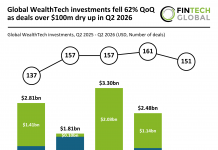
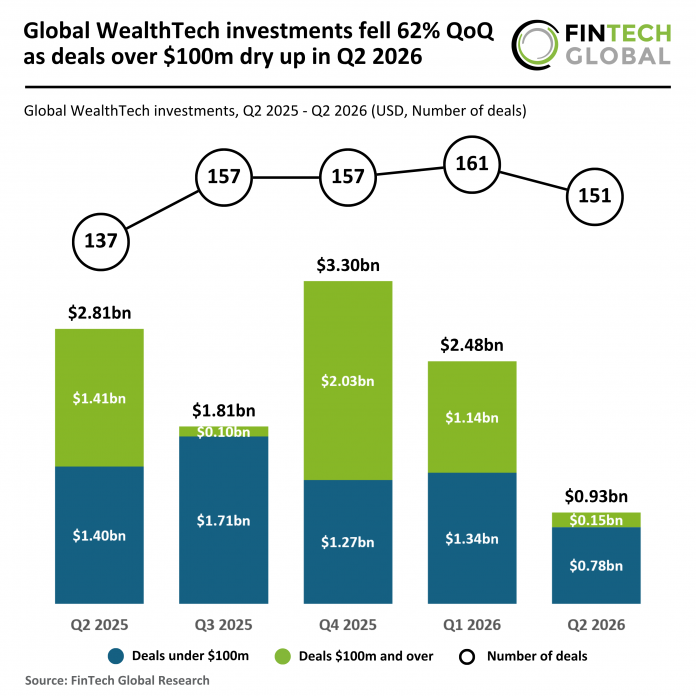
While WealthTech has had a good week, recent research from FinTech Global found that Q2 2026 was a significant decline from the previous quarter. Global WealthTech investments fell 62% QoQ in Q2, going from $2.5bn across 161 deals to $932.2m across 151 deals. Additionally, against the same quarter a year earlier, funding fell 67% from the $2.8bn raised across 137 deals in Q2 2025, whilst deal volume was 10% higher.
Other sectors represented this week were PayTech and RegTech, which had two deals apiece. The PayTechs were GoWish and Payload, while the RegTech companies were Alice and Socure. The remaining two deals were an infrastructure and enterprise software business (Neno), a PayTech (Helcim) and an InsurTech startup (Solace Care).
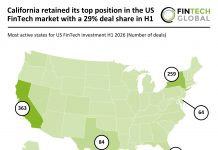
In terms of location, the US continued to dominate, accounting for six deals. The US companies were Alice, RQD* Clearing, Standard Metrics, Multiplier, Payload and Socure.
There was a handful of countries in Northern Europe that also housed a deal this week, including the UK’s Itoflow, Denmark’s GoWish, the Netherlands’ Neno and Sweden’s Solace Care. The final deals of the week were Canada-based Helcim and UAE-based Fasset.
In terms of other developments this week, as the finance sector continues to embrace AI technology and move away from pilots to real developments, Exante’s CTO Richard Forss, sat down with FinTech Global to explore the new tech revolution. His main takeaway was that unlike previous technology revolutions, banks do not have time to sit on the sidelines and must get engaged with the technology as soon as possible.
He added, “I’ve watched a lot of “this changes everything” moments over thirty years and learned to discount most of them. This one I don’t discount. Not because the technology is magic, but because it removes the breathing room the last three gave us.”
Here are the 12 funding rounds covered on FinTech Global this week:
Alice raises $140m as AI attacks outpace defences
Alice, an AI trust, safety and security business that shields billions of internet users from online manipulation, has closed a $140m funding round as enterprises race to contain the risks of giving AI systems real autonomy.
The round was led by the Apax Digital Funds, with fresh backing from Samsung, SentinelOne, Maj Invest, MoreTech and Phoenix Insurance. Existing backers Resolute Ventures, Grove Ventures, CRV, Highland Europe, Vintage Investments, Norwest Venture Partners, NFX and Claltech also took part, lifting Alice’s total funding to $280m.
Alice positions itself across the entire AI lifecycle. Ahead of a model’s release, its researchers collaborate with frontier labs such as Anthropic, Google and Cohere to stress-test systems against adversarial prompts and agentic misuse, hardening them against jailbreaks and prompt injection.
After deployment, the company helps enterprises translate a model’s built-in protections into policies tailored to their own risk requirements, running simulated attacks to expose compliance gaps and data leakage before monitoring live inputs and outputs on an ongoing basis.
The new capital will go towards deepening Alice’s platform across testing, defence and monitoring; growing the team behind Rabbit Hole so its dataset keeps up with fast-evolving attack methods; and scaling the go-to-market function serving both foundation model labs and enterprise customers.
RQD* lands $74m as clearing infrastructure race heats up
RQD* Clearing has secured a $74m minority growth investment led by Bain Capital Tech Opportunities, with participation from ABN AMRO Clearing Bank and Nyca Partners.
The capital will fund RQD*’s expansion across North America, Asia and the Middle East, while accelerating investment in its technology and product roadmap, including digital assets and tokenisation.
It will also strengthen the firm’s position as a custody infrastructure layer for digital assets and widen its capacity to serve institutions that need modern, scalable routes into U.S. markets.
Rather than layering technology on top of legacy or licensed systems, RQD* built its clearing operation from scratch, giving clients a proprietary platform with real-time visibility into their data.
That structure is designed to help clients launch and scale products faster, without the delayed files, fragmented systems and manual processes that still dominate much of the post-trade world.
The firm pairs its technology architecture with deep expertise in clearing and market structure, positioning it to support demanding institutional activity alongside the needs of digital-first financial businesses. Its year-to-date figures illustrate that scale: RQD* processed more than 543 million ledger transactions and cleared roughly 515 million equity transactions, equivalent to 69.5 billion shares and close to $2 trillion in notional value, around 2.43% of the NMS equities market.
Fasset hits $1bn valuation with SBI-led $68m round
Standard Metrics scores $20m to power AI-era investing
Standard Metrics, the AI-driven portfolio management platform built for venture capital and private equity firms, has closed $20m in Series B funding as it pushes deeper into AI-powered tools for private market investors.
The round was led by 8VC, with participation from Salesforce Ventures, Spark Capital, January Capital, First Trust Capital Partners, Socii Capital, Kindergarten Ventures, Calm Ventures, Gaingels and other backers.
Since its Series A, Standard Metrics has expanded its business roughly 20-fold. Its platform now underpins more than 10,000 portfolio companies and serves over 150 investment firms overseeing upwards of $400bn in assets. Notably, three in ten investors on the current Forbes Midas List are Standard Metrics customers.
Founded in 2020, Standard Metrics set out to resolve long-standing inefficiencies in investor relations across private markets, launching first with a reporting network designed to improve collaboration between investors and their portfolio companies. Since then, the platform has grown into a central hub for portfolio performance and investment data, offering benchmarking tools and investment insights. Its automated data ingestion capabilities, paired with AI-driven analysis and reporting, are designed to help VC and PE firms simplify portfolio reviews, valuations, LP reporting and due diligence.
The newly raised capital will go towards expanding the company’s AI capabilities further, growing its team, and extending its platform to a wider base of private market investors and their portfolio companies.
GoWish nets €13.4m ($15.5m) to fuel US growth push
GoWish, the Danish social shopping platform and wishlist app known at home as Ønskeskyen, has picked up backing from a fresh line-up of high-profile investors as it looks to speed up growth beyond its home market.
The company has secured DKK 100m (approximately €13.4m) from new backers including Weco owner Johan Wedell-Wedellsborg and former EQT partner Mads Ditlevsen.
The round values GoWish at more than a billion kroner (€92m) and will be channelled into international expansion, with the United States singled out as the top priority. The country is already GoWish’s biggest market, with more than 9 million registered users.
This marks the second time in a short period that GoWish has widened its investor base. London-based private equity firm Capital D took a stake of around a third of the company in January 2025, when GoWish had roughly 10 million users worldwide, including 3.7 million in the US. Since then, its global user numbers have climbed past 18 million, with the American base more than doubling to over 9 million.
The fresh funding follows a run of notable milestones for the company over the past year. GoWish recently passed one million registered users in Sweden, making it the platform’s fourth-biggest market behind the US, Denmark and the UK, alongside a newly struck partnership with tennis player Holger Rune.
Neno raises €6.6m ($7.6m) to fix Europe’s broken SME accounting
Neno, the Dutch FinTech building an AI-native workspace to automate accounting for small and medium-sized enterprises, has raised €6.6m in seed funding to expand its platform across Europe.
The round was led by AlleyCorp, the New York-based early-stage venture fund, with additional backing from Motive Partners and Firstminute Capital. A group of angel investors also joined, including executives from Juni, Mollie, Deel, PayPal, Navro, Miro, Coinbase and Hugging Face.
Neno founder and CEO Nick Knuppe said he had initially expected a Dutch fund to lead the round, given the company’s roots, but found international investors moved with greater speed and conviction. AlleyCorp, Motive Partners and Firstminute Capital reportedly turned around a term sheet within a week of meeting the team, with the round closing inside three weeks.
Neno has built an AI-native workspace centred on a real-time agentic general ledger, a system designed to unify and contextualise transactional data drawn from business bank accounts, corporate cards, bill payments and receivables into a single source of truth.
The technology continuously learns from that data, delivering reconciliation and VAT preparation five times faster for the company’s in-house accountants. Neno said the approach saves customers an average of eight hours of admin work a month and cuts annualised accounting fees by 20%.
Investors bet $6m that Multiplier can fix finance AI
Multiplier has raised $6m in a seed funding round aimed at helping investment firms move past fragmented software and homegrown AI experiments.
The round was led by Lux Capital, with participation from Y Combinator, GoAhead Ventures, Rebel Fund, General Advance, Unpopular Ventures and Amino Capital.
A group of individual backers also took part, including Bridgewater Associates co-chief investment officers Greg Jensen and Karen Karniol-Tambour, Fortress Investment Group chairman Pete Briger, Google DeepMind chief strategy officer Jasjeet Sekhon, Polygon chief executive Sandeep Nailwal and OpenDoor chief executive Kaz Nejatian. Existing Multiplier customers, particularly Mercator Partners, also contributed to the round.
Multiplier positions itself between off-the-shelf software that firms find too limited and internally built tools that become a drain on resources to maintain. The company argues that early finance-focused AI tools, built around chat interfaces with some data access and compliance features bolted on, have not kept pace with what asset managers now need. As artificial intelligence becomes embedded more deeply across a firm’s operations, demands have shifted towards near-total data access, tighter security to protect competitive advantage, and a level of customisation that generic web applications struggle to deliver.
To meet this, Multiplier deploys the same core technology inside each client’s own systems, then layers firm-specific customisation on top of that shared foundation. Because every asset manager runs different frameworks, data sources, workflows and preferences, Multiplier builds bespoke evaluation systems for each firm it works with, designed to stop AI models drifting or defaulting back to biases picked up in pretraining as they undergo continual learning.
Itoflow bags $2.5m to bring AI to portfolio management
Itoflow, the London-based AI platform helping professional investment teams scale portfolio research and management, has secured $2.5m in pre-seed funding.
The round was led by Balderton Capital, with participation from a group of angel investors including Cleo founder and CEO Barney Hussey-Yeo. Itoflow said the fresh capital would be used to grow its engineering and quantitative research teams, speed up product development and support its commercial and regulatory efforts.
Set up in 2026, Itoflow is developing AI agents that absorb how individual investment firms approach research, risk management and portfolio reviews. Rather than pushing a fixed investment philosophy, the platform converts each team’s existing methodology into governed, repeatable workflows capable of running continuously across asset classes such as equities, bonds, ETFs, commodities and digital assets, spanning global markets.
Because its agentic infrastructure was built in-house, the firm says it has closer oversight of the security and dependability of agents designed to keep operating for months or years as conditions shift.
Solace Care nets €2.1m to redefine end-of-life care
Solace Care, the Stockholm-based end-of-life platform, has closed a €2.1m pre-seed round, marking what it claims to be the largest pre-seed raise to date by a European end-of-life platform.
The round was led by Spintop Ventures, with participation from Plug and Play, the global InsurTech investor whose network spans major carriers.
A group of senior Nordic insurance figures also invested personally, among them Caroline Farberger, former chief executive of ICA Försäkring; Fredrik Solberg, former chief executive of Eir Insurance and a former senior finance leader at Zurich Insurance; Emil Lagerstedt-Karlsson, formerly VP Insurance & Insurtech at Insurely; Tomi Yli-Kyyny, former chief executive of Fennia; and Stefan Moritz, former Head of Innovation at Max Matthiessen. Further Than Capital, Mattias Miksche, Krim Talia and Wave Ventures also backed the round.
The fresh capital will go towards building out enterprise sales, deepening partnerships with existing Nordic carriers and brokers, entering the Netherlands and UK markets, where local commercial advisors have already been appointed, and adding senior hires across product and commercial operations.
Solace Care gives life insurance policyholders a way to record their wishes, gather important documents and leave instructions in a shared vault before death, extending cover from the individual to the relatives who must later manage their affairs. Following a bereavement, families are guided step by step through the administrative process, combining the platform with hands-on human support.
Socure hits $5.2bn valuation in fraud-fighting AI push
Socure has landed a strategic growth investment valuing the business at $5.2bn, alongside its acquisition of Fravity, an agentic platform built to automate fraud, risk and compliance operations.
The funding round was led by Summit Partners, with backing from Goldman Sachs Alternatives, Wells Fargo, Docusign and other participants. The deal combines fresh primary capital with a secondary tender offer that allows existing employees to sell shares.
Socure frames the twin announcement as evidence of its widening footprint as a trust infrastructure provider at a moment when artificial intelligence has reshaped both the scale of fraud and money laundering and the tools used to counter them.
The company ended the second quarter of 2026 with $364m in total annual recurring revenue, having grown that figure 63% year-on-year, alongside net dollar retention of 133% and logo churn of just 0.01% across a customer base exceeding 3,000. Its international business, meanwhile, has expanded from almost nothing to a double-digit share of total network volume within two years.
The Fravity acquisition brings a native agent development platform and agentic operations layer into RiskOS®, the orchestration and decisioning system Socure already runs for its enterprise customer base.
Fifth Third backs Payload in embedded payments push
Payload, a Cincinnati-based embedded payments platform, founded in 2019 by Ryan Rybolt and Ian Halpern, and among the leading processors of earnest money deposits in the US and Canada, has secured a strategic investment from Fifth Third.
The deal represents the first significant outside capital Payload has taken on since it was established, and reflects a shared outlook between the two firms on the direction of embedded money movement for businesses and software platforms.
Payload is currently processing close to $500m per month, putting it on course for roughly $6bn in payment volume annually, alongside annual revenue growth exceeding 100%.
Payload’s technology is built around a unified API and a consistent object model, intended to let integrators build quickly while still accessing sophisticated functionality. Real-time risk monitoring and integrated KYC are built into the core architecture rather than added on top.
Funds from the round will go towards growing Payload’s engineering and go-to-market functions, speeding up integration with next-generation payment rails, and extending the platform’s presence across additional software ecosystems and industries.
Fifth Third will also act as a strategic partner as Payload builds out relationships with financial institutions, enterprise platforms and software providers throughout North America.
Copyright © 2026 FinTech Global