
There was $858m raised in total by FinTech firms this week, as the sector continues to grow healthily going into the final stretch of 2026.
Total deals were up on last week, at 21, however the total amount raised was down considerably – last week, more than $4.5bn was rasied. This was driven predominantly by the mammoth funding round of Mistral, who secured a gigantic €3bn Series D funding round that values the business at more than €21bn.
This week, the biggest overall raise came from UAE-based Tabby, who managed to pull in a powerful $233m in a new equity raise. Onchain finance firm Kaiko secured $110m, making it the second biggest deal.
Geographically, the US dominated with eight deals, with the UK having a strong week pulling in four deals. Following this was the UAE, who secured three deals, and France brought in two.
Singapore, Germany, Switzerland and Belgium also got themselves on the leaderboard with one deal a piece.
The dominant sector this week was financial infrastructure, bringing in eight deals. PayTech followed with five, InsurTech with three, RegTech with three, and then CyberTech and WealthTech with one each.
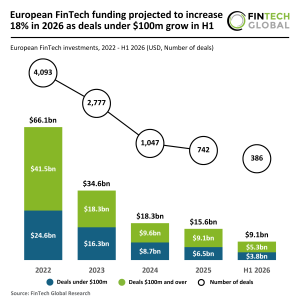
The European FinTech market is continuing to grow healthily, as found by FinTech Global research this week.
European FinTech market attracted $9.2bn across 386 deals in H1 2026, a 5% increase in funding compared to the $8.7bn recorded in H1 2025, though deal count edged down by 2% from 393 transactions over the same period.
The average deal size in H1 2026 came in at $23.8m, up 8% from $22.1m in H1 2025 and above the $20.9m average recorded across 2025, suggesting that while deal volumes have softened slightly, the scale of individual transactions has continued to grow.
Here are this week’s deals.
Tabby raises $233m at $6.5bn valuation
Tabby, the Saudi Arabia- and UAE-based buy now, pay later and financial services provider, has raised $233m in a new equity round.
The financing was led by existing backer Blue Pool Capital, with participation from current shareholders HSG, Wellington Management and Arbor Ventures, and values Tabby at $6.5bn.
Tabby has been profitable since 2023 and now handles more than $18bn in annualised transaction volume, serving 25 million registered users through partnerships with 70,000 businesses. The fresh capital is earmarked for Tabby’s push beyond BNPL into a wider suite of credit and money management products across its two core markets.
As part of the deal, employees will be given a liquidity option. Tabby has run share tenders since 2023, through which staff, past and present, have cashed out more than $100m in share sales.
Tabby has spent the last year building out its licensing footprint. The Saudi Central Bank has awarded the company consumer and SME finance licences, letting it extend larger, longer-term credit to individuals and working capital to businesses.
Tabby also bought Tweeq, a digital wallet licensed by SAMA, adding accounts, cards and transfers to its offering.
In the UAE, the Central Bank granted Tabby a Stored Value Facilities licence, paving the way for Tabby Cash, a fee-free alternative to a debit account that pays cashback on card spending and supports domestic and international transfers.
Tabby was founded on the idea of letting shoppers split the cost of a purchase at checkout, and the company says every product and licence it has added since has extended that same mission. Completion of the round still depends on regulatory sign-off, including clearance from SAMA.
Hosam Arab, CEO and Co-Founder of Tabby, said: “We began with a button at an online checkout to help people spread costs over time. Everything since, every product and every licence, has come back to the same idea: people deserve more from their money. This round means we can build further on that, without changing how we think about growth or discipline.”
Christopher Wu, Chief Investment Officer at Blue Pool Capital, said: “Tabby has demonstrated an impressive ability to innovate for their customers, evolving beyond payments to become the trusted platform for millions of people managing, spending and growing their money across the region. We are proud of our partnership with Tabby over the past three years, and we are excited to continue supporting the impressive growth of the company with this financing.”
S&P Global leads Kaiko’s $110m Series B extension
Kaiko, the regulated provider of data services for onchain finance, has extended its Series B funding round to $110m following a strategic investment led by S&P Global.
The extension drew backing from a broad group of strategic investors, including BNP Paribas, Bpifrance, Broadridge, Canton Foundation, Coinbase Ventures, DRW Venture Capital, Nasdaq Ventures, Royal Bank of Canada, Stellar and Susquehanna Private Equity Investments. Existing shareholders Anthemis, Point Nine and Revaia also took part in the extension.
Alongside the capital injection, participating institutions have joined a Strategic Industry Working Group chaired by Kaiko, through which they will help shape the data and infrastructure needed to bring tokenised products into production.
Because digital asset markets run around the clock, the systems that support them need to operate on the same basis. Kaiko’s principal business supplies institutional-grade market data covering digital assets, while its data infrastructure arm extends this into onchain capital markets, supplying proprietary pricing data to smart contracts, converting onchain activity into standardised off-chain data, and supporting confidential valuation and analytics work.
With tokenisation increasingly reaching Treasury bills, money market funds, equities and bonds, the company views its infrastructure offering as a natural progression of its existing data business, and the new funding will be channelled into both areas.
Kaiko provides regulated data services for onchain finance. Founded in 2014, the company supplies institutional-grade digital asset market data, analytics, indices and data infrastructure across digital asset, tokenised and traditional markets. Its client base spans banks, asset managers, exchanges and other financial institutions worldwide, and its offering supports trading, valuation, risk management, tokenised assets and onchain applications, linking traditional and blockchain-based markets.
Kaiko CEO Ambre Soubiran said, “The investors in this strategic round work across the core functions of digital asset markets: pricing, trading, capital allocation, and blockchain development. They are backing both the company Kaiko has built, a regulated institutional-grade data provider covering over 150 exchanges and protocols, and our vision to provide the data infrastructure layer for onchain capital markets. These are partners, not just shareholders. Together we will define how institutional money moves onchain.”
S&P Dow Jones Indices CEO Cathy Clay said,“As digital assets accelerate, S&P Global is investing for the future, and this investment underscores that conviction.
“Kaiko’s strength in crypto market data and analytics builds foundational transparency for the digital-asset ecosystem, turning complex trading and onchain activity into reliable, decision-ready intelligence. That capability supports our mission to advance essential intelligence by bridging traditional and decentralized finance, giving institutions the transparency and trust they need to deploy capital onchain with confidence.”
Thatch raises $108m at $1bn valuation for health benefits
Thatch, the health benefits platform helping employers move away from traditional group health plans toward a consumer-directed model, has announced a $108m funding round that values the company at $1bn.
The round was led by The General Partnership, Index Ventures, General Catalyst, and Andreessen Horowitz, with additional backing from ADP Ventures, Paychex, Eli Lilly and Company, Scale Venture Partners, QuantumLight, SemperVirens, Quiet Capital, and Avid Ventures.
The company said its revenue has increased almost sevenfold over the last 12 months, with over 5,000 employers now relying on its platform to shift staff away from single, one-size-fits-all group health plans and toward an approach that hands individuals more say over how their healthcare budgets are spent.
This surge in uptake reflects a wider rethink among employers, who are grappling with climbing healthcare costs and the reality that a plan built for an “average” worker often fails to suit anyone in particular. Rather than picking one policy for the whole workforce, businesses are increasingly opting to give staff a set budget and letting them choose cover that matches their own circumstances.
Under Thatch’s system, employers allocate a fixed, tax-free healthcare budget, and staff put those funds toward an individual plan suited to their needs, factoring in their preferred doctors, medications, family circumstances and type of cover. Any leftover budget can go toward other eligible healthcare costs, including GLP-1 medication and therapy. For employers, the approach brings more predictable healthcare expenditure, while shifting the actual purchasing choice to the employee using the care.
Beyond the health insurance sector, Thatch believes the model could carry wider significance. Healthcare ranks among the biggest spending categories for households and employers in the US, yet individuals have traditionally had limited say in how that money gets allocated. The company is working to build infrastructure that brings healthcare closer in line with other consumer markets, where people can set a budget, weigh up options and choose what best fits their circumstances.
To support this shift at scale, Thatch has built links with major health insurance carriers, payroll firms and benefits platforms, and counts ADP, Paychex, Gusto and QuickBooks among its distribution partners.
Thatch co-founder and chief executive Chris Ellis said, “For too long, healthcare has been the one major purchase in someone’s life they never actually got to make.
“Give people control over their own healthcare dollars, and the first thing they do is ask what something actually costs. That’s the behavior change this round is built to scale.”
Index Ventures partner Jahanvi Sardana said, “Every massive consumer market eventually gets rebuilt around the individual – Amazon did it for retail, Expedia for travel, Robinhood for investing. Thatch is doing it for healthcare.
“With AI, the end state is bigger than shopping: an agent that knows you, holds your wallet and can find, book and pay for the right care. The magic is that you stop navigating healthcare and start being taken care of.”
MIND raises $72m as AI turns data security urgent
MIND, the AI-native data loss prevention platform, has raised $72m in Series B funding, marking its second raise in just over a year as it scales efforts to protect enterprise data in the age of artificial intelligence.
The round was led by Crosspoint Capital Partners, with continued backing from existing investors YL Ventures and Paladin Capital Group. It follows MIND’s $30m Series A close a year earlier and takes the company’s total funding to $112m.
The raise lands at a pivotal juncture for the multibillion-dollar DLP sector, as artificial intelligence simultaneously widens the exposure of sensitive information and hands security teams new tools to contain it. MIND intends to use the fresh capital to broaden its footprint across major enterprise markets, strengthen technology and channel partnerships, and grow its team to keep pace with rising customer demand.
The company said the funding would let it move faster to help organisations safeguard sensitive data whether it is stored or in transit, with the broader aim of setting the standard for the next generation of DLP rather than simply updating an existing category.
MIND’s platform is built to give organisations complete oversight of sensitive information, from spotting where it lives to stopping it being lost. It discovers sensitive data across SaaS applications, GenAI and Agentic AI systems, endpoints, on-premise file shares and email, then classifies each file using a multi-layer AI engine that reads both content and context.
A context-aware detection layer is designed to flag genuinely risky activity while filtering out noise that would otherwise generate false alarms. Where issues do arise, the system can remediate data exposure autonomously, cutting down on manual investigation, and enforce policy-driven controls that either block risky activity outright or guide users towards safer behaviour in real time.
Over the past 12 months, MIND said it has grown revenue more than 17-fold and expanded its customer base eightfold, while analysing billions of data events in real time across GenAI, Agentic AI and conventional IT environments.
The company has prevented sensitive data loss across hundreds of thousands of endpoints and recently introduced its MIND AI DLP Agents, designed to take over the routine, day-to-day running of a DLP programme. MIND also said it became the first data security company accepted into Anthropic’s Cyber Verification Program and the first in its field to achieve ISO/IEC 42001 certification for responsible AI.
The company pointed to wider market research to underline the scale of the challenge it is targeting: while 90% of enterprises have already deployed generative AI tools and more than two-thirds are using AI agents, 65% say they lack confidence in their AI data security controls, and one in five AI initiatives fail because of weak data foundations.
MIND co-founder and CEO Eran Barak said, “Security leaders are being asked to protect data that moves at AI speed with complex, manual and incomplete tools designed for a slower world. DLP is a massive, established market, but it was not built with AI in mind. AI is accelerating the problem, giving people and autonomous systems new ways to access and move sensitive data at unparalleled speed. It also gives us the technology to reinvent how that data is protected.
“We believe this is the moment to redefine DLP and build MIND as the leader in data security for the AI era. In less than two years since emerging from stealth, we’ve built an eight-figure revenue business trusted by dozens of customers. Our results, and this funding, put MIND among a select group of cybersecurity companies scaling at this pace, but what matters most is how this will accelerate our growth and bring Stress Free DLP to every enterprise working to achieve AI governance and security.”
Saudi banks back Tarabut’s $50m embedded finance push
Tarabut has secured $50m (SAR 187m) in strategic financing from a consortium of leading Saudi financial institutions and family business groups, as it sharpens its focus on the Kingdom’s financial services market.
The round drew backing from Riyad Bank, the X-Tech Fund managed by SAB Invest, GIB Saudi Arabia, Zamil Group and Kanoo Ventures, part of the Yusuf bin Ahmed Kanoo Group, alongside a number of other prominent regional institutions.
The fresh capital will fund complete, end-to-end embedded finance journeys that combine verification, decisioning and financing into a single flow at the moment a customer needs it, all delivered under the partner institution’s own brand.
The company points to small and medium-sized enterprises as the area of greatest friction in the market. While financial institutions across the region are working to reach more creditworthy SMEs, many still lean on last year’s static paperwork rather than live cash-flow data, leaving approved businesses waiting weeks for the capital they need.
Tarabut’s technology lets financial institutions pair traditional documentation with real financial behaviour, giving lenders live visibility of cash flow and shrinking the wait for finance from weeks of administrative delay to the exact point of need, all without the business leaving the transaction or the lender losing the customer.
The same capability gives institutions a sharper read on millions of consumers who are typically hard to assess through conventional credit models.
Tarabut has processed more than 5bn API calls across the region, linking banks, distributors and consumers on a single regulated platform, and this latest financing is aimed squarely at Saudi Arabia, which the company regards as the region’s largest financial market and the centre of its embedded finance strategy.
The company frames its work as supporting wider access-to-finance goals under Saudi Vision 2030 and the Financial Sector Development Program, and says it will set out the next phase of its embedded finance platform in the coming months.
Tarabut founder and CEO Abdulla Almoayed said, “The institutions backing Tarabut are the institutions that run on our infrastructure. We built a regulated platform across Saudi Arabia, the UAE and Bahrain, and this financing will allow us to take everything we have proven across the region and go deeper where it matters most: Saudi Arabia.
“The biggest prize is SME finance. Financial institutions want to serve more creditworthy businesses, and our infrastructure helps them turn real financial behaviour into a clearer picture for decision-making. Embedded finance will define the next decade of this region’s economy, and we are built to power it.”
Luzern Risk raises $45m Series B led by Insight Partners
Luzern Risk, a full-service captive manager specialising in alternative risk solutions, has closed a $45m Series B funding round.
The round was led by Insight Partners, with participation from Trust Ventures and existing backer Caffeinated Capital, which previously led the company’s seed round in 2023 and its $12m Series A in 2025.
Luzern Risk has built an AI-native technology platform designed to significantly shorten the time needed to launch and run bespoke captive insurance programmes at scale.
The company said organisations are increasingly looking to take greater control over how they finance their exposures, as commercial insurance grows more expensive and unpredictable.
Captives are regulated insurance entities owned by the parent organisation that can turn volatile insurance costs into strategic assets, giving owners the ability to write tailored coverage, keep underwriting profit and build up surplus. Around $240bn in gross premium currently flows through captives globally, equivalent to roughly a tenth of the worldwide property and casualty market, and Luzern Risk noted that uptake is spreading well beyond the Fortune 500 firms that have traditionally relied on the structure.
Luzern Risk partners with brokers, fronting carriers, reinsurers and advisors to meet this rising demand. Its digital platform underpins relationships with a client base spanning multiple industries, from mid-market businesses to large, publicly listed companies, and the company said revenue has climbed quickly year on year as demand for its offering has grown.
The new capital will be directed towards three strategic priorities. It will fund continued development of the platform and its AI capabilities, aiming to deliver more efficient captive administration and sharper risk insights for owners. It will also support efforts to standardise operations across the business to cut turnaround times on complex, specialised work, while giving clients more choice across the alternative risk value chain.
Luzern Risk said captives sit at the core of its long-term ambitions, with the structure becoming increasingly viable for a wider range of firms able to tailor a captive to their exact needs.
Luzern Risk CEO and Co-Founder Gabriel Weiss said, “We set out to make captives more accessible to a broader set of the market, and everything we have learned since has strengthened our conviction that captives will play a far bigger role in risk management than they do today. This investment lets us do what we care about most: deliver better outcomes for our clients, at a much greater scale.”
Luzern Risk CTO and Co-Founder Jonathan York said, “This is a space where technology can have an outsized impact for clients.
“Every process we automate makes a captive more efficient to run while increasing quality, and every capability we add gives owners something they could not get before. The feedback we hear from our clients as we co-develop solutions with them gives us confidence we’re onto something that will be great for insurance industry-wide.”
Insight Partners Managing Director Philine Huizing said, “The captive market is undergoing a structural expansion, moving from a tool reserved for large multinationals into a viable strategy for a much broader universe of companies. Luzern is building the infrastructure layer that makes that expansion possible. We backed this team because we believe they are defining how risk finance gets done, and we’re excited to support them in this next phase of growth.”
AIUC raises $40m to police risk in frontier AI agents
AIUC, the artificial intelligence underwriting company building the audit, standards and insurance infrastructure behind its mission to Underwrite Superintelligence, has closed a $40m Series A round to widen its coverage from AI agents to frontier models.
The round was led by Ribbit Capital, with participation from First Harmonic and Terrain. It follows AIUC’s earlier $15m seed round, which was backed by NFDG, bringing the company’s total funding raised to date to $55m.
The company frames the raise against a backdrop of mounting pressure across the AI industry for independent oversight, pointing to public calls from senior figures at OpenAI, Anthropic and xAI for frontier AI audits.
AIUC argues that confident deployment of AI models depends on three things: auditors with genuine frontier AI expertise, incentive structures that stop providers racing each other to the bottom on safety, and shared standards defining what a credible audit actually looks like.
To make its case, the company draws a parallel with the early history of electricity, when unsafe wiring and appliances caused house fires until insurers funded Underwriters Laboratories to certify products against defined safety standards.
That UL mark, now stamped on household items across America, is presented as an early example of how combining standards, audits and insurance can build public trust in a new and initially risky technology, a pattern AIUC says later repeated with cars and nuclear power.
AIUC’s flagship product, AIUC-1, is a certification standard built specifically for AI agents. It stress-tests how agents perform against threats including jailbreaks, hallucinations and data leaks, drawing on 5,000 risk-and-attack combinations tailored to the type of business being assessed.
The standard was developed in partnership with more than 250 security and risk leaders, who continue to shape the product through a consortium as AI capabilities and associated risks evolve, while also driving its adoption inside their own organisations.
A number of companies building widely used AI agents, including Cursor, ElevenLabs, Harvey, KPMG, Lovable, UiPath and Fin, have certified their products against AIUC-1. AIUC notes that this covers AI systems now writing production code, drafting legal documents and handling customer calls for millions of end users.
Established auditors are also brought into the process, contributing their experience in setting access requirements, reviewing evidence and communicating assurance, which AIUC says complements its technical evaluations to produce a more complete AIUC-1 assessment.
Looking ahead, AIUC said the new capital will be used to extend its audits, standards and insurance offering beyond AI agents to cover frontier models, as it works to build out a broader ecosystem for oversight of advanced AI systems.
Comp AI raises $34m to push security beyond the audit
Comp AI, the AI-native compliance and security platform founded in January 2025, backed by Roo Capital and Grand Ventures, has closed a $34m Series A round to push further into continuous cybersecurity.
The raise arrives after a sharp run of growth for the Miami-headquartered firm, which has posted 15x annual recurring revenue growth year-on-year and now counts more than 1,000 customers, having grown 10x year-on-year.
The new capital will be directed at extending Comp AI’s reach beyond compliance automation and into continuous cybersecurity, covering real-time monitoring, control validation and security testing across applications and infrastructure.
Compliance software’s earlier wave took firms away from spreadsheets, consultants and lengthy manual preparation, yet much of the underlying work has continued to rely on people, leaving businesses with only occasional snapshots of their security standing.
Comp AI argues that agentic AI removes that ceiling, letting software increasingly carry out and check work that once needed constant human input. That shift matters more as AI speeds up both how fast software is built and how quickly it can be attacked, with companies releasing and updating products faster than static, point-in-time reviews can track, pushing security systems towards becoming more adaptive, real-time and exact.
Comp AI has built its platform around that premise, deploying organisational context and AI agents to handle onboarding, policy and risk creation, evidence collection, control monitoring and vendor assessments.
The approach is designed to bring compliance timelines down from quarters to days without loosening standards. Its client base spans healthcare, financial services, higher education, professional services and software, including names such as Corgi, Dub, OpenCode, Inference and Primer.
As software vendors sell into bigger accounts, move into regulated markets and manage increasingly complex technology estates, security demands are showing up sooner and growing tougher to satisfy.
Comp AI positions its platform as a way to meet those demands now while laying the groundwork for a security posture that scales alongside its customers. The company is purpose-built for that agentic shift, designing its systems around the current capabilities of AI agents rather than retrofitting AI onto older workflows, with agents able to reason across organisational context and take on an expanding share of the work.
Beyond product development, the Series A will fund headcount growth across Comp AI’s Miami headquarters and New York office, with hiring planned across product, engineering, operations, sales, customer success and marketing as the company pursues larger, more complex customers.
Comp AI CEO and co-founder Lewis Carhart said, “The first generation of compliance software proved this process could be automated. Agentic AI lets us go much further. Security software shouldn’t just track the work. It should understand the business, perform the work, and act as risk changes. We started by making compliance dramatically faster and less resource-intensive. Now we’re building toward a platform to proactively identify, validate, and act on risk in real time.”
Comp AI COO and co-founder Claudio Fuentes added, “Historically, compliance has been an approximation of security because so much of the work could only be performed manually and periodically. Agentic AI changes that constraint. Work that once required teams of people can increasingly happen continuously in software. At the same time, AI is making the threat landscape faster and more dynamic. We believe the next generation of security companies will be built around that reality from day one.”
Comp AI CTO and co-founder Mariano Fuentes also remarked, “AI changes both what software can do and how quickly technical teams can build it. As models become more capable, we can move beyond software that simply records whether security work happened toward software that can execute and verify that work.”
dtcpay grows Series A to $25m with SBI Group backing
dtcpay, a Singapore-headquartered payment services company that bridges stablecoins with traditional finance, has extended its Series A funding round to $25m after welcoming Japan’s SBI Group as a strategic investor.
The round was initially led by Vertex Ventures Southeast Asia & India in April 2026. It has now been broadened by SBI Group, which is investing through two vehicles: its subsidiary SBI Ventures Asset Pte Ltd and the SBI-NTU-Kyobo Digital Innovation Fund. Genedant Capital also joined the round, alongside continued commitment from existing backer Mr Kwee Liong Tek, a well-known Singaporean business figure.
Founded by Alice Liu and Band Zhao, dtcpay provides infrastructure that lets businesses and consumers accept, hold and transact in stablecoins, using a real-time swap engine designed to settle stablecoin and fiat transactions without the delays and layered fees typical of SWIFT-based cross-border transfers.
The company has built out its product suite with a Digital Payment Token point-of-sale solution for in-store merchant acceptance, an early integration with WalletConnect that extends stablecoin usability across more than 700 wallets, and a partnership with Visa that produced a stablecoin-to-fiat Visa Infinite card, now usable for multi-currency spending at more than 150 million merchant locations worldwide.
dtcpay has also worked with BNB Chain to push stablecoin adoption into everyday commerce, helping Metro become the first Singapore department store to take stablecoin payments and extending acceptance to hospitality partners including Capella Singapore.
The fresh capital will support dtcpay’s continued expansion, funding a revamped business portal for enterprise clients and a series of consumer-facing updates to the dtcpay app through the remainder of 2026.
dtcpay founder and CEO Alice Liu said, “We did not raise this round to sustain what we have built. We raised it to fundamentally change how money moves across borders. SBI Group has spent decades shaping financial infrastructure across Japan and beyond, from banking and securities to blockchain and digital assets, and their conviction in dtcpay is validation that compliant, real-world stablecoin payments are not a distant vision but an infrastructure being built right now.”
dtcpay group chairman Band Zhao said, “The next chapter for dtcpay is about scale. We are strengthening our infrastructure, deepening partnerships with global financial institutions, and expanding into new regulated markets to make stablecoin payments as seamless and trusted as traditional payment rails. With the backing of our investors, we are accelerating our mission to build the financial infrastructure that enables businesses and consumers to move value globally, instantly, and compliantly.”
Ryft secures £20m in UK’s largest payments Series B
Ryft, a Manchester-based payments company that builds infrastructure for marketplaces, platforms and multi-location businesses, has closed a £20m Series B funding round to support its next stage of international growth.
The round was led by Gresham House Ventures, with additional backing from existing investors Pembroke VCT and Ingenii Capital. The fresh capital will be used to fund Ryft’s expansion into Europe and the US, while also accelerating its product roadmap and its push into serving larger, enterprise-scale clients.
The raise follows a period of rapid growth for the company. Ryft has tripled its transaction processing volume over the last year, and its platform is now relied upon by more than 6,500 businesses, including Epos Now, Chaiwalla, the Disasters Emergency Committee, Daytrip and Sprive. As part of its European growth plans, Ryft has submitted an application for a full EU licence with the Malta Financial Services Authority, a move that would allow it to passport its services throughout the European Economic Area.
Since it was established in 2021 by Alex Mackenzie, Richard Kirby and Sadra Hosseini, Ryft has focused on building payment infrastructure for marketplaces, platforms and businesses operating across multiple locations. Its technology helps these organisations manage seller onboarding and handle intricate transaction flows, such as recurring billing, automated split payments and cross-border payouts, all through a single integration, an approach designed to help merchants scale quickly while also opening new revenue opportunities from the payments they process.
The company has built partnerships with several major payment providers since launching, among them Global Payments, Visa, Mastercard, American Express and Nuvei.
Economic Secretary to the Treasury Lucy Rigby said, “Ryft’s success is a vote of confidence in Manchester’s thriving fintech sector and shows how British businesses can start, scale and compete on the global stage. This Government is backing the industries and companies like Ryft that are creating jobs, attracting investment and driving good growth in every postcode.”
Ryft CEO and co-founder Sadra Hosseini said, “This round of investment means we can take what we’ve built in the UK into new European markets and compete on the global stage. Payments have been dominated by a small number of incumbents for a long time. We want to provide a powerful and efficient alternative to businesses, not just in Europe, but globally.”
Gresham House Ventures Partner Rohit Mathur said, “As commerce shifts to instant, multi-party platforms and increasingly agent-initiated payments, ownership of the infrastructure rails becomes a question of national economic sovereignty, not just merchant cost. We’re backing Ryft because the UK needs domestic champions with payment architecture for the next era of commerce, and Ryft is one of them. Sadra, Alex, Richard and the wider team are executing at an impressive pace, and we are proud to back this category-defining Manchester FinTech!
Fin.com’s $20m bet on rebuilding cross-border payments
Fin.com, a financial infrastructure company building a unified network for global money movement, has emerged from stealth with $20m after quietly growing its annual recurring revenue more than 50-fold since the start of the year.
Until today, the company had never published a blog post, given an interview or publicly confirmed its own existence, despite its technology already moving money for some of the world’s largest payments and money-transfer platforms, leading prediction markets and major digital-asset exchanges, reaching 825 million users worldwide through those customers.
The $20m seed round was led by Expa and Uber co-founder Garrett Camp, with participation from Coinbase Ventures, Tenet Fund, Figure’s founders, Mesh founder Bam Azizi, Second Sight Ventures, and sovereign and royal family offices across the Gulf and Africa.
Cross-border money movement remains reliant on an ageing patchwork of bank messaging systems, local payment rails, intermediaries and manual processes. SWIFT, which has underpinned international bank messaging since the 1970s, was never built as a settlement network, and the gap shows up in fees, FX markups and settlement windows that can run for days.
Last year, $195 trillion moved across borders through rails like it, shedding cost and speed at every step. Fintech has spent a decade polishing the user experience sitting on top of that plumbing, while the infrastructure underneath stayed fragmented.
Fin.com was built to replace that plumbing directly. The company runs a single orchestration layer that allows businesses to collect, convert and move money internationally through local payment rails, USD virtual accounts, SWIFT, stablecoin settlement, liquidity and compliance, all within one network.
It holds licences and regulatory approvals that let it operate in markets many global providers find hard to reach, deliberately concentrating on the Middle East, Africa, South Asia and Southeast Asia, where cross-border flows remain especially fragmented.
Its approach to expansion is also unconventional. Rather than raising large sums to break into new markets from outside, Fin.com acquires licensed, established local operators and folds them into its network, a private equity-style playbook executed at venture pace. Buying into existing licences, banking relationships and local expertise lets the company plug new markets straight into its wider infrastructure.
Seven acquisitions have closed so far, with twelve targeted by the end of the year. That strategy has produced a company of more than 200 people across six offices in New York, Las Vegas, Dubai, Dhaka, Bangalore and Lahore, which has already processed billions in payment volume across more than 51 countries, with most transactions settling within minutes.
Fin.com has also built an advisory board drawing on senior figures from across payments and fintech, including Michael Tannenbaum of Figure, Imran Ahmad of Bitso, Matt Heiman of Mercury, Bruce Wallace of Revolut, former Binance board director Christy Choi, and Mesh founder Bam Azizi.
The company was co-founded by Nabeel Alamgir, a Forbes 30 Under 30 honoree and founder of Lunchbox, and Mustafa Dar, founder of 24/7 Jet and a venture partner at Expa, both of whom have personally experienced the cost and friction of sending money across borders.
The new capital will fund expansion into additional payment corridors and further acquisitions, and Fin.com is also targeting a bank acquisition within the next six months.
Hackuity lands $19m as AI fuels a vulnerability tsunami
Hackuity, the AI-powered vulnerability operations centre specialist, has closed a $19m funding round as enterprises struggle to keep pace with a mounting backlog of unresolved security flaws.
The round was led by Forgepoint Capital International, with participation from existing backers Bright Pixel, Bpifrance and Seventure Partners. The fresh capital takes Hackuity’s total funding to $38m and will be used to accelerate product innovation, deepen its AI capabilities and support expansion across Europe and Asia.
The raise lands at what the company describes as a turning point for the cybersecurity industry. AI-powered discovery tools are driving what Hackuity calls a “vulnerability tsunami”: according to the release, Anthropic’s Claude Mythos Preview alone flagged more than 10,000 high or critical severity flaws in under two months, with 99% of them still unpatched.
The number of known Common Vulnerabilities and Exposures has climbed to 350,000, up 20% on the previous year, and the release argues that attackers are now finding and exploiting weaknesses faster than security teams can fix them.
Despite heavy investment in detection technology, Hackuity says traditional vulnerability management has not kept up with this shift. Security teams remain weighed down by fragmented data, disjointed workflows and a rising tide of findings, leaving them unable to consistently identify what matters most and coordinate a response before attackers strike.
Hackuity’s platform is built to address that gap. It draws data from more than 130 security tools, adds business and threat context to every finding, and coordinates remediation work across security, IT and engineering teams, allowing organisations to focus on the vulnerabilities that pose genuine business risk.
At the centre of the system is a proprietary risk scoring engine that continuously weighs severity, exploitability, threat intelligence, asset criticality and business impact to determine what should be fixed first.
The company points to substantial gains for its customers, including a reduction in critical vulnerability noise to 0.01%, a threefold improvement in mean time to remediate, automation of up to 70% of full exposure management activity, and savings ranging from the low hundreds of thousands of dollars to $1m.
Global organisations including ENGIE and BPCE already rely on Hackuity to manage cyber exposure and speed up remediation, and the company also works with a network of systems integrators, resellers and managed security service providers to help enterprises modernise their vulnerability operations, among them Orange Cyberdefense.
Hackuity CEO and co-founder Patrick Ragaru said, “Hackuity was founded on a simple conviction: the volume of vulnerabilities would outpace any human’s capacity to respond. Mythos simply validates that thesis, by making the scale of the tsunami impossible to ignore.
“Having Forgepoint, a globally recognized cybersecurity investor with unmatched sector expertise and a truly global network, lead this round is a strong signal that the market agrees. What we built before the wave arrived is exactly what enterprises need now that it’s here: an agentic platform that automates prioritization and drives remediation at machine speed.”
Integral raises €18m Series A led by Mosaic, Hoffman
Integral, a Berlin-based company building an AI-native platform for accounting, tax and payroll services, aimed at small and medium-sized businesses, has announced an €18m Series A funding round.
The round was co-led by Mosaic Ventures and investor Reid Hoffman, with participation from existing backers Cherry Ventures, General Catalyst and Puzzle Ventures, all of whom increased their stake in this round.
The fresh capital takes Integral’s total funding to more than €30m, achieved in under two years since the company was founded.
Integral’s model pairs its technology with Integral Tax, an affiliated licensed professional services firm that runs entirely on the platform. AI agents handle reconciliation of invoices and bank transactions, prepare account postings, payroll runs and tax filings, while licensed professionals at Integral Tax review, exercise judgement on exceptions, and take legal responsibility for everything that is filed or submitted. Corrections made by professionals feed straight back into the system, a loop the company says continually sharpens its automation.
Since the start of 2026, the professionals at Integral Tax have doubled the number of clients each can serve, and the company reports that monthly accounting turnaround for many clients has fallen from weeks to hours, while filings continue to be reviewed and signed off by accountable professionals throughout.
The founders describe Integral as one of the first companies in what they term “AI-native services”, businesses that deliver a regulated outcome directly, rather than selling software tools to existing service providers. They argue that licensing, professional secrecy and personal liability rules make clear exactly where a human must remain in the loop, allowing everything else to be automated with confidence.
The company intends to use the new funding across three areas: extending automation to more complex accounting, tax and payroll cases; hiring across AI engineering, licensed professional and commercial teams; and developing additional services beyond its current accounting, tax and payroll offering.
Mosaic Ventures partner Chandar Lal said, “With AI, it’s possible to rebuild industries from the ground up, not just sell better software. In accounting, tax and payroll, the need is obvious as labour shortages are only getting worse. Integral is uniquely well positioned to solve that problem in Germany and beyond.”
Integral investor Reid Hoffman said, “AI’s real promise is amplifying what people can do, not replacing them. Integral shows what that looks like in one of the most regulated, trust-dependent industries there is: agents that multiply the reach of licensed professionals, so every small business gets the kind of financial expertise once reserved for large corporations. That’s the pattern the next decade of professional services will follow and Lukas and Anil are building it where the bar is highest: Germany.”
Pave Finance raises $15m in oversubscribed Series A round
Pave Finance, the AI-powered portfolio management platform built for financial advisors, has closed a Series A funding round worth more than $15m, surpassing its original target and lifting the business to a $100m pre-money valuation.
The oversubscribed round arrives as advisory firms grapple with time-intensive manual processes and search for technology capable of delivering more personalised portfolios across a growing client base.
Backers in the round included advisory firms, former executives and board members from major US financial services companies, alongside existing company insiders. Pave said the fresh capital will go toward growing its headcount, with particular focus on expanding its market-facing and internal engineering teams as it deepens its footprint across the wealth management sector.
Advisors already using Pave’s platform collectively manage more than $130bn in assets spread across upwards of 300,000 accounts, a figure the company points to as evidence of rising adoption of its automation and portfolio management tools.
Pave Finance provides an AI-driven portfolio management platform that allows registered investment advisers (RIAs) and wealth management firms to build, personalise and manage client portfolios at scale, while cutting down on the time, cost and operational load placed on advisors.
The Series A builds on Pave’s $14m oversubscribed seed round, which closed in September 2025, and represents the company’s next step in scaling its technology and market presence within wealth management.
The platform tracks more than 50,000 publicly traded securities worldwide, giving US wealth advisors the tools to manage both equity and multi-asset portfolios. Advisors can exclude particular sectors, industries or assets, factor in existing holdings and tax considerations, and tailor portfolios to each client’s risk appetite, with the platform designed to integrate directly with custodians for faster onboarding.
Pave Finance chief executive officer Christopher Ainsworth said, “Reaching this funding stage reflects the growing demand for modernized platforms we’re witnessing within the financial advisory space. As advisory businesses grow, firms must now find efficient ways to manage a larger volume of clients who are simultaneously demanding greater personalization in their portfolios.
“This funding gives us additional resources to grow our team and continue investing in the technology that saves advisors time and resources, ultimately translating to lower fees and more tailored client experiences.”
Partech leads $13m round for Synapse Analytics
Synapse Analytics, an Abu Dhabi-headquartered AI company that builds agentic decisioning infrastructure for regulated financial institutions, has raised $13m in a Series A funding round.
The round was led by global investment firm Partech, with additional participation from Algebra Ventures and Silicon Badia, bringing Synapse Analytics’ total funding since inception to $17m.
The fresh capital will go toward scaling the team, speeding up product development and pushing further into international markets.
Synapse Analytics’ technology addresses a core tension facing financial institutions as they automate more of their operations: capturing the sophistication of AI-native models typically means routing sensitive data to infrastructure outside the institution’s control.
The company’s decisioning platform is designed to sidestep that compromise, deploying within a client’s own environment, whether on-premise, in private, public or sovereign cloud, or fully air-gapped, so that onboarding, credit, fraud and anti-money laundering decisions can be automated without institutions giving up ownership of their data, policies or the intelligence those decisions generate.
Its proprietary models operate entirely inside client infrastructure, supporting regulatory compliance without limiting capability, the company said.
The platform also lets risk and credit teams amend policies directly and simulate the effect of those changes against historical data ahead of deployment, giving institutions a route to introducing AI at scale while preserving the governance regulators in the sector require.
Synapse Analytics co-founder and CEO Ahmed Abaza said, “Our mission is to give financial institutions the intelligence and decision infrastructure they need to make faster, more secure decisions to reduce risk, unlock growth and build stronger customer relationships. Partech’s investment reflects the momentum we have built and gives us the backing of a leading global technology investor to pursue the next stage of that ambition.”
Synapse Analytics co-founder and COO Galal Elbeshbishy said, “We built Synapse Analytics to help financial institutions make better underwriting decisions. Today, we’re taking that a step further by working with banks, fintechs, and other firms to enable intelligent agents that actively work alongside their teams — helping them build and refine credit policies, continuously enhance underwriting criteria, and monitor portfolios in real time.
“These agents identify emerging opportunities and risks, help institutions grow their portfolios while reducing risk, and allow them to react quickly as market conditions and borrower behavior change. Our vision is to create the AI operating system for the new age of finance.”
ETFBOOK raises $13m to unify global ETF data
ETFBOOK, the Zürich-headquartered ETF data and analytics platform, has closed a $13m funding round to take its offering beyond its established European base.
The company positions itself as the default intelligence layer for participants across the global ETF ecosystem, spanning issuers, asset managers, liquidity providers, hedge funds and capital markets desks.
The round was led by Expedition Growth Capital, with existing backer BlackFin Capital Partners also contributing.
The fresh capital will fund the next stage of ETFBOOK’s growth, extending its data infrastructure from the EMEA region into the AMER and APAC markets.
As part of the deal, Boston-based Steve Twomey of Expedition Growth Capital has taken a seat on ETFBOOK’s board to help guide the company’s push into the US. To back that effort, ETFBOOK is standing up a US legal entity, opening a New York office and hiring locally.
The raise arrives as ETF markets expand rapidly, with assets under management reportedly reaching $25tn and projected to climb towards $35tn by 2030, according to ETFBOOK’s own figures. The company argues that the data infrastructure supporting this growth has failed to keep up, leaving fragmented sources and manual reconciliation processes that struggle to scale. Company data suggests more than 1,320 new funds have launched across Europe and the US so far this year, equivalent to roughly seven per trading day.
ETFBOOK already counts more than 70 enterprise clients across EMEA, including ETF issuers, fund administrators, market makers and authorised participants, alongside buy-side firms such as asset managers, wealth managers and hedge funds.
The business says recurring revenue has more than doubled annually over recent years. Its offering is split across three areas: programmatic data access via API, analytics delivered through a proprietary web application, and a workforce layer that combines verified ETF data with clients’ own sources for large-scale data operations. The company is also building out an AI conversational layer across its products.
Beyond the US push, ETFBOOK plans to grow its presence in Hong Kong and expand its technology hub in Cracow, while broadening data coverage and enhancing its web application across more use cases.
ETFBOOK co-founder and CEO Pawel Janus said, “Global capital has been moving out of mutual funds and into ETFs for years, and there is no turning back. What never kept up is the data and analytics underneath this growth, globally and for AI-native applications.
“Most firms still piece raw data together by hand, across a stack of vendors, formats, languages or conflicting versions. There is no single source of truth for global ETF markets across ETF data layers. That’s the problem ETFBOOK is solving, and this round is what takes our AI-native approach from the EMEA region into the AMER and APAC markets.”
ETFBOOK co-founder and CTO Bartlomiej Igla said, “We are rethinking how financial data platforms scale and deliver value. We’ve built an intelligent architecture that automates our core operations and frees us from linear headcount growth.
“This allows a lean team of technical and domain experts to focus on the best product experience for every user segment across our massive global ecosystem. With new funding, we will scale our product offering into the AMER and APAC regions, delivering an unprecedented level of unification and depth in ETF data and analytics. All that while maintaining flawless operational efficiency.”
Chift lands €10.5m to connect Europe’s fragmented finance
Chift, a European financial data connectivity platform, and a specialist integrator of accounting and business software for small and medium sized enterprises, has raised €10.5m in a Series A funding round.
The round was led by BlackFin Capital Partners, a private equity firm focused on the European FinTech sector, with participation from existing investors Entourage, Shapers, Seeder Fund and Wallonie Entreprendre.
The company was founded on the premise that financial data across Europe remains locked within thousands of disconnected national systems, preventing software providers from scaling across borders and stopping AI tools from gaining a full view of a business’s finances.
Chift’s founders spent years manually linking individual software tools for small businesses before deciding a broader, unified approach was needed.
Chift points to two developments reshaping its market: the rollout of e-invoicing mandates across Europe, which will push every business onto digital finance systems by 2030, and the rise of AI agents in accounting, which depend on connected data to function.
The company estimates that around 30 million small and medium sized businesses across Europe and the UK, alongside a €174bn accounting services sector that remains largely manual, will need their financial systems linked together in the coming years.
Chift operates a single integration that links software providers to more than 120 financial systems spanning the continent, with new connections added on an ongoing basis. More than 150 software businesses currently build on the platform, giving over 50,000 companies across 13 countries access to connected financial data, among them Sage, Revolut, Qonto, Pennylane and Mollie.
The firm holds a leading position in France, Belgium and the Netherlands, entered Spain a year ago and is now expanding into the UK, the Nordics and Germany.
The new capital will fund development of an agentic layer that lets integrations configure themselves automatically and allows AI systems to act safely on financial data.
Chift also intends to extend its coverage into Spain, the UK, the Nordics, Germany and Italy over the coming years, while working to reach small businesses through the software providers, accountants and partners they already use. The company is recruiting for 15 positions across Europe during the second half of 2026.
Velocity’s Series A swells to $48m as banking giants circle stablecoins
Velocity, the stablecoin payments and treasury platform, has closed a $10m extension to its Series A round, with backing from Visa Ventures, Circle Ventures, Ripple, Haun Ventures, Translink Capital and Mirana Ventures.
The fresh capital follows Velocity’s $38m Series A announced last month, taking the company’s total Series A funding to $48m. The extension will support Velocity’s efforts to bring stablecoin infrastructure to issuers, acquirers, payment providers, financial institutions and merchants around the world.
The participation of Circle Ventures and Ripple links Velocity with two established players in regulated stablecoins, spanning payments, liquidity and institutional finance. Translink Capital’s involvement gives Velocity a strategic connection into its network of corporate and institutional partners across Asia.
Together, the backers share a view that the next stage of stablecoin adoption will hinge not just on the underlying assets and blockchains, but on the infrastructure that links them to the banking, treasury and settlement systems institutions already rely on.
Haun Ventures brings experience from backing several generations of stablecoin and financial infrastructure companies, including previous investments in Bridge and BVNK. Its investment in Velocity reflects a belief that stablecoins will become increasingly woven into the systems that underpin payments, banking and treasury.
Velocity builds infrastructure that lets institutions and businesses use stablecoins for settlement, liquidity and treasury functions, without needing to overhaul their existing systems. The platform aims to make the flow of money behind payments more continuous, cut dependence on prefunding and push settlement beyond the hours traditional banking allows.
With its Series A now totalling $48m, Velocity plans to keep expanding its platform and broadening its reach across the global payments and treasury landscape. The company’s ambition is to embed stablecoins seamlessly into how institutions move and manage money, linking issuers, acquirers, merchants and financial institutions through infrastructure built for continuous, global settlement.
Velocity founder and CEO Eric Queathem said, “We are excited to welcome several new investors to Velocity, including Visa through Visa Ventures. From day one, we have focused on improving how money moves through the payments ecosystem. These investors operate at the center of that ecosystem and will provide invaluable insight as we use stablecoins to transform the experience.”
Visa global head of growth products and strategic partnerships Rubail Birwadker said, “Stablecoins are playing an increasingly important role in reshaping how value moves across the Visa ecosystem, and companies like Velocity are helping accelerate adoption and unlock new opportunities for our customers and partners. We’re excited to invest in Eric and the Velocity team as they build the infrastructure needed to bring stablecoin-powered money movement to every business.”
Quartz raises £2.75m pre-seed for AI-led wealth platform
Quartz, a UK-based wealth platform that brings together everything a person owns and pairs it with an AI assistant to deliver personalised financial guidance, has launched in the UK after securing £2.75m in pre-seed funding.
The round was led by Daphni, with participation from Outward VC and K Fund, alongside a group of angel investors including Kantox founder Philippe Gelis and former N26 and Kraken chief product officer Gilles BianRosa.
The company has been testing its platform since the beginning of the year, and more than £10m of its members’ assets are already being tracked.
Following the launch, Quartz will begin admitting members from its UK waitlist in batches, by invitation, as the business focuses on the quality of each new member’s experience over the pace of growth.
Quartz was founded to close a long-standing gap in wealth management, where consumers have traditionally had to choose between costly, personalised advice or standardised products offering little guidance.
The company’s co-founder, André Silva, who previously led global expansion at Revolut, said that while millions of people gained access to fast, transparent banking, the more valuable guidance needed to grow their money remained expensive and largely limited to wealthy clients. Alongside co-founder Mateus Mesquita Alves, the team set out to build technology that could extend that kind of guidance to a much wider group of people.
At the core of Quartz’s offering is its own aggregation technology for pensions and brokerage accounts, built in-house over the past year. The company has registered with the UK Financial Conduct Authority as an Account Information Service Provider, allowing it to securely connect to customers’ pensions, ISAs, savings and investment accounts, with permission, and consolidate financial information that would otherwise sit fragmented across multiple providers.
Layered on top of this is Charlie, an AI-based assistant designed to learn a user’s goals, monitor markets on their behalf, and surface relevant information at the right time, allowing members to interact directly with their portfolio.
Daphni partner Paul Bazin said, “The wealth management industry has always been very good at serving its non-digital native clients, but it isn’t equipped for the new generation, whose expectations are entirely different. Quartz is the first team we’ve seen with both the product instincts and the regulatory foundations to serve them properly.”
Joiin secures €1.5m to fuel global growth
Joiin, the UK-founded financial reporting and consolidation platform, has secured €1.5m in growth financing, a deal designed to strengthen its go-to-market strategy and support its next stage of international growth.
The capital has been provided by Gilion, a firm that specialises in flexible, non-dilutive growth funding for technology businesses. The injection is intended to widen Joiin’s commercial capacity, help it enter fresh markets and allow it to respond to rising appetite for more intelligent financial reporting and consolidation tools.
Established in the UK in 2018, Joiin has grown into a profitable and cash-generative operation relied upon by thousands of organisations worldwide. Its platform pulls together financial and non-financial information from providers such as Xero, QuickBooks and Sage, giving finance teams a real-time picture of how their business is performing across different entities, currencies and systems.
Demand for the platform has continued to build as finance teams look for simpler ways to consolidate and report on their numbers without having to overhaul their existing finance software. Because Joiin operates as a genuine multi-ledger, multi-entity system, businesses can keep different accounting platforms running across various markets and entities while still viewing all of their data in one unified format.
Much of this momentum has come from the steady broadening of Joiin’s fintech ecosystem. In the last year alone, the company has added new integrations with FreeAgent, MYOB, Zoho Books, Fortnox and Stripe, building on existing connections with Xero, QuickBooks, Intuit Enterprise Suite and Sage.
Joiin has also introduced forecasting functionality, Microsoft Excel and BI connectivity, API access and Joiin Intelligence, an AI-driven reporting feature built on the company’s secure data layer that lets AI tools work across connected entities and systems to support sharper reporting, consolidation and analysis. The company has continued to deepen its partnerships across accounting and FinTech more broadly, helping it reach new markets and giving finance teams additional routes to connect their data.
Joiin CEO and co-founder Lucien Wynn said, “We’ve built Joiin into a profitable, cash-generative business, with a product and reputation we’re incredibly proud of. This investment gives us the firepower to accelerate our go-to-market, reach more finance teams globally and move faster to capture the opportunity ahead.”
Gilion VP Origination Nikolaj Sørstrup Jørgensen said, “Joiin has made itself part of how finance teams close the month, and it shows in the numbers. A genuinely diverse customer base, retention that stays stable year after year, and new cohorts landing like clockwork. That’s the kind of predictability we want to back.”
Copyright © 2026 FinTech Global