As wealth management companies settle into 2026, they are looking ahead to the next 12 months and what trends will define the year.
WealthTech has been a major force in helping the wealth management sector digitise. This has not only streamlined incumbent processes for both the clients and customers, but also helped democratise the world of investing. What was once reserved for the wealthy has now become accessible to the majority of people, with some services letting customers build savings a dollar at a time.
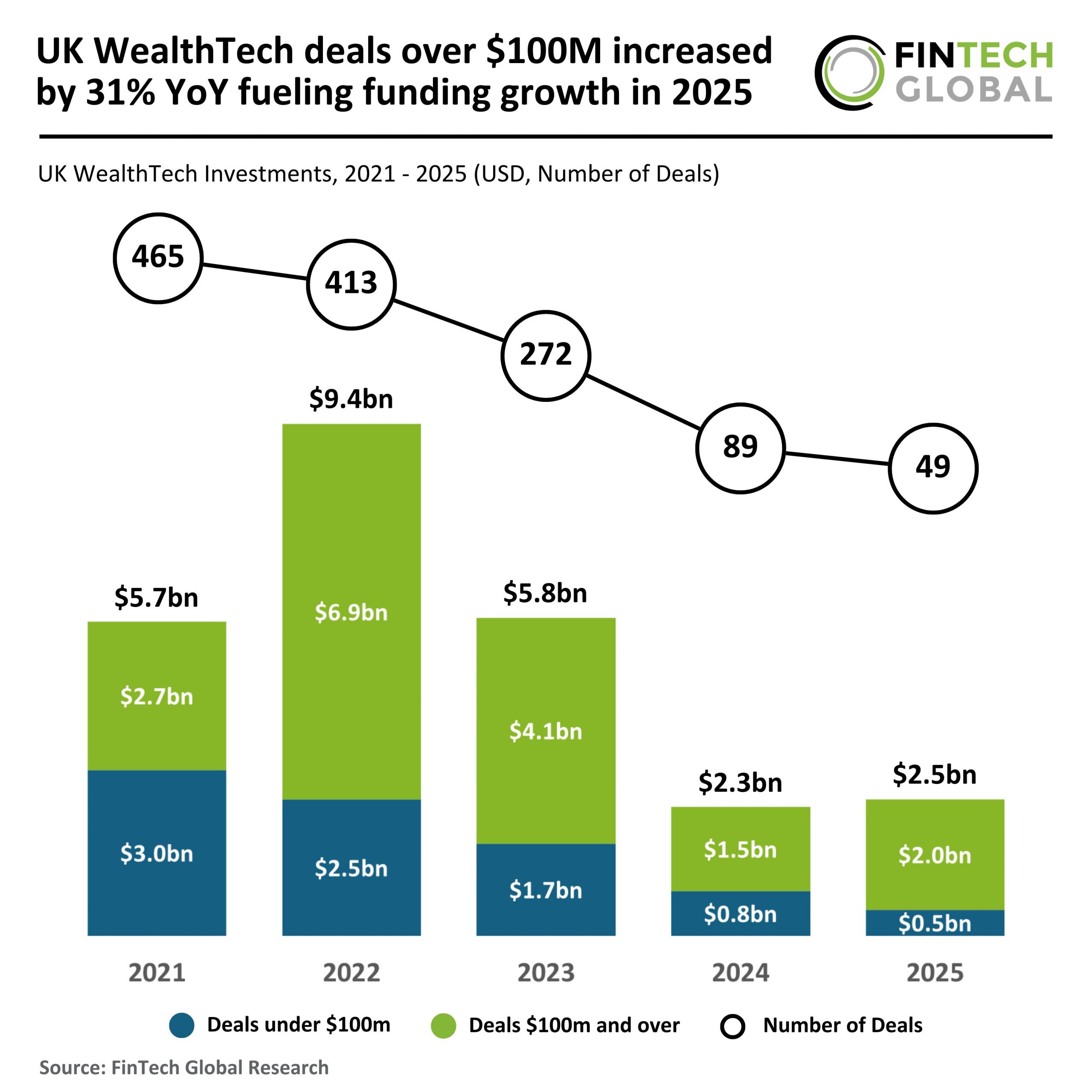
The question is will 2026 be a strong year for the sector? The WealthTech sector has seen a decline in the volume of deals and funding over the past few years as consolidation takes shape. However, funding levels could be back on the rise. Recent research from FinTech Global on the UK’s WealthTech sector found that while deal activity declined by 49% in 2025, falling from 89 to 49, funding increased to $2.5bn, up 6% from $2.3bn.
FinTech Global recently spoke to a number of leaders from the WealthTech sector to get their insights on WealthTech in 2026. It included insights from Jurgen Vandenbroucke, managing director at everyoneINVESTED, Zaliia Gindullina, head of business development at WealthTech provider Kidbrooke and Shri Krishnansen, chief commercial officer at WealthOS.
To kick off the discussions, they were each asked whether they were optimistic for the year. Each of the respondents expressed excitement for the year and the potential for significant growth in the coming months.
Gindullina said, “We are very optimistic about 2026 for WealthTech, mostly because wealth management firms have historically prioritised quite important steps before their products could truly scale and that was digital communications post-pandemic and then data readiness. We believe that in 2026, enough firms have invested and developed their data capabilities to truly scale their service.
“The main story of 2026 is going to be wealth management firms scaling their financial advice capabilities without increasing headcount and deploying analytical systems to facilitate that and also exploring how increased digitalisation will affect wealth management brands.”
While Krishnansen was also optimistic about the year, he was also aware of certain challenges that could persist from 2025. He said, “In 2026, I think it is going to be interesting for WealthTech from a perspective of consolidating a lot of the momentum over the past few years and a lot of it is also being driven by forces external to our particular market. By that I mean some of the potential fears of a market slowdown or an AI bubble, etc. I really think that is impacting how and where people are spending, all the way from investors who invest into WealthTech to the clients of WealthTech as well.”
Each of the respondents was also asked to predict what the major WealthTech trends will be for the year.
One of the major trends Vandenbroucke predicts will be the continuation of the hype around AI and decentralised finance, particularly in the advisory space. For everyoneINVESTED, its core focus is on behavioural design and the use of data, rather than pure AI. However, Vandenbroucke sees the combination as a powerful way to scale investor protection.
He added, “Simply put, feeding advanced AI with client-centric data and applying behavioural economics to create smarter interfaces and screens is helping us to capture what we call the emotional component in the financial technology and that is what many of our clients and prospects are looking for.”
Gindullina highlighted three major trends that will shape the coming year. The first is firms moving from creating bespoke financial advice to the analytical systems creating the financial advice. She stated that many of the robo-investing solutions struggled in the past, but many of the challenges have been overcome and these solutions could flourish.
Secondly, Gindullina sees technology playing an important part in brand reputation. As digitalisation continues to transform wealth management, these capabilities will shape how customers view the firm. Slow onboarding or clunky interfaces will damage their perception of the brand. Finally, Gindullina expects the increase in generative AI has made it riskier for firms to be slow to change.
As for Krishnansen, he sees 2026 as a continuation of what was seen in 2025. One of the biggest areas he is excited about is the shift from legacy technology and towards more future-ready systems. He said, “We’re seeing a lot of this already happening in core banking, where that industry has kind of leapfrogged us and moved from on-premise monoliths all the way to modular, microservice-based, cloud-native software. So, I think that is going to happen for wealth management.”
Keep up with all the latest FinTech news
Copyright © 2026 FinTech Global