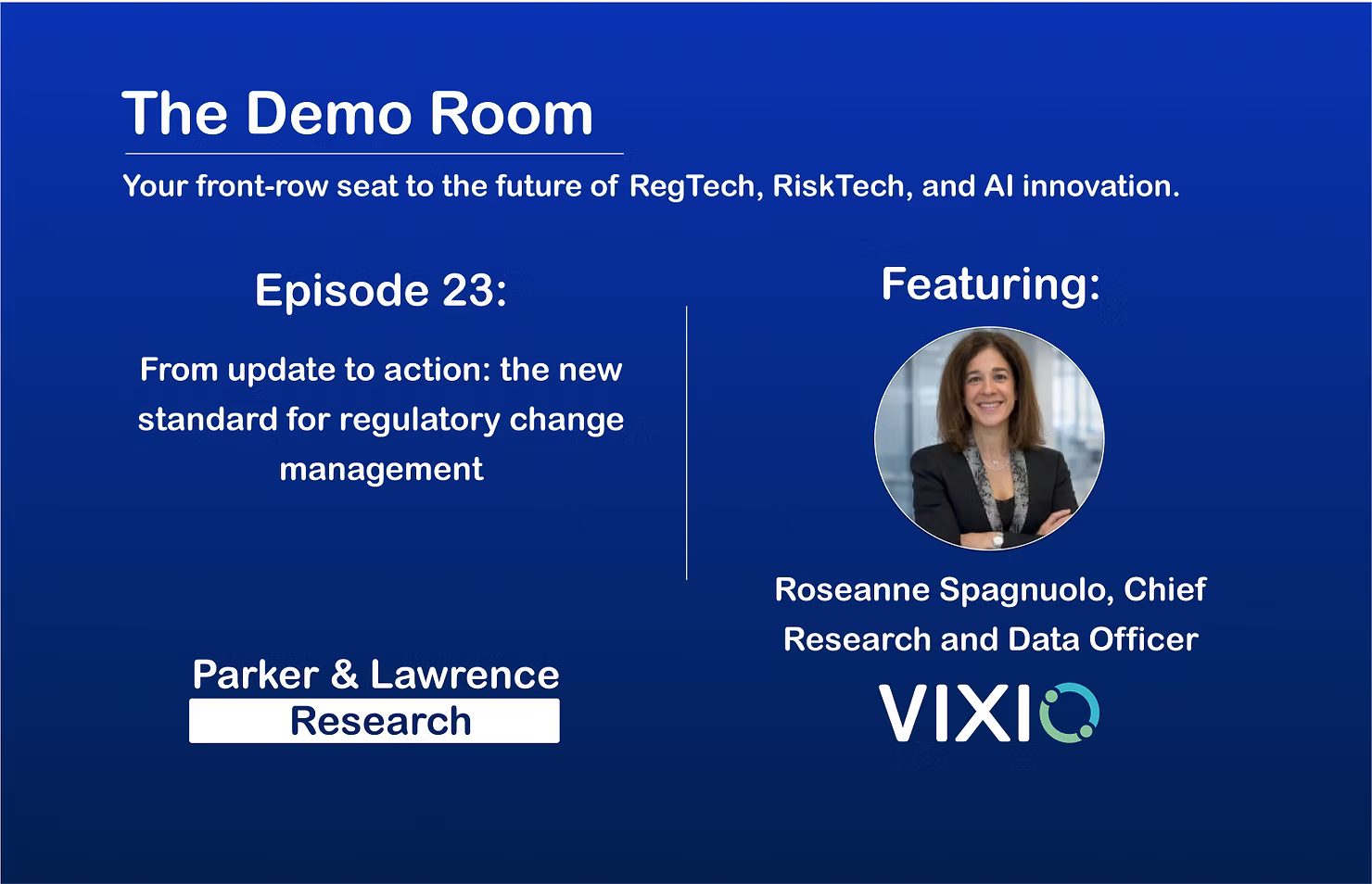
Regulatory change has become a constant challenge for financial institutions, with firms facing an ever-growing volume of new rules, updates and supervisory expectations across multiple jurisdictions. As manual processes struggle to keep pace, technology is becoming essential to helping organisations identify, assess and implement regulatory changes efficiently. The Global State of RegTech 2026 report – authored by RegTech Analyst and Parker & Lawrence Research – delved into regulatory change management and why it is becoming ever more vital.
As part of the research for the report, Parker & Lawrence Research interviewed market leaders in the space to discuss the importance of regulatory change management in 2026.
On this occasion, the firm spoke with Roseanne Spagnuolo, Chief Research and Data Officer, Vixio, a regulatory change management platform for firms operating across financial services, payments, digital assets, gambling and gaming.
This interview was part of the wider Global State of RegTech report conducted by RegTech Analyst and Parker Lawrence Research. To download the full report, click here.
Regulatory change management remains one of compliance’s most persistent challenges, but the bottleneck is no longer access to information. Regulatory updates are publicly available and increasingly digital. The genuine difficulty lies in determining which updates are material to a firm, what they require in practice, who owns the response, and how the organisation can evidence that it acted.
The pressure is mounting. Firms now operate across a growing number of jurisdictions, products and licence types, each carrying its own regulatory calendar and expectations. Regulators, meanwhile, are producing more output than ever, spanning rules, consultations, thematic reviews and enforcement signals.
The Global State of RegTech 2026 flagged Compliance Management as a domain where technology adoption remains relatively immature. Most institutions still depend on spreadsheets and siloed technology stacks to handle horizon scanning, obligation mapping, compliance gap analysis and remediation task management.
Yet compliance teams occupy a uniquely valuable position. Sitting at the crossroads of regulatory intelligence and business operations, they enjoy firm-wide visibility that few other functions can rival. This opens the door for compliance to evolve from enforcer to informer, becoming the function that tells the business what is coming, what it means and what to do next. Seizing that opportunity, however, demands infrastructure capable of matching the volume and complexity of the modern regulatory landscape.
Vixio chief research and data officer Roseanne Spagnuolo said, “Regulatory change management is no longer just a line item in the compliance budget. It’s critical infrastructure.”
Knowing an update has been published is only the beginning. The harder questions follow: is it relevant, is it actionable, which products, licences, jurisdictions and policies are affected, who owns the response, what decision was taken, and can the firm prove the right people reviewed it at the right time? Regulatory text is rarely self-executing, and the gap between what a regulator has said and what it means for a specific business model can be considerable.
For firms spanning multiple jurisdictions, this becomes even more acute. The same theme can develop differently across markets, with payments, digital assets, consumer protection, AML, fraud, operational resilience and financial promotions all moving at different speeds. Some regimes are highly prescriptive; others rest on principles.
Manual processes buckle under this at scale. Excel trackers, local inboxes and shared folders may suffice for small firms or narrow regulatory perimeters, but they turn fragile as organisations enter new markets, acquire businesses or add products. Boards are also raising the bar, demanding foresight rather than status updates, and asking whether the firm is prepared and whether existing controls are sufficient.
Spagnuolo said, “Customers want to know where the puck is going, not where it is.”
Vixio unites regulatory intelligence with execution, helping firms monitor change, interpret relevance, route work, manage obligations and build an evidence trail from source material through to business action.
Its horizon scanning covers more than 8,000 regulatory authorities across roughly 200 jurisdictions, with updates classified as actionable, indicative or informative, and deadlines surfaced so teams understand time sensitivity. Watchlists reflecting a firm’s actual regulatory perimeter can trigger alerts daily, weekly or monthly, cutting noise without sacrificing coverage.
Analyst-led interpretation remains central to Vixio’s heritage. Jurisdictional analysis and forward-looking commentary explain what developments mean for different business models, which is especially valuable where regulation is unclear or still forming. The “Ask the Analyst” capability lets compliance teams seek clarification from specialists who track the relevant regulatory environment closely.
Structured country and requirements reports support growth questions such as market entry, licensing and applicable obligations, while a report builder converts this intelligence into usable internal outputs. An obligations library, meanwhile, allows users to extract obligation text, categorise it, assign risk and connect it to policies, procedures and controls, creating a predictive workflow that flags which internal documents may need updating when source material changes.
A workspace enables teams to triage updates, assign work, set priorities and track progress, supporting collaboration across compliance, legal, product and operations. Underpinning it all, Vixio deploys AI through its SCANS technology and VIQ assistant, while keeping analyst oversight central.
Spagnuolo said, “The combination of human judgment and machine precision is often underestimated.”
Read the original post from Parker & Lawrence Research here.
Copyright © 2026 FinTech Global