
FinTech funding experienced a significant drop this week, with just $673m raised across 15 FinTech deals.
This marked a significant decline from last week, which saw over $2bn raised across 27 deals.
There was only one deal to exceed $100m this week, with CyberTech company Zenity securing $125m for its Series C. The company, which received capital from Norwest, Qumra Capital, SoftBank Vision Fund 2 and others, will use the capital to bolster its global expansion and product development.
It is worth noting that Moss secured an undisclosed amount of capital, but the deal helped the FinTech earn unicorn status with its valuation exceeding $1bn. The all-in-one spend management platform secured capital from Portage and Cherry Ventures.
In terms of sectors, CyberTech and infrastructure and enterprise software companies proved to be the flavour of the week with each recording six deals. The infrastructure companies were 10x Banking, Ambrook, Maximum, Moment, Rivio and Moss. The CyberTechs to close rounds were Zenity, Obsidian Security, OLIGO Security, inforcer, Bloom Security and Balance Theory.
The companies to secure rounds were WealthTech Decade, InsurTech Faye and PayTech Yellow Card.
In terms of location, four countries were home to deals this week. The US led the way with 11 of the deals. These included Zenity, Obsidian Security, OLIGO Security, Faye, Yellow Card, Ambrook, Maximum, Bloom Security, Balance Theory and Rivo.
The UK was the only other to record two deals, with it home to inforcer and 10x Banking. The final two companies are based in Brazil (Decade) and Germany (Moss).
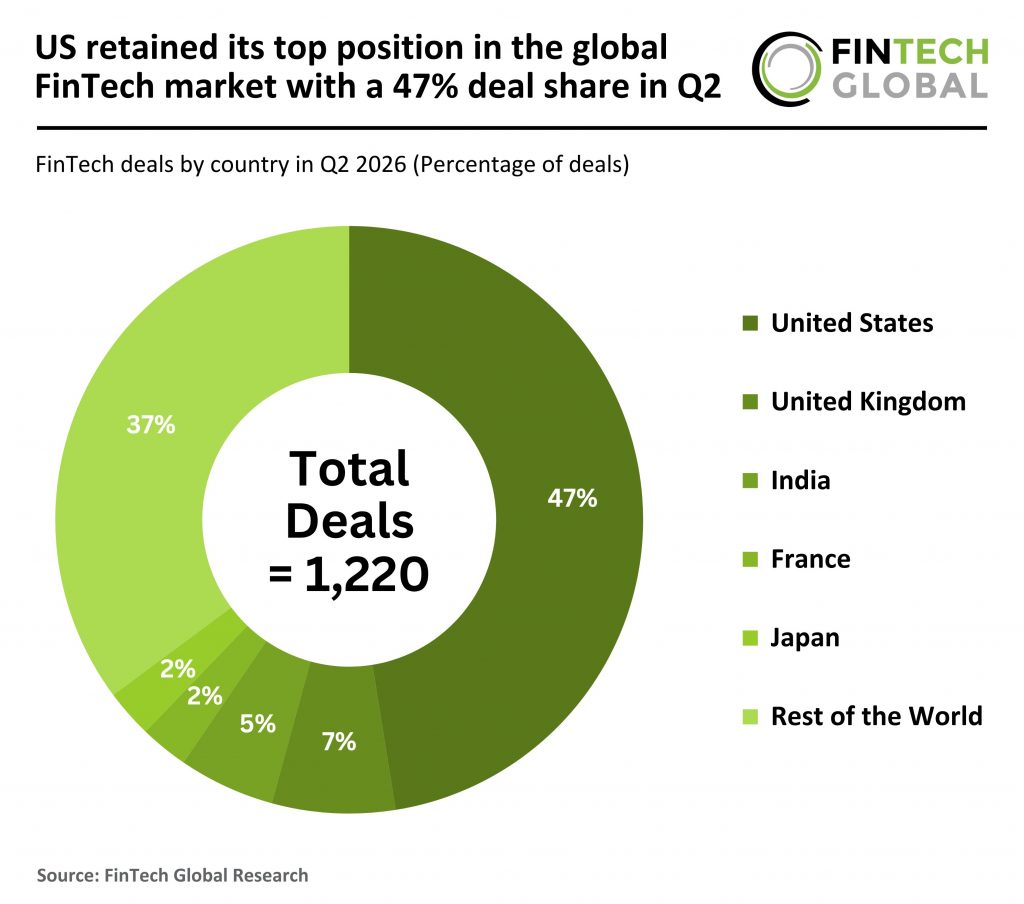
Research from FinTech Global this week found that the US maintained its position as the top position for FinTech deals, with it accounting for 47% of deal share during Q2. Global FinTech funding increased by 34% QoQ, going from $19.8bn to $23bn.
Here are the 15 FinTech deals covered on FinTech Global this week.
Zenity lands $125m as AI agent security race heats up
Zenity, the AI security and governance platform built specifically for AI agents, has closed a $125m Series C round.
The round was led by Norwest, with new backers Qumra Capital, SoftBank Vision Fund 2, Hitachi Ventures and LG Technology Ventures joining existing investors Vertex Ventures, Third Point Ventures, DTCP and Intel Capital. The capital will fund global expansion, further platform development and rising enterprise demand for agent-focused security.
While much of the cybersecurity industry has concentrated on defending models or inspecting individual prompts, Zenity argues the threat has moved on. Agents can now reach critical systems, call tools, make decisions and act on them, demanding controls designed for autonomy rather than static software.
Its platform works by interpreting an agent’s intent, then deterministically permitting, altering or blocking an action before it happens, separating legitimate work from behaviour that has been hijacked or strays beyond its purpose.
This coverage spans any agentic framework, from Microsoft Copilot, ChatGPT Enterprise and Gemini, through coding agents such as Claude, Codex and Cursor, to bespoke systems on AWS Bedrock and AgentCore, Microsoft Foundry and Google Vertex AI.
Decade nabs record seed to disrupt Brazilian wealth advice
Decade, an AI-native wealth advisory company built to serve Brazilian savers, has stepped out of stealth mode after closing an $85m seed round, the largest seed financing ever secured by a Latin American startup.
The round was led by Greenoaks, with participation from Benchmark and Diffusion, a bet on a founding team already credited with shaping much of Brazil’s banking infrastructure and a strategy built around applying artificial intelligence to financial advice at scale.
Rather than launching another bank, brokerage or investment app, Decade wants to hand ordinary savers the kind of financial guidance historically reserved for the ultra-wealthy and the teams of advisers built around them, positioning itself as the foundation for what it hopes will become a new wave of Brazilian millionaires.
Decade’s model pairs each client with a senior human adviser working alongside a proprietary AI system that retains full knowledge of a client’s financial history and every prior conversation, using this context to analyse markets and portfolios beyond the capacity of a single adviser working alone.
Obsidian Security lands $85m to police rogue AI agents
Obsidian Security, a platform securing non-human identities and AI agents across third-party applications, has closed an $85m Series D funding round.
The round was led by Crescent Cove Advisors, with participation from existing backers Greylock Partners and Menlo Ventures. It follows a period of accelerating customer growth for Obsidian, with more than 100 customers now spending over $100K a year on the platform and upwards of 14 customers spending more than $1m annually.
The raise comes as businesses roll out AI agents built on leading models, including Anthropic’s Claude, OpenAI’s ChatGPT and Microsoft Copilot Studio, and look for ways to govern how those agents behave once embedded in the third-party applications that underpin daily operations.
Obsidian points to non-human identities now outnumbering human identities by 144 to 1 within these applications, a gap it says is widening further as agents built on frontier models proliferate, often in settings where closing a single exposure can take months. With enterprises running agents across several AI ecosystems simultaneously, the company argues that agent misbehaviour is becoming more frequent and that security teams require a single control point spanning every ecosystem in use.
Obsidian will direct the new capital toward extending its reach across the Fortune 500 and Global 2000, positioning its platform as the standard for governing what AI agents can reach and do inside enterprise systems. The company says its traction with the world’s largest organisations has itself become a growth driver, as a larger customer base feeds network intelligence that turns risks identified at one company into faster safeguards for every other customer on the platform.
OLIGO Security raises $60m to counter AI-speed attacks
OLIGO Security, the runtime security company, has raised $60m in fresh funding as it races to help organisations keep pace with attacks that are now being planned and executed by AI at machine speed.
The round takes OLIGO’s total funding to $140m and drew backing from Ballistic Ventures, Canon Capital, Greenfield Partners, Lightspeed Venture Partners, Red Dot Capital Partners and TLV Partners, alongside angel investors including Eyal Waldman, the co-founder of Mellanox Technologies, which NVIDIA acquired for $6.9bn.
The company said the raise caps a strong year of growth, with revenue climbing 300% year-on-year and its valuation more than doubling since its Series B.
OLIGO plans to put the new capital towards product development and expanding its go-to-market operations internationally, as it works towards its goal of helping businesses block zero-day and n-day exploits before they cause damage.
The company provides runtime security for applications, cloud workloads and AI systems, pairing continuous visibility into live code execution with real-time protection. This lets customers intercept exploit attempts without disrupting production systems, filter out unnecessary vulnerability alerts and gain breathing room between patch releases through virtual patching.
10x Banking secures £40m ($54m) from AshGrove Capital
10x Banking, a cloud-native core banking platform provider whose technology underpins major institutions such as Westpac and Chase UK, has secured £40m in new capital from AshGrove Capital.
The funding follows a sustained stretch of profitability for the company, which turned EBITDA-positive over the past 12 months. During that same period, 10x Banking passed the milestone of 10 million live customer accounts, brought more than 10 new financial institutions onto its platform and lifted annual recurring revenue by upwards of 30%.
The capital injection will be channelled into scaling the firm’s sales operations and go-to-market activity as it pursues global expansion. AshGrove Capital, which backs fast-growing B2B software and services firms across Europe, comes on board as a new investor, drawn by the company’s revenue trajectory, cost discipline and a customer base that has deepened its use of the platform over time.
According to the company, its recent performance reflects rising appetite among financial institutions to replace ageing infrastructure that cannot operate in real time, sustain ongoing product development, or deliver the data capabilities and adaptability needed for AI-driven banking.
10x Banking offers a fourth-generation, cloud-native core banking platform built for real-time operations, continuous product innovation and AI-enabled financial services. The technology helps banks overhaul legacy systems, cut operational complexity and bring new products to market more quickly.
Faye raises $50m to build autonomous travel care
Faye, the AI-powered travel protection platform known for its award-winning app and near-instant claims payouts, has raised $50m in a Series C funding round, taking its total funding to $100m.
The round was led by Madrona, with participation from BRM and existing backers Portage, F2 Venture Capital, Viola Ventures and Lumir Ventures.
The fresh capital will support Faye’s expansion into new international markets, deepen its partnerships with online travel agencies, airlines and cruise lines, and fund further development of AI tools for underwriting, traveller assistance and claims handling.
The company said it expects AI to autonomously settle more than half of all claims by the end of the year, with three-quarters of the remainder resolved on first contact.
Alongside its core protection business, the funding will also go towards growing Faye’s FinTech offering. Building on the existing Faye Wallet product, the firm wants to give travellers a more affordable way to handle money on their trips, while ensuring support is readily available during difficult moments abroad.
The raise caps off a strong year for the company, which saw it open a new US head office in Richmond, Virginia, pick up a TIME Best Invention award for its app, and earn a place among U.S. News & World Report’s leading travel insurance providers.
Founded in 2022, Faye has established itself as a prominent AI-driven travel protection provider, collecting more than 20 industry accolades as it broadened its offering beyond conventional insurance into a combined package of protection, financial tools, traveller support and travel data insights. Through its app, customers can buy cover in under a minute, submit claims online in a matter of minutes, and get approved payouts sent straight to their mobile wallets while still travelling. Additional features include overseas telemedicine, eSIM data access, airport lounge entry and live concierge support.
inforcer’s $50m Series C targets AI-driven cybercrime
inforcer has secured $50m in a Series C round headed by global software investor Insight Partners.
Insight Partners has taken a minority position in the business, joining existing backers Meritech Capital and Dawn Capital. The investor brings extensive experience from its portfolio across cloud, security and infrastructure, which features Kaseya, Veeam, SentinelOne, Darktrace, Mimecast and Wiz.
The raise caps a remarkable pace of fundraising, with inforcer closing its Series A, B and C rounds within an 18-month window.
The company’s growth over the past two years has been fuelled by MSPs seeking to standardise, protect and monetise Microsoft 365 and AI services at scale.
The firm describes itself as the first platform to bring together Microsoft management with security both left and right of boom, allowing MSPs to consolidate on Microsoft technologies, build AI service offerings and improve their unit economics.
10x Banking secures £40m ($54m) from AshGrove Capital
10x Banking, a cloud-native core banking platform provider whose technology underpins major institutions such as Westpac and Chase UK, has secured £40m in new capital from AshGrove Capital.
The funding follows a sustained stretch of profitability for the company, which turned EBITDA-positive over the past 12 months. During that same period, 10x Banking passed the milestone of 10 million live customer accounts, brought more than 10 new financial institutions onto its platform and lifted annual recurring revenue by upwards of 30%.
The capital injection will be channelled into scaling the firm’s sales operations and go-to-market activity as it pursues global expansion. AshGrove Capital, which backs fast-growing B2B software and services firms across Europe, comes on board as a new investor, drawn by the company’s revenue trajectory, cost discipline and a customer base that has deepened its use of the platform over time.
According to the company, its recent performance reflects rising appetite among financial institutions to replace ageing infrastructure that cannot operate in real time, sustain ongoing product development, or deliver the data capabilities and adaptability needed for AI-driven banking.
10x Banking offers a fourth-generation, cloud-native core banking platform built for real-time operations, continuous product innovation and AI-enabled financial services. The technology helps banks overhaul legacy systems, cut operational complexity and bring new products to market more quickly.
Yellow Card raises $40m to scale stablecoin rails globally
Yellow Card, a global provider of stablecoin infrastructure, has wrapped up a $40m strategic funding round as it looks to accelerate its expansion into new international markets.
Backers in the round included SC Ventures by Standard Chartered, Sony Innovation Fund, Polychain Capital and Blockchain Capital, alongside a number of other strategic investors.
The raise lifts the firm’s total equity financing beyond the $120m mark. Capital from the round will be directed towards scaling Global USD Accounts, the company’s end-to-end dollar account product for businesses, and broadening the stablecoin rails that link the offering to markets around the world.
The involvement of Sony Innovation Fund underlines rising institutional appetite for stablecoin-based payments worldwide and will help Yellow Card strengthen its footprint across Asia-Pacific.
Through the fresh capital, Yellow Card intends to bring Global USD Accounts to a wider pool of businesses. The product gives companies a single account through which they can hold US dollars, hold and swap stablecoins, oversee treasury operations, and collect and pay out local currencies via domestic rails in more than 50 countries.
The accounts are built on infrastructure the firm has run for years, and the new financing will deepen its presence in Latin America and Asia Pacific while extending the local payment rails and currency coverage required for global scale. Customers already relying on Global USD Accounts include Visa and Western Union.
Ambrook lands $30m to power independent businesses
Ambrook, the AI-native financial management platform built for independent businesses, has secured $30m in a Series B funding round to expand its accounting, payments and cash management tools for sectors including agriculture, trucking, construction and property management.
The round was led by Lachy Groom, with backing from Thomson Reuters Ventures, Thrive Capital, Field Ventures and Cameron Ventures, alongside individual investors Akshay Kothari, co-founder of Notion, Tomer London, co-founder of Gusto, and Guillermo Rauch, chief executive of Vercel.
The fresh capital takes Ambrook’s total funding raised to date to $59m and will be used to accelerate the company’s product development across the agriculture, trucking, construction and property management sectors it already serves.
Customer numbers have climbed sharply, growing from around 2,500 in July last year to more than 8,000 businesses spanning every US state. Having launched in the agriculture space, Ambrook’s platform now supports more than 1,000 trucking operators as well as numerous contractors and property managers, with much of this expansion stemming organically from its existing farming client base, many of whom also work in haulage, property or contracting.
Designed with the owner-operator in mind, Ambrook brings together accounting, payments and cash management within one platform tailored to businesses juggling multiple profit-and-loss statements and asset-heavy balance sheets. It lets owners track profitability as it happens, using terminology relevant to their trade, whether that means bushels harvested or miles driven, and whether they are checking figures from an office or a truck cab.
Bank, card and loan account data feeds into the platform automatically, with payouts handled through Ambrook Wallet, cutting down on the duplication that comes from juggling separate systems. Artificial intelligence handles much of the administrative load, itemising receipts, drafting bills from forwarded correspondence and recommending how to categorise transactions, invoices and payments, while owners retain final sign-off on every entry to keep records precise and audit-ready.
Maximum lands $30m to rip out banks’ legacy cores
Maximum, an AI-native operating system builder for banks, has come out of stealth after securing a $30m Seed round, ranking among the biggest Seed raises the FinTech industry has seen.
CRV led the investment, joined by Pear VC, Restive, Plug and Play Ventures, Anthemis and other backers. The company was established by Randy Fernando, a serial FinTech founder whose previous ventures include Vault, acquired by Acorns in 2017, and Power, purchased by Marqeta in 2023.
The startup is targeting the ageing, disjointed technology stacks that underpin much of the banking sector. Among the almost 5,000 banks operating in the US, over 70% still run on core platforms engineered in the last century, well before the arrival of mobile banking, real-time payments, digital currencies or AI.
This dependence on dated systems leaves institutions struggling to innovate quickly, cheaply or without operational strain, even as customer demands shift.
Maximum’s answer is a real-time platform with AI embedded at its foundation. Banks using the system can build and deploy their own agents to automate intricate operational workflows, monitor customer activity as it happens, and launch new financial products aimed at driving growth.
Moment closes $22m round to scale African payments
Moment, a pan-African FinTech, has closed a $22m Series A funding round led by AlphaCode Venture Partners, with continued backing from General Catalyst and MultiChoice, alongside fresh investment from Canal+.
The raise brings Moment’s total funding since launch to $55m, capital the company has used to build what it describes as one of the continent’s most sophisticated payment infrastructure platforms.
Its offering spans payment collection and revenue retention tools built specifically for corporate and enterprise merchants operating across Africa. Proceeds from the new round will go towards strengthening Moment’s network, upgrading its platform capabilities, and pushing further into new African markets.
The fresh capital arrives against the backdrop of a payments landscape that varies enormously from one African market to the next. In South Africa, in-person retail payments still account for more than two-thirds of transactions, even though bank penetration is comparatively high, it said.
Moment’s product suite gives billers and merchants, including insurers and subscription businesses, tools for recurring billing, customer outreach, and recovering failed payments across both digital and physical channels, with the option to connect directly into a merchant’s existing enterprise billing system.
Bloom Security exits stealth with $20m to tame AI endpoints
Bloom Security, a cybersecurity company focused on governing AI-era software on corporate devices, has emerged from stealth with a $20m seed round.
The round was led by Glilot Capital Partners and Ten Eleven Ventures, with participation from Okta Ventures and Runtime Ventures. Angel investors who founded Dig Security, Demisto, Snyk and Talon also backed the raise. The company said its platform is already live at dozens of large enterprises in the US and Europe.
The funding targets a shift in how employees work. AI assistants, browser extensions, MCP servers and code packages are woven into daily workflows, and browsers, IDEs and AI agents now come with their own marketplaces where fresh software can be bolted on. The result is a software layer on corporate devices that grows faster than security teams can catalogue or evaluate.
Bloom argues the danger extends beyond malware; legitimate, popular tools can become hazardous when they carry excessive permissions, are misconfigured or touch sensitive data in unforeseen ways. Examples cited by the firm include badly configured AI agents, over-permissioned plugins, screen recorders and code libraries drawing from untrusted sources, a class of exposure that sits outside the remit of conventional EDR products.
Bloom Security’s platform builds a complete inventory of tools, extensions and code running across an organisation’s endpoints, and analyses how each component interacts with data and systems, alongside supply-chain risks, configurations and permissions.
Balance Theory bags $19m to end CISO budget guesswork
Balance Theory has closed a $19m Series A round to change the way enterprises allocate their security budgets.
The round was led by SYN Ventures, with existing backers DataTribe and TEDCO also taking part. Alongside the raise, cybersecurity veteran Dan Burns, who founded Accuvant and previously served as CEO of Optiv, has been appointed executive chairman of the company.
The capital will be channelled into faster go-to-market activity, deeper integrations with enterprise systems, a broader pool of proprietary cybersecurity market intelligence, ongoing development of the platform’s agents and skills, and a bigger push to educate the market on a new approach to managing security investments.
The platform is built on three connected systems: a system of record that maintains persistent context and working memory for the enterprise security programme; a system of intelligence that curates proprietary market data unavailable through general-purpose AI and feeds it into decision flows; and a system of execution that deploys AI-powered agents, extensible skills and workflows to turn choices into coordinated action.
Beyond identifying needs and weighing purchase options, the platform maintains a living record of each investment decision, logging the rationale and tracking shifts that could affect its value, fit, leverage or priority.
Rivo raises $3.1m to end banks’ inertia tax on savers
Rivo, a consumer FinTech building autonomous cash management on top of existing bank accounts, has exited beta and closed a $2.7m seed round, taking its total funding to $3.1m.
The round was backed by South Park Commons, Wisdom Ventures, Script Capital, 645 Ventures, 20VC, and angel investor and advisor Jag Duggal, the former chief product officer at Nubank. The fresh capital will support Rivo’s model of automatically shifting idle household cash into higher-yielding accounts and returning funds before bills fall due, without requiring customers to switch banks or move money manually.
The problem Rivo is targeting is what it calls the Inertia Tax, the gap between the near-zero returns consumers earn on dormant current account balances and the far higher yields banks capture by holding those same deposits.
Rivo links directly to a customer’s existing current account, tracks cash flow in real time, and automatically sweeps idle balances into higher-yield US government Treasuries, protected by SIPC, through its banking partner Jiko. Funds are moved back into the account before bills are due, meaning users never switch banks, transfer money manually or change their day-to-day habits.
Moss becomes a unicorn after Series C round
Moss, the all-in-one spend management platform built for modern finance teams, has closed a Series C funding round that pushes its valuation beyond €1bn.
The size of the investment was not disclosed.
The round was backed by investors including Portage and Cherry Ventures, propelling the seven-year-old business into unicorn territory.
The company, which now employs more than 350 people, said the raise will support its mission of building what it calls Finance AI, a suite of agents designed to learn from the finance professionals who use them and assist across closing, controlling, budgeting and forecasting.
Moss provides a spend management platform that combines corporate cards, invoice handling and reimbursements with real-time budgeting tools, automated approvals and built-in accounting features. The platform connects with widely used ERP systems such as DATEV, Xero and Exact Online, along with HR platforms including Personio, BambooHR and HiBob.
Copyright © 2026 FinTech Global