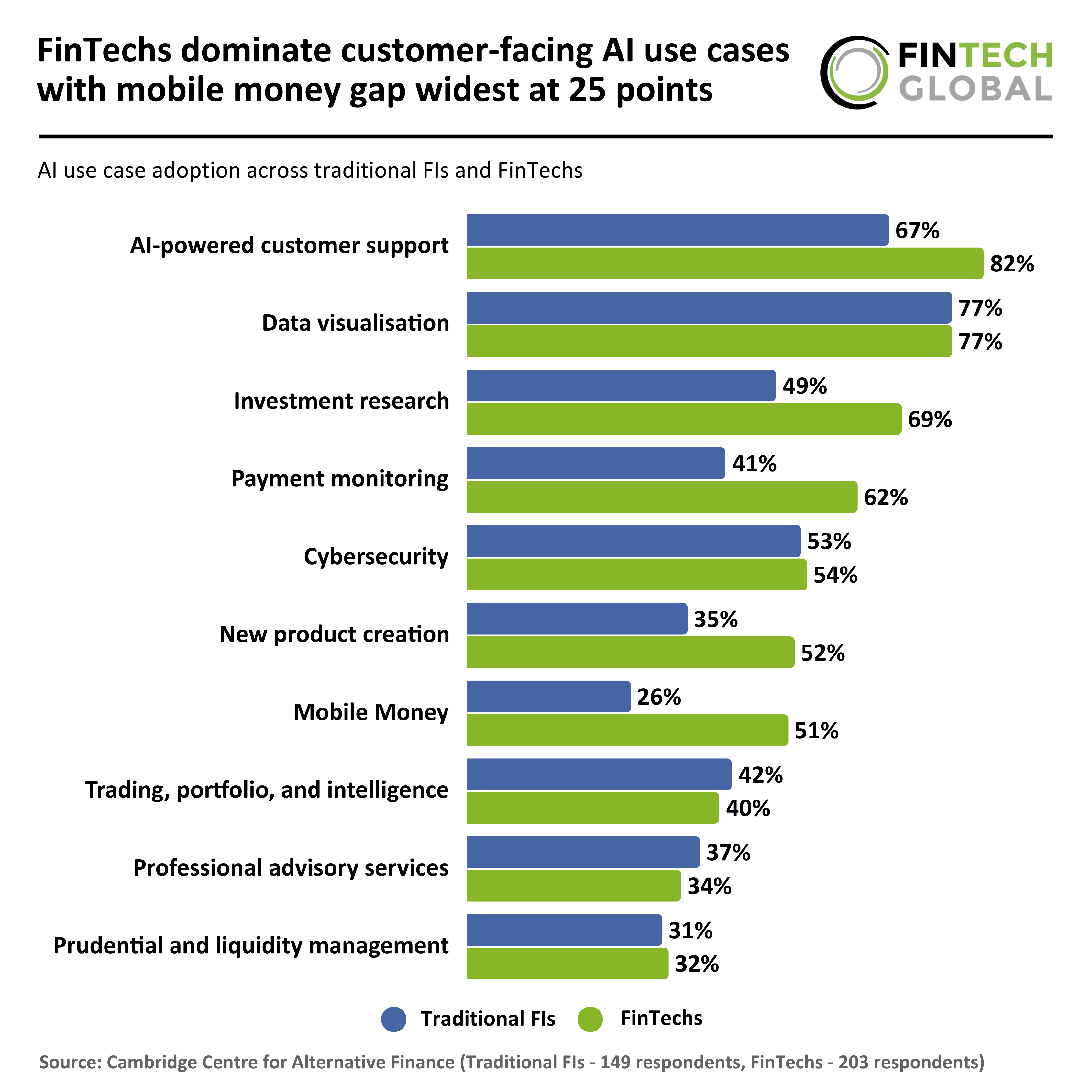
Key views on AI use case adoption across traditional FIs and FinTechs:
- The Cambridge Centre for Alternative Finance surveyed 203 FinTechs and 149 traditional FIs across 151 countries on AI use case adoption
- Mobile money shows the widest adoption gap in the dataset, at 51% for FinTechs versus just 26% for traditional FIs
- FinTechs are deploying AI closest to the customer, while traditional FIs risk falling behind in the areas reshaping client experience
The Cambridge Centre for Alternative Finance surveyed 203 FinTechs and 149 traditional FIs across 151 countries on AI use case adoption
The 2026 Global AI in Financial Services Report was produced by the Cambridge Centre for Alternative Finance at the University of Cambridge.
The study draws on 628 respondents across 151 countries, using three parallel survey instruments to capture perspectives from FinTechs, traditional financial institutions, AI vendors and regulators.
For the specific question this chart addresses, only FinTechs and traditional FIs were surveyed, representing 203 and 149 respondents respectively.
The regional spread is robust, with Asia-Pacific, Europe and Latin America and the Caribbean each accounting for between 29% and 36% of firm respondents, and Sub-Saharan Africa representing the smallest share at 14%.
The chart examines AI use case adoption across both groups, capturing where each is deploying the technology and where gaps between them are widest.
Mobile money shows the widest adoption gap in the dataset, at 51% for FinTechs versus just 26% for traditional FIs
The results reveal a consistent pattern: FinTechs are deploying AI more broadly and more ambitiously, with the gaps between the two groups widest wherever the technology touches the customer directly.
Multiple responses were permitted.
AI-powered customer support leads the chart at 82% for FinTechs against 67% for traditional FIs, a 15-point gap that sets the tone for much of what follows.
Data visualisation is the notable exception, the only use case where the two groups are entirely aligned at 77%, suggesting that foundational analytical tooling has become table stakes across the sector regardless of firm type.
From there, the divergence reasserts itself.
Investment research and payment monitoring show gaps of 20 points each, at 69% versus 49% and 62% versus 41% respectively, pointing to meaningful differences in how each group is using AI to drive decision-making and operational throughput.
Cybersecurity sits in near-perfect alignment at 54% and 53%, which is perhaps unsurprising given that both FinTechs and traditional FIs face comparable threat environments and regulatory pressure in this area.
The most striking gap in the entire dataset is mobile money, where FinTechs lead at 51% against just 26% among traditional FIs, a reflection of how differently the two groups approach last-mile financial services.
Mobile money refers to AI-enabled financial services delivered through mobile platforms, covering areas such as digital wallets, payments and money transfers, and is particularly associated with reaching customers outside traditional banking infrastructure
Trading, portfolio and intelligence is one of the few areas where traditional FIs hold a marginal lead at 42% to 40%, as do professional advisory services at 37% to 34%, where institutional depth and client relationships appear to give them a natural edge.
Prudential and liquidity management closes the list in close alignment at 32% and 31%, reinforcing the pattern seen in cybersecurity: where regulatory necessity drives adoption, the gap between FinTechs and traditional FIs narrows considerably.
FinTechs are deploying AI closest to the customer, while traditional FIs risk falling behind in the areas reshaping client experience
The pattern that emerges is of two different AI strategies taking shape within the same industry.
FinTechs are pushing AI into areas that are closest to the customer and most directly tied to revenue generation, customer support, payment monitoring, mobile money and new product creation.
Traditional FIs, by contrast, are more measured in their deployment, leading only in the more analytical and advisory functions where their institutional depth gives them a natural advantage.
The near-identical figures on cybersecurity and prudential management suggest both groups recognise AI as a necessity in risk and control functions, regardless of their broader strategic posture.
What the data ultimately signals is that traditional FIs risk ceding ground in the areas where AI is most visibly reshaping client experience and product design.
The competitive pressure from FinTechs in these spaces is already evident in the numbers, and the gap is unlikely to narrow on its own.
Keep up with all the latest FinTech research here
Copyright © 2026 FinTech Global