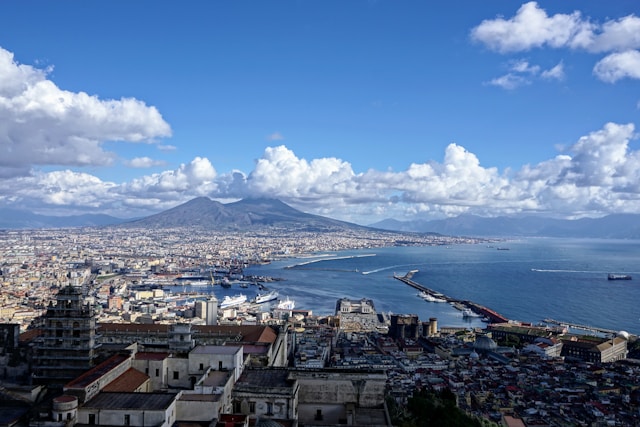
Southern Italy has grown faster than the rest of the country in recent years, but according to Prometeia’s latest “Scenarios for Local Economies” report, that outperformance has been built on foundations that are unlikely to hold.
The trend marks a reversal of decades of stagnation. Prometeia’s analysis shows that in the ten years before the pandemic, the South failed to close the gap with the Centre-North, with per capita GDP actually slipping from 57% to 55% of Centre-North levels between 2009 and 2019, falling further behind the EU-27 average in the process.
Prometeia’s review of regional accounts suggests the recent turnaround owes more to one-off stimulus than to structural change. More than a quarter of the South’s growth has come from construction alone, propelled by NRRP funding and incentives for private building work. Prometeia notes that construction has an outsized ability to stimulate local economies through procurement, and its momentum has spilled into real estate, engineering and technical services, aided by a sharper rise in public administration hiring than seen elsewhere in Italy. Manufacturing has also held up, supported by domestic food demand and stronger international trade in shipbuilding, aerospace, chemicals, pharmaceuticals and refined petroleum products.
Prometeia’s forecasts for 2026 to 2028 strike a more cautious tone.
The South’s growth premium over other regions already began narrowing through 2024 and 2025, a warning sign that recent momentum is fading. Prometeia flags three specific risks.
First, the NRRP has now formally wound down, and while it lifted GDP through short-term investment demand, the productivity gains it was meant to generate only materialise over the medium to long term.
Second, household consumption is exposed to uncertainty stemming from the conflict in the Middle East, which Prometeia says hits the South disproportionately hard given its higher concentration of low-income households more sensitive to purchasing power shifts.
Third, although Southern exports are expected to pick up, Prometeia points out that export activity remains concentrated in a handful of sectors and regions, limiting how much foreign demand can lift the broader economy.
Prometeia concludes that the real test for Southern Italy is whether temporary stimulus can be converted into lasting, systemic competitiveness, rather than a growth spurt that fades once exceptional support runs out. Closing the regional gap for good, the report argues, will depend on what happens well beyond the current two-year horizon.
For more insights, read the full story here.
Copyright © 2026 FinTech Global