Key views on financial services industry outlook on AI’s workforce impact by 2030:
- The Cambridge Centre for Alternative Finance surveyed 259 FinTechs and traditional FIs across 151 countries on the expected job impact of AI by 2030
- Reskilling and job transformation leads expectations at 25%, with 24% of respondents anticipating a net reduction in roles
- The data points to a workforce in transition, where managing reskilling pathways will matter as much as the pace of AI adoption itself
The Cambridge Centre for Alternative Finance surveyed 259 FinTechs and traditional FIs across 151 countries on the expected job impact of AI by 2030
The 2026 Global AI in Financial Services Report was produced by the Cambridge Centre for Alternative Finance at the University of Cambridge.
The study draws on 628 respondents across 151 countries, using three parallel survey instruments to capture perspectives from FinTechs, traditional financial institutions, AI vendors and regulators.
For the specific question this chart addresses, only FinTechs and traditional FIs were surveyed, representing a combined 259 respondents.
The regional spread is robust, with Asia-Pacific, Europe and Latin America and the Caribbean each accounting for between 29% and 36% of firm respondents, and Sub-Saharan Africa representing the smallest share at 14%.
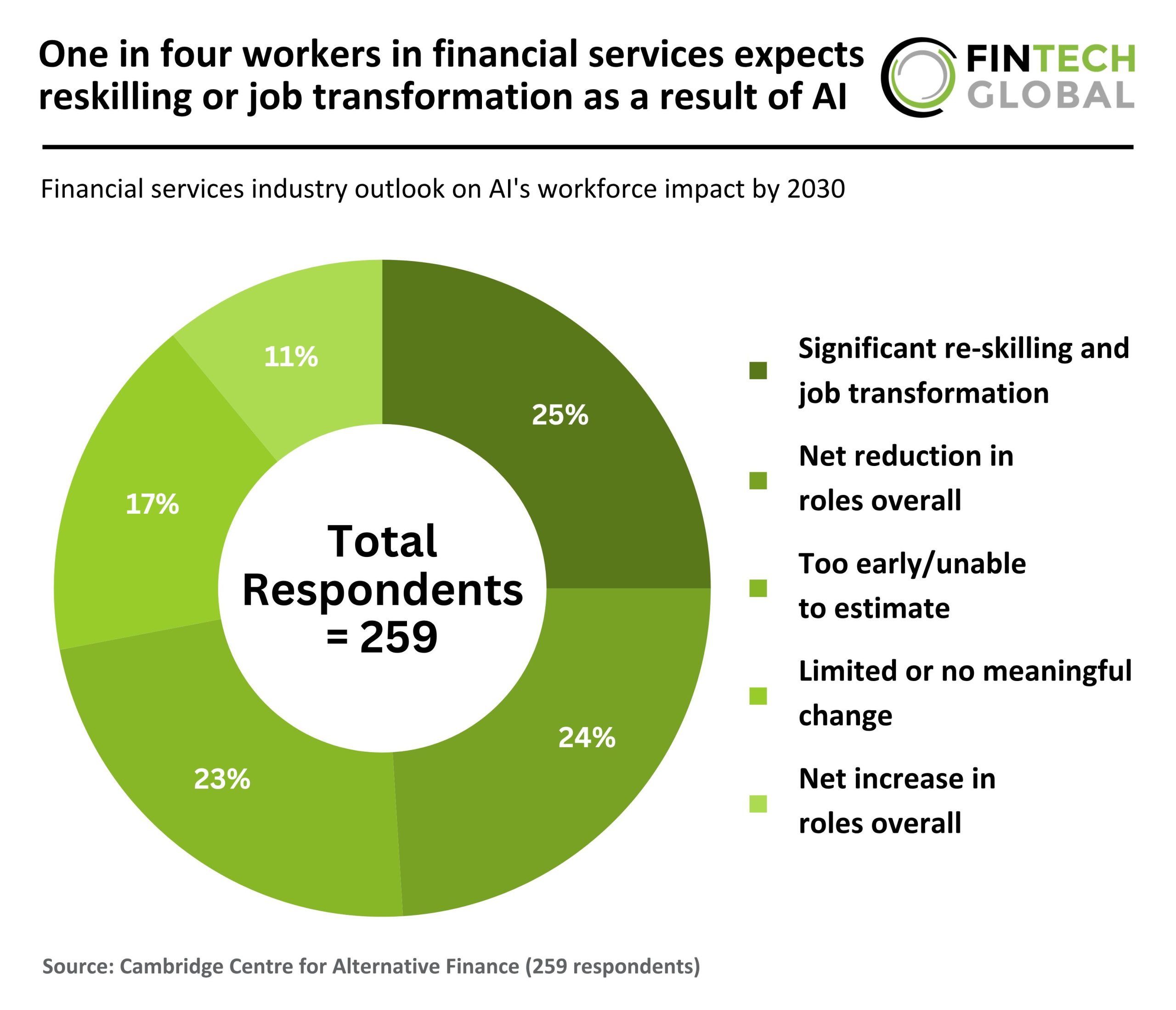
The chart captures industry expectations for the net job impact of AI by 2030, asking respondents to select the outcome they consider most likely.
Reskilling and job transformation leads expectations at 25%, with 24% of respondents anticipating a net reduction in roles
The results reveal a sector that is divided on what AI will mean for employment over the next four years, with no single view commanding a clear majority.
Significant reskilling and job transformation without large net job losses was the most commonly held expectation, cited by 25% of respondents.
A net reduction in roles overall followed closely at 24%, with 23% saying it was too early or that they were unable to estimate the impact.
Limited or no meaningful change was anticipated by 17% of respondents, while a net increase in roles overall was the least common expectation at 10%.
The data points to a workforce in transition, where managing reskilling pathways will matter as much as the pace of AI adoption itself
On one hand, the two most optimistic outcomes, reskilling and transformation combined with net job growth, account for 35% of respondents, suggesting that a meaningful share of the industry believes AI will ultimately create or preserve employment rather than simply displace it.
On the other, a quarter of respondents anticipate a net reduction in roles, a figure that should not be understated.
The 23% who say it is too early to estimate may be the most revealing group of all, pointing to a genuine uncertainty about how this will play out rather than a settled view in either direction.
The World Economic Forum’s 2025 Future of Jobs Report draws a similar conclusion, characterising the period ahead as one of intense volatility where the ability to manage reskilling pathways will be the critical determinant of organisational success.
For financial services firms, the practical implication is clear: the question is less whether AI will reshape the workforce and more whether institutions are preparing their people for that shift now, rather than waiting for the picture to become clearer.
Keep up with all the latest FinTech research here
Copyright © 2026 FinTech Global