Financial crime compliance is undergoing a period of significant transformation. As financial institutions contend with evolving regulatory expectations, increasingly sophisticated criminal activity and growing volumes of customer and transaction data, firms are under pressure to modernise compliance frameworks, improve operational efficiency and strengthen risk detection capabilities. The Global State of RegTech 2026 report – authored by RegTech Analyst and Parker & Lawrence Research – explored the shifting sands of financial crime compliance, and where the biggest changes are occuring across the wider financial services market.
As part of the research for the report, Parker & Lawrence Research interviewed market leaders in the space on how they are tackling the industry’s most pressing financial crime compliance challenges hampering the sector today.
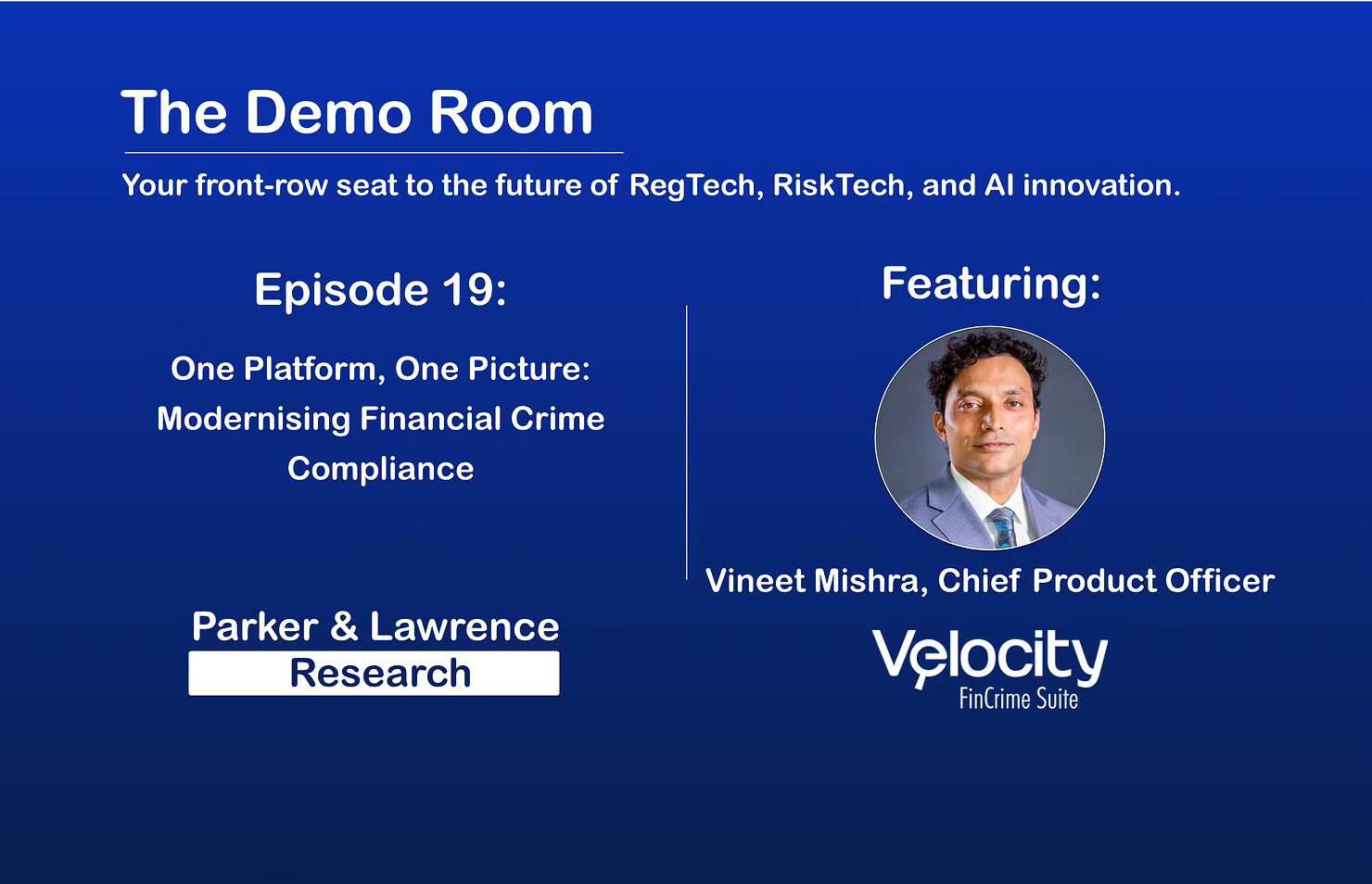
On this occasion, the firm spoke with Vineet Mishra, CPO of Velocity FSS, provider of a modular financial crime platform combining AML, fraud, data tools, workflow and AI-assisted investigation. In the report, Velocity was recognised for its entity resolution, country resolution and data normalisation offerings as well as its recognition that monitoring is only as good as the data underneath it.
This interview was part of the wider Global State of RegTech report conducted by RegTech Analyst and Parker Lawrence Research. To download the full report, click here.
More than a third of financial institutions remain in the early stages of adopting financial crime technology — fragmented, under-deployed, or yet to implement meaningful controls at all. For community banks, credit unions and FinTechs serving money service businesses, that is not simply a technology problem. It is a compliance liability.
The market for financial crime solutions has historically been shaped around the needs of large institutions. Smaller firms have been left to assemble compliance programmes from point solutions, manual processes and tools that were never designed for their operational reality. These institutions carry the same core regulatory obligations as their larger counterparts — transaction monitoring, sanctions screening, suspicious activity report filing, and the ability to demonstrate a defensible programme at examination — but frequently lack the infrastructure, headcount or IT budget to match those requirements.
The result is a structural gap that has widened over time. Regulatory expectations have continued to rise while accessible, fit-for-purpose technology has lagged. Many institutions remain dependent on disconnected systems and manual workflows that are difficult to defend when examiners come knocking.
The problem with silos
At most institutions, anti-money laundering and fraud controls are still operated separately. Different teams, different alert queues, different platforms. That separation made administrative sense when the two disciplines were treated as distinct functions. It makes considerably less sense today. Scam proceeds require laundering. Mule accounts sit across both fraud and AML typologies. When teams work from disconnected systems, neither holds a complete picture, and the patterns linking criminal activity across both domains go undetected.
Data quality compounds the challenge. Smaller institutions often run several legacy systems for core banking, payments and customer records. Transaction data from cross-border payments or correspondent banking relationships frequently arrives inconsistent, incomplete or in differing formats. High-risk jurisdiction monitoring depends on accurately knowing where a transaction originated and settled. When that data cannot be cleanly resolved, the monitoring logic built on top of it is weakened before an analyst has even begun work.
The third problem is defensibility. Regulators increasingly want to see how data entered the system, how monitoring rules were applied, why specific alerts were generated and how investigations were conducted. Many smaller institutions cannot clearly demonstrate that lineage. Spreadsheet-based processes, fragmented workflows and manual documentation make it difficult to produce the audit trail that modern examinations require.
For lean compliance teams, these three problems converge into a single operational constraint: too much time spent gathering, reconciling and documenting, and too little spent on the judgement work that actually matters. Velocity FSS chief product officer Vineet Mishra said, “There’s a regulatory change that comes in — we immediately jump on it, we fix it, our team is there. We make sure that nothing passes through your system which is not regulatory compliant.”
The Velocity FinCrime Suite
Velocity FSS offers a cloud-based financial crime platform that consolidates AML, fraud and data capabilities into a single environment — an approach designed specifically for institutions that have historically been underserved by the market.
The platform’s foundation is data quality. Rather than leaving institutions to resolve data problems before the software can function effectively, Velocity addresses those issues inside the product itself. Its data tools layer handles entity resolution, country resolution, country risk ratings and entity-linkage context — all applied before monitoring logic runs. Country resolution is particularly significant for cross-border payments, where transaction data passing across multiple systems and jurisdictions is routinely ambiguous about origin and settlement. The platform also publishes quarterly AML and counter-terrorist financing country risk ratings for 256 countries, feeding into onboarding decisions and transaction risk assessment.
AML and fraud capabilities sit together within a single suite. On the AML side, the platform covers sanctions screening, transaction monitoring, case management, due diligence and US-specific requirements including FinCEN 314(a). The fraud suite addresses payment fraud across fund transfers, electronic payments, cheques, ATM and card activity, alongside employee and insider risk. The operational benefit is a shared workflow environment: analysts working on connected typologies — mule accounts, scam proceeds, cross-domain activity — can work from the same data and the same case management layer, rather than switching between siloed systems.
Alert triage, assignment, investigation, escalation and oversight across both AML and fraud are managed within a single interface. Dashboards surface alert volumes, ageing, team productivity and investigation status — giving compliance leaders the visibility they need to manage regulatory risk proactively and produce the audit trail that examiners now expect.
The platform also includes an AI Investigator capability, which supports transaction monitoring investigations by compiling case information, producing summaries and presenting evidence in a structured report of two to three pages. The analyst remains the decision-maker; the AI handles gathering, organisation and explanation. Analysts who might previously process five to eight AML alerts per day can move closer to 15 to 20 with AI-assisted investigation — a material efficiency gain for teams operating with limited resources.
Velocity integrates with core banking systems and specialist data providers including CLEAR, LexisNexis Risk Solutions and Signzy. The model reflects a practical reality of financial crime compliance: the category is too broad for any single platform to build every capability internally. Velocity focuses on monitoring, case management and regulatory workflows, and integrates point solutions where specialist capability adds value.
Industry context and strategic positioning
Independent analysis from Parker & Lawrence positions Velocity FSS as one of the clearest examples of a vendor that has built its product around a specific operational reality rather than a generic compliance framework. The platform’s recognition that monitoring is only as effective as the underlying data quality is noted as its strongest characteristic — precisely because this is where controls tend to fail examinations at smaller institutions.
Results in practice support that assessment. A US correspondent bank operating under a consent order deployed Velocity across a network of more than 350 respondent banks, combining transaction monitoring, KYC, case management and automated SAR reporting. The outcome was a 200% increase in AML programme efficiency and a successful exit from the consent order within the required timeframe.
There is also a commercial dimension worth noting. Bankers’ banks and sponsor banks can use Velocity to offer financial crime monitoring as a managed service to FinTechs, MSBs and other banks — repositioning compliance infrastructure from a cost centre into a revenue-generating capability.
Regulatory expectations for smaller institutions are unlikely to ease. Stablecoin monitoring is emerging as a new compliance requirement, and the operational case for connecting AML and fraud management is only strengthening. For institutions still relying on fragmented systems and manual processes, the question is increasingly not whether to consolidate, but when.
Read the original post from Parker & Lawrence Research here.
Copyright © 2026 FinTech Global